
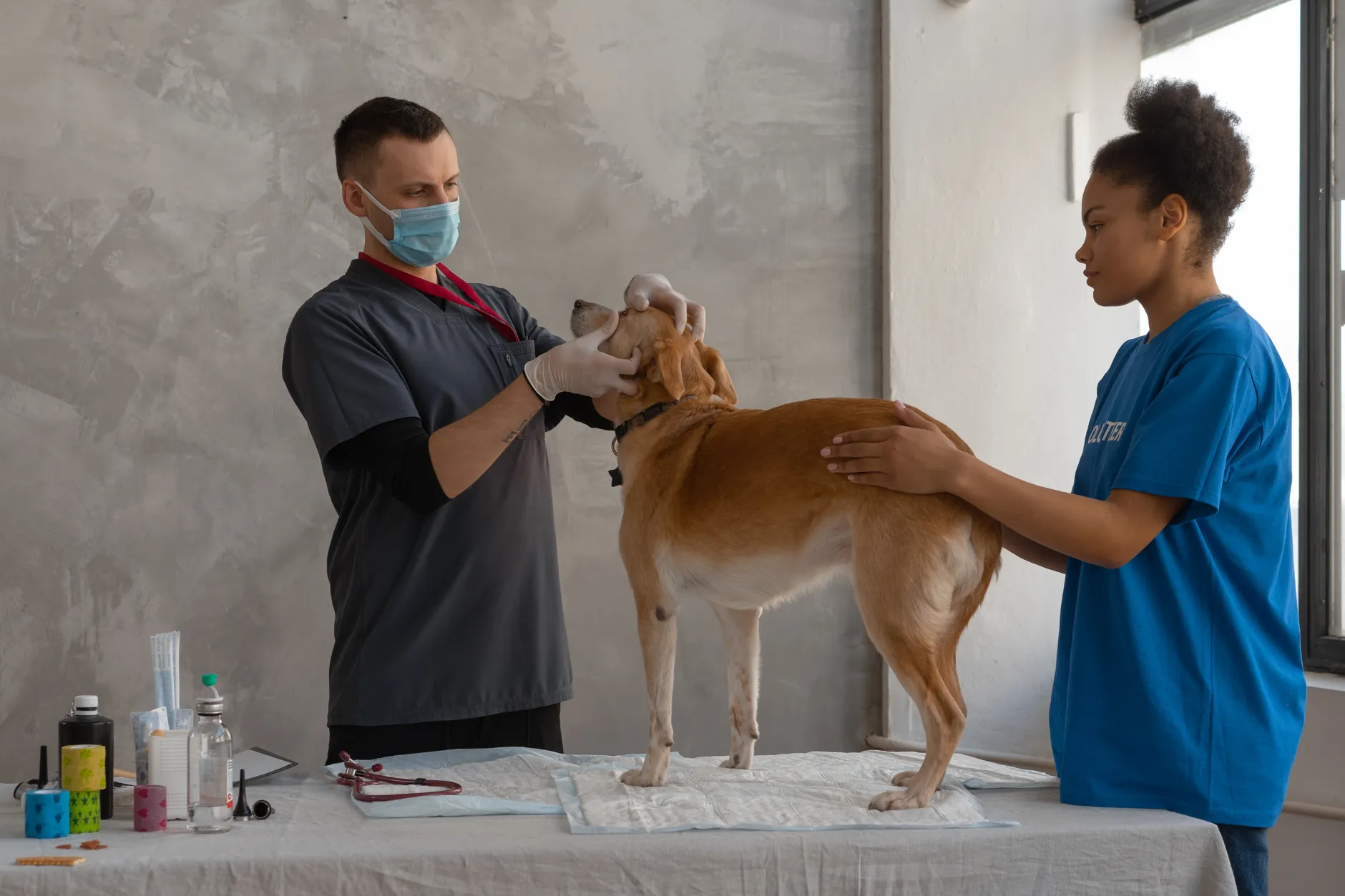
Emergency vet bills are the leading source of unexpected financial stress in dog ownership. A single cruciate tear, a bout of bloat, or a foreign body ingestion can generate a bill between $2,000 and $7,000 — often payable within hours. How much you should set aside depends on your breed's risk profile and whether you have pet insurance alongside the fund.
The most expensive dog emergencies: real cost ranges
Understanding which emergencies are most likely for your breed — and what they cost — is the foundation for sizing your fund. The table below covers common major emergencies with US cost ranges. These are actual surgical and hospitalisation costs, not estimates based on a routine vet visit.
| Emergency condition | Typical cost | Highest-risk breeds |
|---|---|---|
| Gastric dilatation-volvulus (bloat/GDV) | $3,000–$7,500 | Great Dane, Standard Poodle, Weimaraner, Doberman, Saint Bernard, Irish Setter, Rottweiler |
| Cranial cruciate ligament (CCL) rupture | $3,000–$6,000 | Labrador Retriever, Golden Retriever, Rottweiler, Mastiff, Newfoundland — overweight dogs of any breed |
| Foreign body ingestion (surgical) | $2,000–$5,000 | Any breed — especially curious puppies and Labs |
| BOAS surgery (brachycephalic airway) | $2,500–$5,500 | French Bulldog, English Bulldog, Pug, Shih Tzu, Cavalier KCS |
| Emergency orthopaedic fracture repair | $2,000–$6,000 | Any breed — higher in active, high-energy dogs and large breeds |
| Pyometra (uterine infection — unspayed females) | $1,500–$4,000 | Any unspayed female dog over 5 years old |
| Toxin ingestion and hospitalisation | $1,000–$4,000 | Any breed — xylitol, grapes/raisins, antifreeze, rat poison, chocolate are most common |
| Intervertebral disc disease (IVDD) surgery | $3,000–$8,000 | Dachshund, Basset Hound, Corgi, Beagle, Cocker Spaniel, French Bulldog |
| Emergency c-section | $1,500–$4,000 | Any breeding female — especially brachycephalic breeds where dystocia is very common |
Costs are US national averages. Emergency and specialist hospitals charge a premium over general practice rates (often 30–60% more). Geographic location adds further variation — California and New York vet costs run 30–40% above the national average.
Recommended fund size by breed risk tier
PupWiki's insurance model uses five risk tiers based on breed-level claims data. The recommended emergency fund size maps directly to these tiers — higher-risk breeds need a larger cushion because their emergencies are both more frequent and more expensive.
| Risk tier | Example breeds | Recommended fund | Rationale |
|---|---|---|---|
| Low | Chihuahua, Maltese, Whippet, Toy Fox Terrier | $1,000–$1,500 | Low frequency of expensive emergencies; smaller body size generally means lower surgery costs |
| Low-Standard | Beagle, Shih Tzu, Havanese, Yorkshire Terrier | $1,500–$2,000 | Some breed-specific conditions but generally manageable risk; fund covers most diagnostic workups |
| Standard | Golden Retriever, Labrador, Australian Shepherd, Border Collie | $2,000–$3,000 | CCL risk in large breeds; cancer in Goldens; fund covers one major emergency or partial coverage of a large one |
| Medium-High | German Shepherd, Cavalier KCS, Boxer, Weimaraner | $2,500–$4,000 | Elevated likelihood of conditions requiring specialist care; cardiac monitoring adds to routine costs |
| High | Rottweiler, Doberman, Pug, Bulldog variants | $3,000–$5,000 | Multiple high-cost conditions are likely over a lifetime; fund alone is unlikely to be sufficient without insurance |
| Very High | Great Dane, French Bulldog, Bernese Mountain Dog | $3,000–$5,000 + insurance | Single emergency events (bloat, BOAS surgery) frequently exceed $4,000–$7,000. Insurance is the primary strategy; fund covers deductibles |
Not sure of your breed's risk tier? Use the Dog Insurance Cost Estimator — it shows your breed's risk category alongside the premium estimate, and links to the Pet Insurance by Breed guide for a full breakdown of tier-level risks.
Emergency fund vs. pet insurance: which approach?
These two strategies are not mutually exclusive, but they have different strengths. Understanding the difference helps you decide the right combination for your situation.
Emergency fund
- Available immediately — no waiting periods
- No monthly premium — the money stays yours if unused
- Fully flexible — covers any expense, no pre-approval
- Capped at what you've saved — a $3,000 fund does not cover a $7,000 bloat surgery
- Takes time to build — not useful in the first year if starting from zero
Pet insurance
- Covers major claims fully — annual limits of $10,000–$unlimited
- Predictable monthly cost — budgetable, unlike emergency bills
- Best when started young — pre-existing conditions excluded
- Waiting periods apply — typically 14 days illness, 6 months cruciate
- Ongoing monthly premium — cost rises with age (up to 3.53× by age 14)
The recommended combination
For most dog owners, particularly those with medium or high-risk breeds: maintain a $500–$1,000 accessible buffer for immediate costs, deductibles, and items not covered by insurance — and take out pet insurance for protection against major claims. The fund covers the gap; insurance covers the event.
How to build an emergency fund
If you don't have an emergency fund in place yet, the fastest way to build one is to treat it like a subscription rather than a savings target:
- Set a target based on your breed's risk tier (see table above)
- Open a separate savings account specifically for this fund — keeping it separate prevents dipping into it for non-emergencies
- Set a monthly auto-transfer: for a $2,000 target, $100/month builds it in under 2 years; $200/month in under a year
- Do not treat the emergency fund as a budget top-up — replenish it immediately after any use
Use the Dog Cost Calculator to see your total annual dog budget including an insurance estimate, which helps identify how much room you have to allocate toward an emergency fund alongside monthly expenses.
Frequently asked questions
- How much should I save for dog emergencies?
- The practical minimum is $1,000, but $1,500–$3,000 is a more realistic target for most dog owners in the US. If you own a large or giant breed, or a high-risk breed (Great Dane, French Bulldog, Labrador), raise that target to $3,000–$5,000. This covers the most common major emergencies (cruciate tear repair, foreign body surgery, toxin treatment) in full, or at minimum covers the diagnostic workup before payment plans can be arranged.
- What are the most expensive dog emergencies?
- The most costly single-event emergencies are: GDV (bloat with gastric dilatation-volvulus) surgery at $3,000–$7,500; cruciate ligament (CCL) repair at $3,000–$6,000; orthopaedic fracture repair at $2,000–$6,000; emergency thoracic or abdominal surgery at $3,000–$8,000; and toxin ingestion requiring hospitalisation at $1,000–$4,000. Cancer treatment costs vary widely — a single chemotherapy cycle can run $1,000–$3,000, and total treatment over a course of care may reach $5,000–$15,000+.
- Is pet insurance better than an emergency fund?
- For most dog owners — especially those with high-risk breeds or limited liquid savings — pet insurance is the more robust option. An emergency fund caps your coverage at whatever you've saved; insurance is uncapped (subject to annual limits). The trade-off: insurance has an ongoing monthly cost and waiting periods; an emergency fund has no monthly premium and is immediately available. The ideal approach for high-risk breeds is both: a smaller $500–$1,000 buffer for deductibles and immediate expenses, plus an insurance policy to cover major claims.
- What if I can't afford an emergency vet bill?
- Several options exist short of surrendering your dog or declining treatment. CareCredit and Scratchpay are medical financing options accepted at many vet practices — they provide 0% APR promotional periods for 6–24 months on qualifying amounts. Many vet hospitals will negotiate payment plans, especially for established patients. Humane societies and breed rescue organisations sometimes have emergency assistance funds. Veterinary schools offer significantly reduced-cost care for complex cases. None of these replace having a fund or insurance — they're last resorts.
- When should I get pet insurance instead of an emergency fund?
- Pet insurance becomes the right primary strategy when: (1) you own a high-risk breed (Very High or High tier) where a single likely event could cost $3,000–$8,000; (2) your liquid savings cannot absorb a $2,000+ unexpected expense; (3) your dog is young and uninsured conditions can still be covered; or (4) you want peace of mind that major treatment decisions won't be financial rather than medical decisions. Insurance is not a replacement for an emergency buffer — keep at least $500 in accessible cash for deductibles and immediate costs.


