
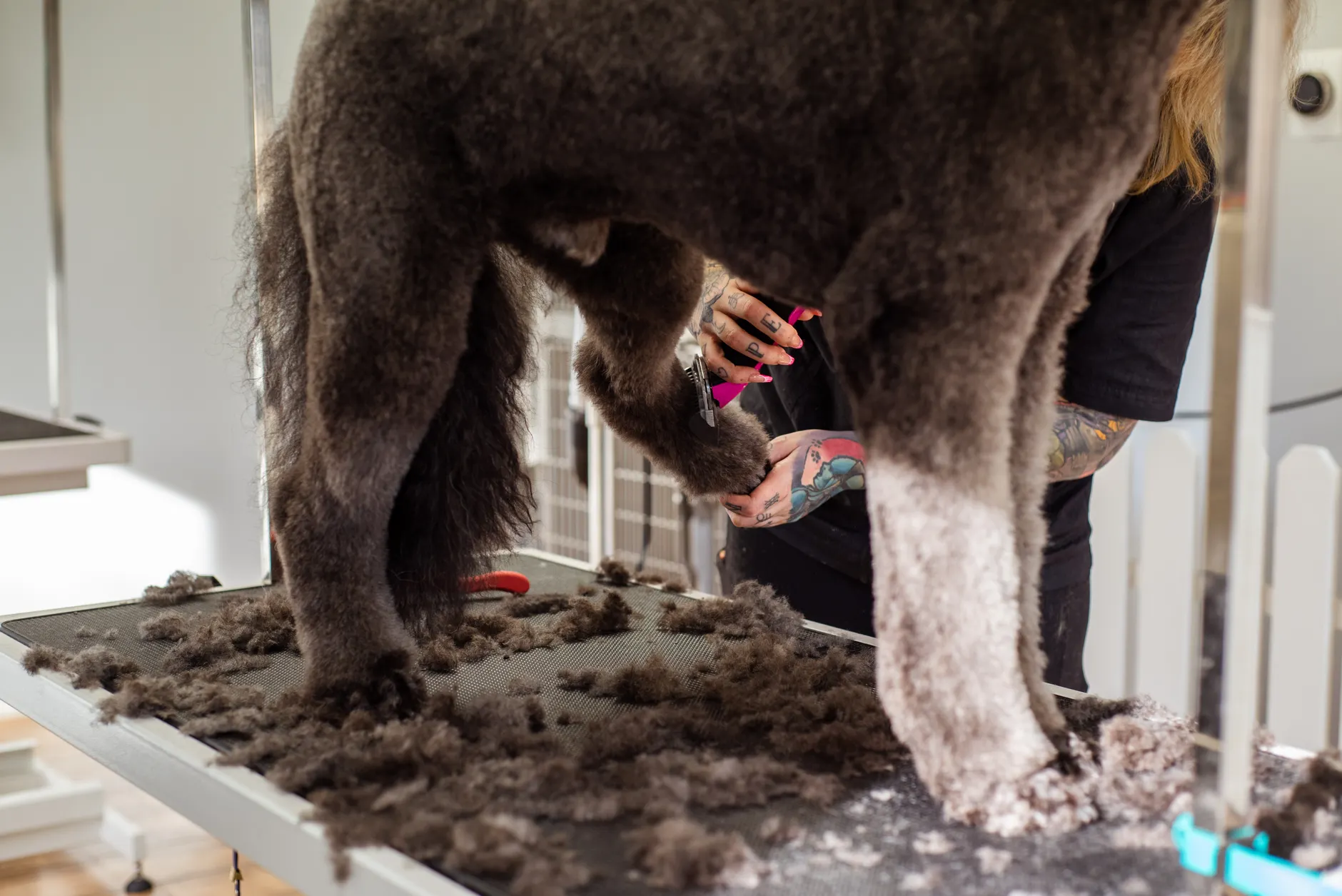
Grooming costs vary more by coat type than by dog size. A short-coated Great Dane may cost $60-$200 per year in grooming, while a medium-sized Poodle can exceed $1,400 annually at professional rates. This guide breaks down grooming costs for every major coat archetype, compares professional versus home grooming economics, and shows how the right tool investment can cut your annual grooming bill substantially.
Note: Grooming prices reflect 2026 US national averages. Metro areas charge 25-50% more; rural areas may be 10-20% less. Matting, temperament surcharges, and add-on services can increase individual session costs beyond the ranges shown. Use the Grooming Schedule Generator for a personalised schedule based on your dog's coat archetype.
Grooming costs by coat archetype
The coat archetype is the primary determinant of grooming cost. Two dogs of identical size but different coat types will have dramatically different grooming budgets. The table below compares professional grooming costs, recommended frequency, and annual totals across the five main coat archetypes.
| Coat type | Example breeds | Per session | Frequency | Annual (pro) |
|---|---|---|---|---|
| Short single coat | Beagle, Whippet, Great Dane, Boxer, Doberman | $30-$50 | Rarely needed (2-4x/year optional) | $60-$200 |
| Short/medium double coat | Labrador, German Shepherd, Husky, Golden Retriever, Corgi | $50-$90 | 3-4x/year (seasonal de-shedding) | $150-$360 |
| Long silky coat | Maltese, Yorkshire Terrier, Shih Tzu, Afghan Hound | $60-$100 | Every 4-6 weeks | $520-$1,200 |
| Curly/wavy coat | Poodle, Bichon Frise, Labradoodle, Portuguese Water Dog | $65-$120 | Every 4-6 weeks | $560-$1,440 |
| Wire/rough coat | Schnauzer, Wire Fox Terrier, West Highland Terrier, Airedale | $60-$180 (hand-strip) | Every 8-12 weeks | $260-$900 |
The gap is stark: a Beagle owner might spend $60-$200/year on grooming while a Poodle owner spends $560-$1,440/year — a 7x difference. Over a 12-year lifespan, that translates to a $5,000-$15,000 difference in lifetime grooming cost alone.
Professional vs. home grooming: the real economics
The decision to groom at home versus professionally is not simply about saving money — it depends on coat type, your skill level, and the opportunity cost of your time. Here is a realistic breakdown.
When home grooming makes financial sense
- Short coats — home bathing and brushing is straightforward and saves $100-$200/year over salon visits
- Double coats — regular home brushing is essential regardless; adding a home bath and de-shedding treatment 2-3x/year saves $100-$270 vs. pro-only approach
- Between-appointment maintenance for all coats — regular home brushing extends the interval between professional grooms, reducing annual visit count by 1-3 sessions
When professional grooming is worth the cost
- Curly and long-silky coats requiring clips or trims — improper home clipping can cause razor burn, clipper tracks, or uneven results that cost more to fix than the original groom
- Wire coats needing hand-stripping — hand-stripping is a skilled technique that takes months to learn; most home groomers do not achieve professional results
- Matted coats — never attempt to cut out mats at home with scissors; serious lacerations are common, and professional de-matting tools are both safer and more effective
- Fearful or aggressive dogs — professional groomers have handling skills, equipment, and (in some cases) veterinary sedation options that make the process safer
A practical hybrid approach works for most owners: professional grooming on the recommended schedule for your coat type, with consistent home brushing and occasional baths between appointments. This approach typically reduces annual grooming cost by 20-30% compared to relying entirely on professional services.
Home grooming tool investment
The right tools make home grooming effective and efficient. A starter kit costs $50-$120 depending on coat type; quality clippers for full home grooming add $60-$200. These tools last years, making the per-year cost minimal compared to the grooming savings they enable.
| Tool | Cost | For which coats | Typical lifespan |
|---|---|---|---|
| Slicker brush | $10-$25 | All except short single | 2-3 years |
| Undercoat rake / de-shedding tool | $15-$40 | Double coats | 3-5 years |
| Rubber curry brush / grooming mitt | $8-$15 | Short single coats | 2-4 years |
| Metal comb (wide + fine tooth) | $10-$20 | Long, curly, wire coats | 5+ years |
| Dog clippers (quality) | $60-$200 | Curly, long silky (if home clipping) | 5-8 years |
| Nail clipper or grinder | $10-$30 | All | 3-5 years |
| Dog shampoo (quality) | $10-$20 per bottle | All | 2-6 months per bottle |
| Detangling spray | $8-$15 | Long, curly coats | 2-4 months per bottle |
| Ear cleaning solution | $8-$15 | All (especially floppy-eared breeds) | 3-6 months per bottle |
| Grooming table (optional) | $50-$150 | All (especially medium-large dogs) | 10+ years |
Total starter kit investment for a double-coated breed: approximately $55-$120 (slicker brush + undercoat rake + nail clipper + shampoo + ear solution). For a curly-coated breed adding home clipping: $115-$320 (add clippers + metal comb + detangling spray). The investment pays for itself within 2-4 professional grooming sessions.
The matting penalty: what neglected grooming costs
Matting is not just a cosmetic problem — it is a welfare concern that directly increases grooming costs. Most professional groomers charge a matting surcharge of $20-$50+ per session for mild matting, and severely matted dogs may be quoted $100-$200 above the standard groom price.
More importantly, severe matting often results in a mandatory shave-down rather than the intended style, because mats pull tightly against the skin and cannot be safely brushed out. For owners who maintain their dog at a specific coat length (Poodle clips, Bichon styles, Shih Tzu topknots), this means starting over from a very short clip — which some owners find distressing.
The financial lesson: consistent home brushing between professional appointments is not optional for mat-prone coat types. A $15 slicker brush and 10 minutes of brushing every other day prevents a $50+ matting surcharge at every grooming appointment. Over a year, that is a potential savings of $200-$500 in matting fees alone.
Seasonal cost variations
Grooming costs are not perfectly flat across the year. Two seasonal factors affect pricing and frequency:
Coat blow seasons (March-May, September-November)
Double-coated breeds shed their undercoat heavily twice a year. During these periods, brushing frequency should increase to daily, and many owners add 1-2 professional de-shedding treatments ($40-$80 each) to manage the volume of loose coat. This adds $80-$160 in seasonal grooming costs that do not occur in other months.
Holiday and summer demand spikes
Professional groomers experience peak demand before holidays (Thanksgiving, Christmas, July 4th) and during summer. Appointments book out 2-4 weeks in advance, and some groomers apply peak-season surcharges. Booking 3-4 weeks ahead during these periods avoids both surcharges and the stress of finding last-minute availability. See the seasonal grooming tips guide for a complete seasonal care calendar.
Regional price differences
Grooming prices vary substantially by location. The main factors:
- Major metro areas — 25-50% above national average; Manhattan, San Francisco, and Los Angeles are the most expensive US markets for grooming
- Suburbs and mid-size cities — approximately national average; the widest range of options and competition
- Rural areas — 10-20% below national average, but fewer groomers mean longer wait times and potentially longer drives
- Mobile grooming — $15-$30 premium over salon grooming in all regions; convenience-driven, growing rapidly in suburbs
For a Standard Poodle groom, the range across US markets is approximately $60-$130 per session — a more-than-2x difference. If grooming is a significant line item in your dog budget (and it will be for curly and long-coated breeds), factor in your local market when estimating total annual costs. The Dog Cost Calculator includes regional adjustments in its grooming estimates.
Reducing grooming costs: practical strategies
Several approaches reliably reduce annual grooming spend without compromising coat health:
- Brush consistently at home — prevents matting surcharges and extends the interval between professional visits; the single highest-return time investment
- Learn to trim nails at home — saves $10-$20 per trip; nail trims every 4-6 weeks add up to $80-$240/year if done professionally
- Bathe at home between professional grooms — a home bath with quality dog shampoo ($3-$5 per bath) replaces a $30-$50 bath-only salon visit
- Consider a grooming school — grooming schools offer supervised grooms at 30-50% below salon prices; quality is generally good because students are being graded
- Buy multi-visit packages — many groomers offer 5-visit or 10-visit prepaid packages at a 10-15% discount
- Choose coat type intentionally before getting a dog — if grooming cost is a concern, short and double-coated breeds cost 5-10x less annually than curly or long-silky coats
The most impactful decision happens before you get the dog. Use the Grooming Schedule Generator to see the full grooming commitment for any breed before committing, and factor grooming into your annual cost projection.
Frequently asked questions
- How much does professional dog grooming cost per session?
- Professional grooming ranges from $30-$50 for a basic bath-and-brush on a small short-coated dog to $80-$150+ for a full groom (bath, blow-dry, haircut, nail trim, ear cleaning) on a large or high-maintenance coat. Factors that increase cost include dog size, coat condition (matting adds $20-$50+), temperament surcharges for difficult dogs, and add-on services like teeth brushing, de-shedding treatments, or speciality shampoos.
- Which dog coat types cost the most to groom?
- Curly and wavy coats (Poodle, Bichon Frise, Doodle mixes) are consistently the most expensive to maintain professionally. They require clipping every 4-6 weeks ($60-$120 per session), frequent brushing between appointments, and matting removal if brushing lapses. Long-silky coats (Maltese, Yorkshire Terrier, Shih Tzu) are a close second. Short single-coated breeds (Beagle, Whippet, Great Dane) are the least expensive — many never need professional grooming.
- Can I groom my dog at home to save money?
- Yes, but the savings depend on coat type. Home grooming is highly practical for short coats (bath + brush), double coats (regular brushing + de-shedding + occasional bath), and basic maintenance between professional appointments. It is less practical for coats requiring clipping (curly, long-silky) unless you invest in quality clippers ($50-$200) and learn technique — a bad home clip can cause skin irritation or an uneven result that requires professional correction.
- How often should I take my dog to the groomer?
- Short coats: rarely or never professionally (home bathing is sufficient). Double coats: 3-4 times per year for bath and de-shedding treatment, or seasonally during coat blow. Long-silky coats: every 4-6 weeks for trim and maintenance. Curly/wavy coats: every 4-6 weeks (stretching beyond 6 weeks risks matting). Wire coats: every 8-12 weeks for hand-stripping or clipping. All breeds: nail trim every 4-6 weeks if not worn naturally.
- Do grooming costs vary by region?
- Yes, significantly. Metropolitan areas (New York, Los Angeles, San Francisco, Chicago) charge 25-50% more than rural or suburban areas. A standard Poodle groom costs $60-$80 in a mid-cost area but $90-$130 in a major metro. Mobile grooming services, which bring a grooming van to your home, typically charge a $15-$30 premium over salon grooming for the convenience.
- What is hand-stripping and why does it cost more?
- Hand-stripping is a grooming technique where dead outer coat hairs are pulled out by hand rather than clipped. It preserves the wire coat's texture, colour, and weather resistance. It is the traditional grooming method for terrier breeds (Schnauzer, Wire Fox Terrier, West Highland Terrier, Airedale). Hand-stripping costs $80-$180 per session because it is time-intensive (2-4 hours) and requires a skilled groomer. Many owners opt for clipping instead, which is faster and cheaper but changes the coat texture over time.


