
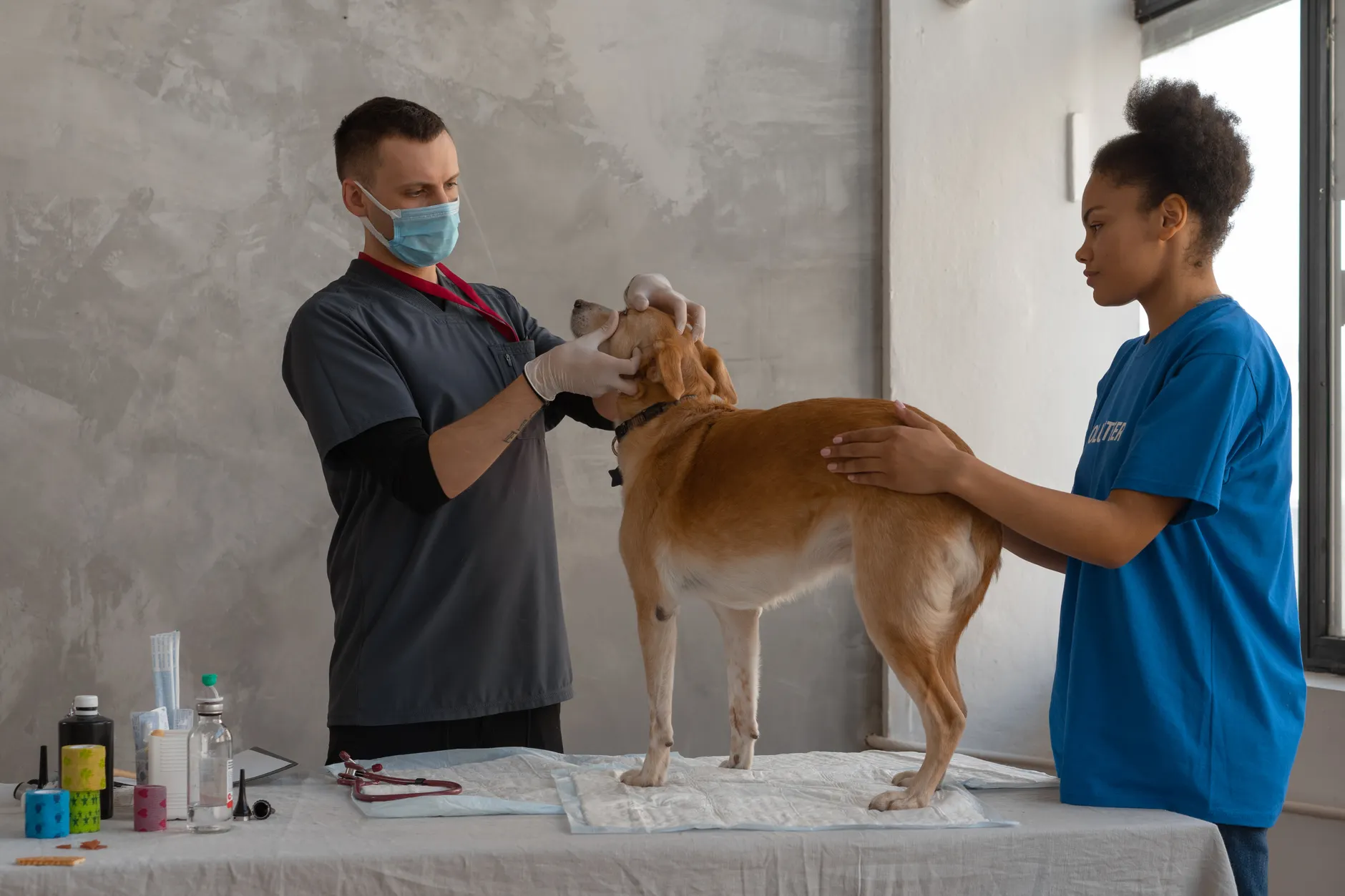
Veterinary care is the most variable and least predictable cost category in dog ownership. Routine care alone — exams, vaccines, parasite prevention, dental cleanings, and blood work — runs $400-$1,000 per year for a healthy adult dog, and that total climbs significantly as your dog ages. This guide itemises every routine vet expense, shows how costs shift across the five life stages, and identifies the moments when vet bills are most likely to spike.
Note: Vet costs vary substantially by region. California, New York, and New England generally run 15-25% above national averages; rural Midwest and Southern states often sit 5-15% below. The figures in this guide reflect national average ranges. The Dog Cost Calculator applies state-level adjustments for a more precise estimate.
Complete routine vet cost breakdown
The table below lists every standard component of annual veterinary care, with frequency, cost range, and context for when each item applies. Not every dog needs every item every year — vaccine schedules cycle every 1-3 years, and dental cleaning frequency depends on breed and home care.
| Item | Frequency | Cost range | Notes |
|---|---|---|---|
| Annual wellness exam | 1x/year (2x for seniors) | $50-$100 | Physical exam, weight check, overall health assessment. Senior dogs benefit from semi-annual visits. |
| Core vaccines (DHPP) | Every 3 years (after puppy series) | $25-$50 per round | Distemper, hepatitis, parainfluenza, parvovirus. First adult booster 1 year after puppy series. |
| Rabies vaccine | Every 1-3 years by state law | $15-$35 | Legally required in most US states. First dose annual; subsequent doses often 3-year. |
| Non-core vaccines | Annual if applicable | $20-$45 each | Bordetella, Leptospirosis, Lyme, canine influenza. Depends on lifestyle and geography. |
| Heartworm prevention | Monthly, year-round | $8-$25/month | Weight-based dosing. Year-round in warm climates; seasonal in northern states (vet-guided). |
| Flea/tick prevention | Monthly, year-round | $10-$25/month | Combination products (flea + tick + heartworm) can reduce cost vs. separate products. |
| Annual heartworm test | 1x/year | $35-$75 | Blood test to confirm prevention is working. Required before prescribing prevention in most clinics. |
| Faecal test | 1-2x/year | $25-$50 | Checks for intestinal parasites. More frequent for dogs in multi-dog environments or dog parks. |
| Professional dental cleaning | Every 1-2 years | $300-$800 | Under anaesthesia. Cost increases significantly if extractions are needed (+$100-$500). |
| Comprehensive blood panel | Annual for seniors; as-needed for adults | $100-$300 | Liver, kidney, thyroid, CBC. Standard for senior wellness; baseline recommended at age 5-6. |
A practical annual total for a healthy adult dog in a non-core-vaccine year: wellness exam ($50-$100) + parasite prevention ($216-$600) + heartworm test ($35-$75) + faecal test ($25-$50) = $326-$825/year minimum, before any dental work or illness visits.
How vet costs change across life stages
Veterinary expenses follow a U-shaped curve: high in the first year (puppy vaccine series and spay/neuter), low during healthy adulthood, then steadily rising from the senior phase onward. Understanding this curve helps you plan savings and insurance decisions.
| Life stage | Annual vet cost | Key expenses | Notes |
|---|---|---|---|
| Puppy (0-12 months) | $700-$1,500 | Vaccine series (3-4 rounds), spay/neuter, microchip, frequent wellness checks | Highest first-year vet cost. See puppy vaccination schedule guide for the full timeline. |
| Young adult (1-3 years) | $400-$800 | Annual exam, core vaccine boosters (3-yr cycle starts), parasite prevention, first dental cleaning | Lowest-cost life stage if the dog is healthy. A good time to establish a vet savings fund. |
| Adult (3-7 years) | $500-$1,000 | Annual exam, parasite prevention, dental cleanings, non-core vaccines, occasional illness | Dental costs begin to surface. Chronic conditions (allergies, ear infections) may start. |
| Senior (7-10 years) | $800-$1,800 | Semi-annual exams, blood panels, dental work, arthritis management, screening tests | Costs accelerate. Large breeds enter senior phase at 6-7; small breeds at 9-10. |
| Geriatric (10+ years) | $1,200-$3,000+ | Frequent exams, specialised blood work, pain management, mobility support, possible oncology | Highest per-year vet costs. Quality-of-life decisions may arise. End-of-life care: $500-$3,000. |
The shift from "young adult" ($400-$800/year) to "geriatric" ($1,200-$3,000+/year) represents a 3-4x increase. This is where many owners are caught off guard — the dog they budgeted $50/month for in vet costs is now requiring $150-$250/month. Starting a vet fund during the low-cost adult years is the most practical way to prepare.
The vaccine schedule explained
Vaccine costs are front-loaded in the first year and then cycle every 1-3 years. Understanding the schedule prevents both over-vaccination and missed protection.
Core vaccines (required for all dogs)
- DHPP (distemper, hepatitis, parainfluenza, parvovirus) — puppy series at 8, 12, and 16 weeks; first adult booster at 1 year; then every 3 years
- Rabies — first dose at 12-16 weeks; booster at 1 year; then every 1 or 3 years depending on state law and vaccine type
Non-core vaccines (based on lifestyle and geography)
- Bordetella (kennel cough) — annual or every 6 months; recommended if your dog attends daycare, boarding, grooming, or dog parks
- Leptospirosis — annual; recommended in areas with wildlife exposure, standing water, or flooding risk
- Canine influenza (H3N2/H3N8) — annual; increasingly recommended in multi-dog environments and urban areas
- Lyme disease — annual; recommended in tick-endemic regions (Northeast, upper Midwest, Pacific Northwest)
In a typical year, an adult dog with a standard lifestyle might receive 1-3 non-core vaccine boosters ($20-$45 each) plus, every third year, core vaccine boosters ($40-$85). The vaccine line item averages $75-$200/year when amortised across the 3-year core vaccine cycle.
Dental care: the most underbudgeted vet expense
Professional dental cleaning is consistently the most underestimated routine vet cost. Many owners skip it entirely until a problem becomes visible — by which point, extractions are often needed, multiplying the bill.
A professional dental cleaning under general anaesthesia costs $300-$800 for a straightforward cleaning (scaling, polishing, full-mouth radiographs). If extractions are needed, add $100-$500+ depending on the number and complexity of teeth removed. Some complex extractions (fractured molars, roots fused to jawbone) require referral to a veterinary dental specialist at $800-$2,000+.
Which breeds need dental care most frequently?
- Small breeds (Chihuahua, Yorkshire Terrier, Maltese) — crowded mouths and retained baby teeth mean more plaque accumulation; often need annual cleanings
- Brachycephalic breeds (Pug, French Bulldog, Shih Tzu) — jaw structure creates overcrowding and malocclusion; dental disease develops faster
- Greyhounds and Whippets — genetically predisposed to poor dental health despite their size; annual cleanings recommended
Home dental care (daily brushing, dental chews, water additives) can extend the interval between professional cleanings but does not replace them. Even with excellent home care, sub-gingival tartar requires professional removal. See the dental health guide for a complete home care routine.
Size-class impact on routine vet costs
While exam fees are typically the same regardless of dog size, most other vet costs scale with body weight. The practical differences:
- Parasite prevention — weight-based dosing means a 90-lb dog pays 2-3x more per month than a 15-lb dog for the same product
- Anaesthesia (for dentals and procedures) — larger dogs require more anaesthetic agent, longer monitoring time, and larger IV catheter setups
- Medications — antibiotics, pain medications, and chronic-condition drugs are dosed by weight; a large breed on daily arthritis medication can spend $80-$150/month vs. $30-$50 for a small breed
- Blood work — same lab cost regardless of size, but large breeds may need additional tests (cardiac screening, orthopaedic evaluations) more frequently
Over a lifetime, the size-class vet cost gap compounds significantly. A small breed owner might spend $8,000-$15,000 in total vet care over 14 years; a giant breed owner can spend $12,000-$25,000 over just 8-10 years.
When vet costs spike: the warning points
Beyond the predictable age-related curve, several events can cause sudden, significant increases in vet spending. Knowing the common triggers helps you maintain adequate reserves.
- First dental cleaning with extractions — often happens at age 3-5; can turn a $400 cleaning into a $1,200 bill overnight
- Allergy onset (age 1-3) — allergies often manifest young and require ongoing management: allergy testing ($200-$500), immunotherapy ($300-$600/year), or Apoquel/Cytopoint ($100-$200/month)
- Cruciate ligament tear (ACL equivalent) — common in active medium-to-large breeds; surgery $3,000-$6,000 per knee, and 40-60% of dogs that tear one will tear the other
- Senior screening discovers a condition — the first comprehensive blood panel at age 7-8 may reveal kidney disease, thyroid issues, or early liver changes requiring ongoing management
- Cancer diagnosis — treatment ranges from $3,000 for a simple mass removal to $10,000-$15,000+ for chemotherapy or radiation; some breeds (Golden Retriever, Boxer, Bernese Mountain Dog) have significantly elevated cancer rates
None of these events are covered by "routine" vet budgets, which is why the emergency vet fund guide recommends maintaining a separate reserve of $2,000-$5,000 in accessible savings.
Practical budgeting: what to set aside each month
Based on the cost data above, here are practical monthly vet budget targets by life stage. These cover routine care only — add a separate emergency reserve contribution of $25-$75/month.
- Puppy year — $60-$125/month (front-loaded; budget the full amount from month one)
- Adult (1-7 years) — $35-$75/month (lower in off-vaccine years, higher in dental-cleaning years)
- Senior (7-10 years) — $70-$150/month (semi-annual exams, blood panels, early chronic condition management)
- Geriatric (10+ years) — $100-$250/month (frequent monitoring, pain management, specialised care)
The Dog Cost Calculator incorporates vet cost estimates adjusted for your breed's size class and your state's cost-of-living multiplier. Running the calculator gives you a more precise baseline to build your monthly budget around.
Frequently asked questions
- How much does a routine vet visit cost for a dog?
- A standard annual wellness exam costs $50-$100 in most US markets, though high cost-of-living areas (New York, San Francisco, Los Angeles) can charge $80-$150. This is the exam fee only — vaccines, blood work, and treatments are billed separately. Most dogs need at least one comprehensive wellness visit per year; senior dogs (7+) benefit from twice-yearly exams.
- What vaccines does an adult dog need each year?
- Core vaccines (rabies, DHPP) do not require annual boosters after the initial puppy series and first adult booster — most are on a 3-year cycle. However, your dog may need annual boosters for non-core vaccines like Bordetella (kennel cough), canine influenza, Leptospirosis, and Lyme disease depending on lifestyle and geography. Annual vaccine costs for an adult dog typically run $75-$200, less in years without core vaccine boosters.
- How much does monthly heartworm and flea prevention cost?
- Monthly parasite prevention (heartworm + flea/tick) costs $15-$50/month depending on your dog's weight. Larger dogs require higher doses, which cost more. Annual total: $180-$600. Many vets offer a year's supply at a discount, and some online pharmacies are cheaper than in-clinic purchases. Skipping prevention is a false economy — heartworm treatment costs $1,000-$3,000+ and carries real health risks.
- When should my dog get a dental cleaning?
- Most veterinary dentists recommend a professional dental cleaning every 1-2 years starting at age 2-3, though frequency depends on breed (small breeds and brachycephalic breeds need more frequent cleanings), diet, and home dental care habits. Dental disease affects over 80% of dogs by age 3. A professional cleaning under anaesthesia costs $300-$800; add $100-$500+ if extractions are needed. Annual dental chews and home brushing reduce but do not eliminate the need for professional cleanings.
- Are senior dog vet costs significantly higher than adult dog vet costs?
- Yes. Senior dogs (7+ for large breeds, 10+ for small breeds) typically cost 40-80% more per year in routine veterinary care than healthy adults. The increase comes from semi-annual exams instead of annual, comprehensive blood panels ($150-$300 each), arthritis management ($50-$150/month in medications and supplements), more frequent dental cleanings, and screening tests for age-related conditions. Budget $1,200-$2,500/year for routine senior dog vet care vs. $500-$900 for a healthy adult.
- Is there a difference in vet costs between small and large dogs?
- Yes, though the difference is smaller for routine care than for medications and procedures. Exam fees are typically the same regardless of size. But vaccine doses, anaesthesia for dentals, parasite prevention, and medications are weight-based — a 90-lb dog will cost 2-3x more for these items than a 15-lb dog. Surgery costs also scale with body weight due to longer anaesthesia time and larger supply needs. Annual routine vet costs run roughly $400-$700 for small breeds and $600-$1,100 for large/giant breeds.


