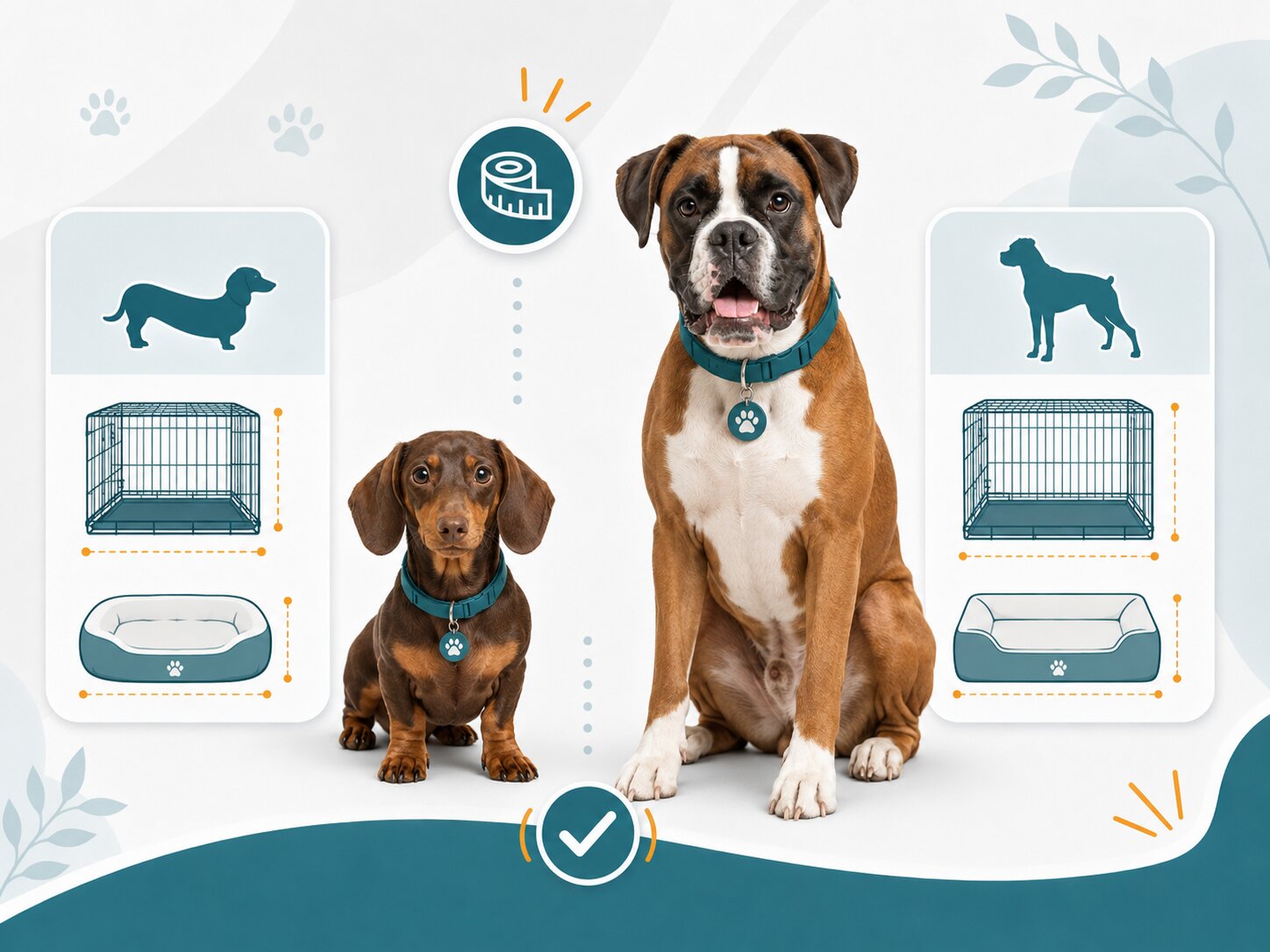
Calculate the right crate and bed size for your dog. Home sizing, IATA airline pre-check, brachycephalic adjustment, puppy growth guidance, and current crate audit.
Crate and bed sizing charts on most retail sites are based on breed averages, but body shape
varies a lot within a breed — and a crate that's the wrong size creates real welfare problems.
Too small, and your dog can't stand, turn around, or stretch out. Too large with no divider, and
a puppy may treat the far corner as a bathroom. This tool uses the same body-measurement method
vets and trainers recommend to calculate your dog's minimum interior dimensions for home use, a
separate IATA pre-check estimate for airline travel (with an automatic adjustment for flat-faced
breeds), and a bed size and style recommendation — plus an audit of any crate you already own.
IATA CR-1 formulaDual units (in / cm)Brachycephalic adjustmentPuppy growth guidance
Step 1 of 5
Tell us about your dog
10 weeks = 2.5 months. 1 year = 12 months. Puppies grow fast — we'll flag sizing caveats.
Helps identify brachycephalic (flat-faced) breeds for airline sizing adjustments.
Select all that apply — you'll get the right sizing for each use.
How your crate and bed sizes are calculated
The calculator is a deterministic formula engine — the same measurements always produce the same
result, with no AI involved. It runs your answers through 7 safety gates first, then applies a
separate formula for each thing you asked about: a home crate, an airline travel crate, and a bed.
Home crate formula
length = A × 1.1, height = D × 1.1, width = C × 1.25
IATA CR-1 formula
length = A + B÷2, width = C × 2.0, height = D
Brachycephalic adjustment
all IATA dimensions × 1.10
Standard size bands
6 (XS through XXL)
Bed sizing formula
flat length = A × 0.8 + 4in, width = C × 1.2
Safety gates checked first
7
A, B, C, and D are your dog's body length, leg length, shoulder width, and standing height — the
same four measurements used throughout every formula. The home crate result is mapped to the
smallest of 6 standard size bands that fits all three dimensions; the IATA result gets the
brachycephalic +10% adjustment automatically if your dog is (or is flagged as) a flat-faced
breed; and the bed result picks a style — flat, bolster, or orthopedic — based on your dog's age,
mobility, and sleep habits. If a safety gate returns "urgent" (acute injury) or "vet-first"
(post-surgery/medical recovery), the tool stops there with guidance instead of size results.
Puppies under 12 months get a divider recommendation and a re-measure reminder every 4-6 weeks.
Worked example: large breed vs. flat-faced (brachycephalic) breed
Same engine, two very different bodies — both dogs are 3 years old, need a crate for home use and
airline travel, and have measurements entered directly:
Dog A: Golden Retriever (large, non-brachycephalic) — A=30in, B=14in, C=18in, D=27in, sleeps sprawled out.
Dog B: French Bulldog (small, brachycephalic) — A=14in, B=6in, C=11in, D=12in, sleeps curled up.
← Scroll to see all columns →
Golden Retriever (Dog A) vs. French Bulldog (Dog B)
Dog A: Golden Retriever
Dog B: French Bulldog
Home crate size band
XL — Extra Large
XS — Extra Small
Home crate interior (L x H x W, in)
33" x 29.7" x 22.5"
15.4" x 13.2" x 13.8"
Home crate interior (cm)
83.8 x 75.4 x 57.1 cm
39.1 x 33.5 x 35.1 cm
IATA airline crate (L x W x H, in)
37" x 36" x 27"
18.7" x 24.2" x 13.2"
Brachycephalic +10% applied
No
Yes — unadjusted would be 17" x 22" x 12"
Bed size (flat, in)
28" x 21.6"
15.2" x 13.2"
Recommended bed style
Flat / mat (sprawls out)
Bolster / donut (curls up)
Dog A's larger frame maps to an XL home crate and a 37" x 36" x 27" IATA travel crate — no
brachycephalic adjustment applies, since Golden Retrievers aren't flat-faced. Dog B's smaller
frame maps to an XS home crate, but its IATA travel crate gets the +10% brachycephalic
adjustment on all three dimensions: without it, the CR-1 formula would produce 17" x 22" x 12";
with it, 18.7" x 24.2" x 13.2". The two dogs also land on different bed styles purely from their
sleep preferences — Dog A's "sprawl" habit suits a flat mat, while Dog B's "curl up" habit suits
a bolster bed with raised edges.
Frequently asked questions
How is my home crate size calculated?
The home crate calculator uses the four-measurement A/B/C/D method recommended by the AKC and VCA: A = body length (nose to tail base), B = leg length (floor to elbow), C = shoulder width (widest point), and D = standing height (floor to ear tips). Interior length = A x 1.1, interior height = D x 1.1, and interior width = C x 1.25 — these multipliers give your dog room to stand, turn around, and lie fully stretched out. The result is then mapped to the smallest of 6 standard crate size bands (XS through XXL) that fits all three dimensions. If you skip the measurements, the tool estimates from your dog's breed or size class instead, with a lower confidence label.
What is the IATA CR-1 formula, and can I book a flight based on it?
Airline cargo travel uses the IATA Live Animals Regulations Container Requirement 1 (CR-1) formula: length = A + B/2 (body length plus half the leg length), width = C x 2.0 (twice the shoulder width), and height = D (standing height). This is a pre-check estimate only — every airline sets its own rules, enforces its own measurements, and may refuse travel at any point regardless of what this tool shows. Always confirm dimensions, carrier policies, and any breed restrictions directly with your airline before booking, and allow 4-6 weeks for crate familiarisation beforehand.
Why does the tool add 10% for flat-faced (brachycephalic) breeds?
For brachycephalic breeds — French Bulldogs, English Bulldogs, Pugs, and similar flat-faced breeds — all three IATA dimensions are multiplied by 1.10 per USDA APHIS guidance, accounting for the increased ventilation these breeds need and their different body proportions relative to a standard CR-1 calculation. This adjustment applies automatically once you select a known brachycephalic breed or flag your dog as flat-faced. It does not override airline policy: many carriers restrict or refuse cargo-hold travel for brachycephalic breeds entirely because of heat-stress and breathing risk, independent of crate size — so this is one more reason to confirm directly with your airline before booking.
How is my dog's bed size and style chosen?
Flat bed length = body length (A) x 0.8, plus a 4-inch buffer; flat bed width = shoulder width (C) x 1.2. The recommended style then depends on your dog's age, mobility, and sleep habits: orthopedic memory foam is recommended for senior dogs (roughly 7+ years for large/giant breeds, 10+ for small breeds) or any dog with mobility concerns, per VCA guidance on joint support. For dogs without mobility concerns, a bolster (raised-edge) bed suits dogs that like to lean or curl up, while a flat mat suits dogs that sprawl out or prefer a cooler surface.
What changes if my dog is still a puppy?
For puppies under 12 months, the tool flags lower confidence on size estimates and adds an info-level note recommending a crate divider panel — this reduces the crate's usable space to your puppy's current size, which helps with housetraining and makes the crate feel more secure than an empty oversized space. The action plan also recommends re-measuring every 4-6 weeks as your puppy grows, since body proportions (and therefore the A/B/C/D measurements) change quickly during this stage.
What safety checks does this tool run, and what happens if one is triggered?
Before generating any size recommendation, the tool runs your answers through 7 safety gates. An acute injury or distress flag is "urgent" and stops the tool entirely — it tells you to contact a vet rather than continue with sizing. Post-surgery or medical recovery is a "vet-first" gate, because standard sizing formulas may not apply during recovery and your vet should guide crate type, size, and duration. Crate panic or escape history, heavy chewing, and collar-in-crate risk are "caution" gates — sizing continues, but each adds specific safety guidance (for example, never leave a collar on a dog in a crate, and use only indestructible bedding for heavy chewers). Puppy growth and multi-dog households add informational notes without changing the recommendation.
Crates, beds, and other one-time setup costs are part of your dog's first-year budget. Use the Dog Cost Calculator to see how these purchases fit alongside food, vet care, and other ongoing costs.