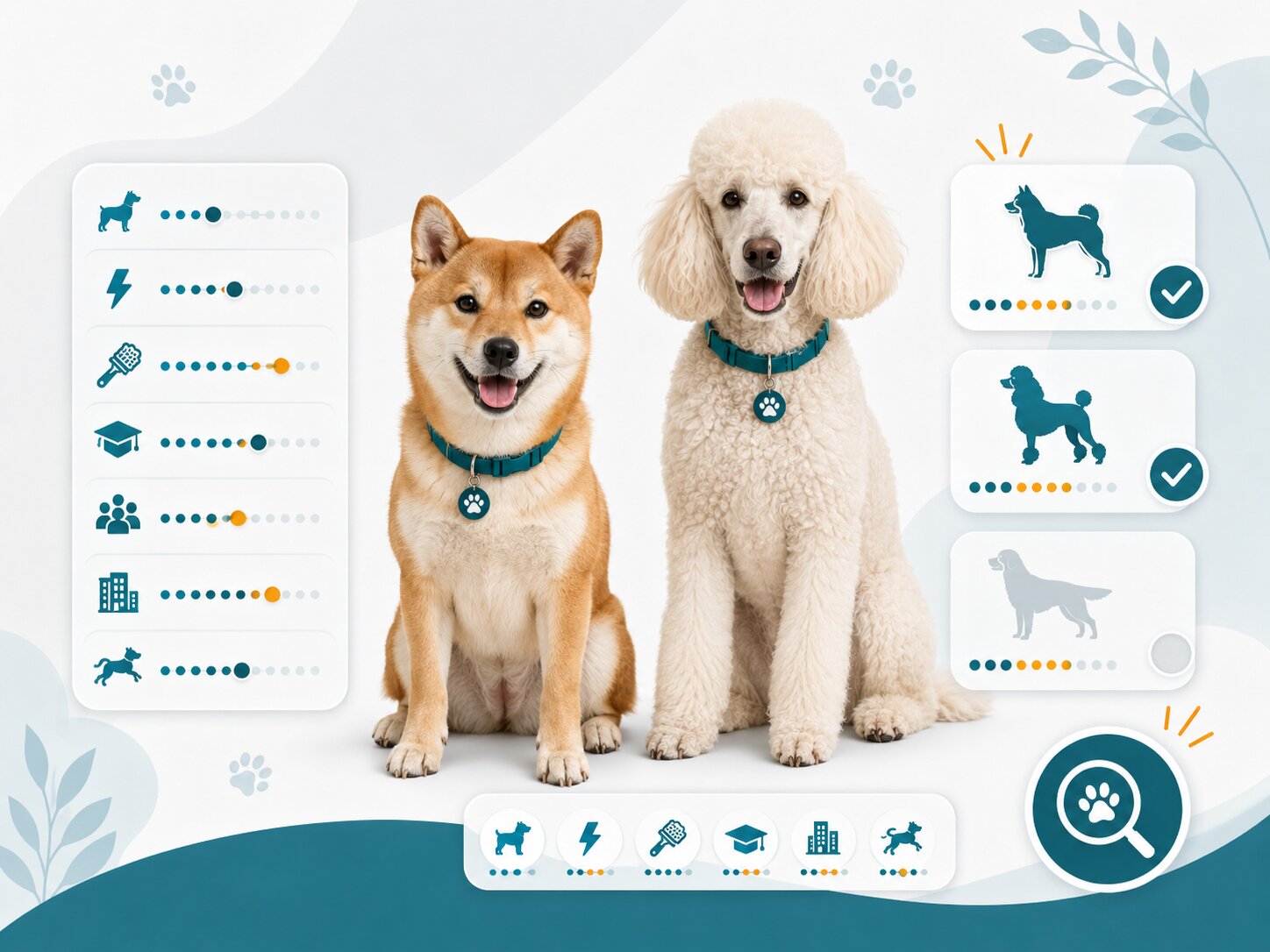
Set your trait preferences — energy, grooming, trainability, apartment fit, kid-friendliness — and get all breeds ranked by match percentage.
Most breed-matching tools start with your lifestyle and work out which breed fits. The Trait
Finder works the other way around: tell us exactly which traits matter to you — energy level,
grooming demands, how easy a breed is to train, whether it suits apartment living, how it does
with kids, and how well it copes alone — and PupWiki ranks all 100 breed profiles by how
closely each one matches what you asked for. No quiz, no lifestyle questions — just direct,
trait-by-trait search.
Set each trait to Low (you want less of that trait), High (you want more), or leave it Any to ignore it.
Breeds are scored against all active preferences — the more specific you are, the more targeted your results.
Energy
Grooming
Training
Space
Kids
Alone
Barking
Shedding
Size
Set your preferences above
Choose low, any, or high for each trait, then tap Find matching breeds to rank all 100 breeds by how well they match your lifestyle.
How the match score is calculated
Each of the six traits below can be set to Low, High, or left on
Any. For every trait you set, PupWiki compares your preference against that breed's
documented trait level — rated on a seven-point scale from very low to very high — and assigns a
match score from 1 (the opposite of what you asked for) to 7 (exactly what you asked for). Traits
left on Any contribute a neutral score and don't change the ranking. The overall match percentage
is the average score across all active traits, shown as a percentage of the maximum possible
score of 7.
85–100%
Great match
65–84%
Good match
Below 65%
Fair match
No traits set
100% — every breed shown, nothing ranked against yet
The six traits, and what Low vs. High favours:
Energy — Low favours calmer, lower-exercise breeds; High favours athletic, high-exercise breeds.
Grooming — Low favours minimal-maintenance coats; High favours breeds that need frequent brushing or professional grooming.
Training — Low favours breeds known to be easy for beginners; High favours breeds that do best with an experienced handler.
Space — Low favours breeds that do best with a yard; High favours breeds documented as comfortable in apartments.
Kids — Low favours breeds better suited to adult-only homes; High favours breeds with a documented kid-friendly temperament.
Alone — Low favours breeds that need company most of the day; High favours breeds more tolerant of being left alone.
Trait data comes from the same breed profiles used throughout PupWiki. Results reflect breed-level
averages — individual dogs vary, and a high trait match doesn't replace meeting a dog in person or
reviewing its full health profile.
Worked example: low-energy, apartment-friendly, low-grooming — French Bulldog vs. Border Collie
Here's how the same three trait preferences produce very different match scores for two popular
but very different breeds:
Energy: Low.
Grooming: Minimal.
Space (apartment fit): Apt OK (High).
Training, Kids, and Alone: Any (no preference).
← Scroll to see all columns →
Same three preferences, two breeds
French Bulldog
Border Collie
Energy (preference: Low)
Low — score 6/7
Very High — score 1/7
Grooming (preference: Minimal)
Low — score 6/7
Medium — score 4/7
Space (preference: Apt OK)
Very High — score 7/7
Very Low — score 1/7
Overall match
90% — great match
29% — fair match
The French Bulldog's low energy, minimal grooming, and very-high apartment-fit rating align
closely with all three preferences, averaging 6.3 out of 7 across the active traits for a 90%
match. The Border Collie's very-high energy and very-low apartment-fit rating are close to the
opposite of what was asked for, averaging just 2 out of 7 for a 29% match — even though its
grooming needs are only moderate.
If this same search also set the Alone preference to Solo OK — a reasonable add
for an apartment dweller who's out at work most of the day — the French Bulldog's match would drop
to about 71% ("Good match"), because its alone-time tolerance is rated very low. The Border
Collie's match stays at 29%, since its alone-time tolerance doesn't shift the average by much
either way. Try adding the Alone preference above to see this shift in real time.
For every trait you set to Low or High, PupWiki compares your preference against that breed’s documented trait level (rated on a seven-point scale from very low to very high) and assigns a score from 1 to 7 — 7 means the breed is exactly what you asked for, 1 means it’s the opposite. Traits left on Any contribute a neutral score and don’t affect the ranking. The match percentage is the average score across all active traits, shown as a percentage of the maximum possible score of 7. See the methodology below for the full breakdown.
What’s the difference between the Trait Finder and the Dog Breed Selector Quiz?
The Trait Finder is an inverse search: you tell us which traits matter — energy, grooming, training, space, kids, and alone-time — and we rank all 70 breeds by how closely they match. The Dog Breed Selector Quiz works the other way around: you answer questions about your home, schedule, experience, and budget, and it returns a 0–100 lifestyle fit score with a factor-by-factor breakdown. Use the Trait Finder when you already know which traits you want; use the quiz when you want your lifestyle translated into a fit score, including a budget check the Trait Finder doesn’t cover.
What happens if I don’t set any trait preferences?
With every trait left on Any, all 70 breeds show as a 100% match — there’s nothing to rank against yet. This lets you browse the full breed list before narrowing down. Set at least one trait to Low or High to start differentiating results, and use the “Show top 5 only” toggle once you have several preferences set and want a shorter list.
Can I combine multiple traits, like low energy and good with kids?
Yes — set as many of the six traits as you like. Each active trait contributes equally to the overall match percentage, which is the average of all active trait scores. A breed doesn’t need to score perfectly on every trait to rank highly overall: strong scores on some traits can offset weaker scores on others.
Why does a breed with a high trait match still show a health-risk flag?
Trait match and health risk are scored independently. A breed can closely match your stated traits — say, low energy and great with kids — while also carrying documented breed-specific health considerations, such as brachycephalic airway issues in flat-faced breeds. A high match percentage is a starting point for research, not a full picture — always review the full breed profile, including its Health section, before deciding.
How accurate are these trait ratings for my individual dog?
Trait ratings reflect general tendencies for the breed as a whole, drawn from breed standards and documented sources — individual dogs vary based on genetics, early socialisation, and training. A 90% trait match is a strong starting point for research, not a guarantee. Combine your results with the Dog Breed Selector Quiz for a fuller lifestyle fit check, and always meet a dog (or talk to its breeder or rescue) before deciding.
Found a few breeds that match your traits? Run them through the Dog Breed Selector Quiz to get a full 0–100 lifestyle fit score — including the budget, training-match, and alone-time factors this trait search doesn't cover.