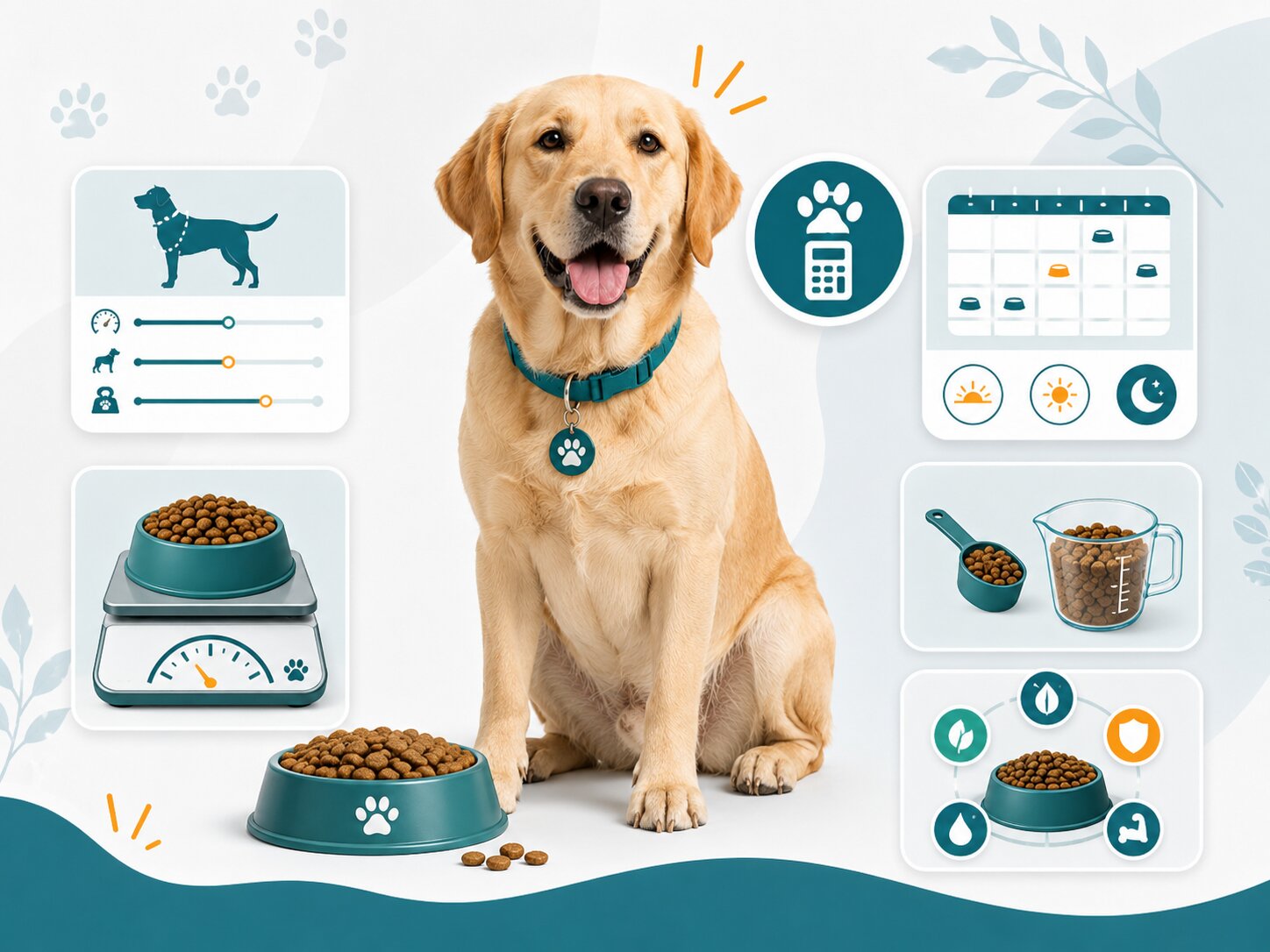
Beagle with food bowl — Dog Food Calculator & Label Checker
active

Dog Food Calculator & Label Checker

Estimate dog calories, portions, meal frequency, label quality, and nutrition red flags using age, weight, body condition, activity, and food-label details.

Pet food packs print a single feeding chart that assumes every dog at a given weight needs the same amount — it does not account for age, neuter status, activity level, body condition, or breed size, all of which can change daily calorie needs by 50% or more. This tool calculates your dog's resting and maintenance energy needs from published veterinary formulas, converts that into a portion size for your specific food, checks your current label against AAFCO adequacy standards, and flags anything that needs a vet's attention before you change anything.

Step 1 of 7

Tell us about your dog

10 weeks = 2.5 months. 6 months = 6.

Enables breed-specific notes where relevant.

How calorie, portion, and label results are calculated

The calculator starts with the Resting Energy Requirement (RER) — 70 × (body weight in kg)0.75 — the veterinary standard for estimating how many calories a dog burns at rest, per WSAVA and AAHA nutrition guidelines.

RER is then multiplied by a life-stage and activity band to estimate the Maintenance Energy Requirement (MER) — the calories your dog needs for daily life:

Neutered adult, normal activity
1.4–1.6 × RER
Intact adult, normal activity
1.6–1.8 × RER
Low activity / weight-prone
1.2–1.4 × RER
Active adult
1.6–2.0 × RER
Very active / working dog
2.0–2.5 × RER
Weight-loss plan (uses target weight)
0.8–1.0 × RER
Young puppy (under 3 months)
2.0–3.0 × RER

A breed size-class modifier is applied on top of this band — toy breeds ×1.08 and small breeds ×1.04 (proportionally higher metabolic rates), large breeds ×0.97 and giant breeds ×0.93 (proportionally lower) — reflecting documented metabolic-rate differences by size.

If you enter your food's calorie content (kcal per cup, can, or kilogram), the calculator reserves 10% of MER for treats and divides the remaining 90% by your food's calorie density to produce a daily and per-meal portion in cups, grams, and millilitres. Meal frequency follows life-stage rules — four meals a day for very young puppies, down to two for most adults and seniors, or three during a weight-loss plan. The label assessment checks the AAFCO nutritional adequacy statement and life-stage claim against your dog's profile, and safety gates flag urgent symptoms or conditions that need veterinary input before any dietary change.

Read the full methodology →

Worked example: Golden Retriever, 31.5 kg, neutered, normal activity

Here's how the calculator turns a dog's profile into a daily calorie target and food portion, step by step:

  1. RER = 70 × 31.50.75931 kcal/day.
  2. A neutered adult at normal activity uses a 1.4–1.6× RER multiplier band.
  3. Golden Retrievers are a large breed, so a ×0.97 size-class modifier is applied (large breeds have proportionally lower metabolic rates).
  4. Estimated daily target (MER) = 931 × 1.4 × 0.97 to 931 × 1.6 × 0.97 ≈ 1,264–1,445 kcal/day.
  5. With a dry kibble at 380 kcal/cup, 90% of MER (reserving 10% for treats) gives a daily portion of about 3.0–3.4 cups (≈710–804 ml), split into 2 meals/day.
Resting Energy Requirement (RER)
931 kcal/day
Estimated daily target (MER)
1,264–1,445 kcal/day
Daily portion (380 kcal/cup kibble)
3.0–3.4 cups (≈710–804 ml)
Per meal (2 meals/day)
1.5–1.7 cups
Treat budget (10% of MER)
126–145 kcal/day

Try it yourself: open the calculator above, enter an age of 48 months and a weight of 31.5 kg (69.4 lb), select Golden Retriever as the breed, normal activity, neutered, ideal body condition, and 380 kcal/cup on the food label step.

Switching to a new food safely

If the calculator's output prompts you to switch your dog to a different food — more protein-dense, lower calorie, or a different protein source — the transition needs to be gradual. A sudden food change causes digestive upset in most dogs regardless of food quality, because the gut microbiome has time to adapt.

← Scroll to see all columns →

7-day food transition protocol
DaysOld foodNew foodWhat to watch
Days 1–2 75%25%Normal stools, good appetite
Days 3–4 50%50%Any loose stools or gas
Days 5–6 25%75%Any vomiting or appetite changes
Day 7+ 0%100%Monitor for 48 hours after full switch

If your dog has a sensitive stomach, a history of food intolerance, or IBD, extend this to 10–14 days and spend more time at each stage. Signs that the transition is moving too fast: loose stools lasting more than 24 hours, repeated vomiting, or refusing the new food entirely. Slow down by 2–3 days at the current mix ratio before continuing.

For dogs with diagnosed allergies or on a prescription elimination diet, the transition protocol is different — follow your veterinarian's instructions rather than the general 7-day guideline above.

Frequently asked questions

How much should I feed my dog using this calculator?
Enter your dog's age, current weight, activity level, and (optionally) breed and body condition score. The calculator works out a daily calorie target — your dog's Maintenance Energy Requirement (MER) — using veterinary RER/MER formulas, then, if you add your food's calorie content from the label (kcal per cup, can, or kilogram), converts that into a daily and per-meal portion in cups, grams, and millilitres.
How is my dog's daily calorie need (RER and MER) calculated?
The calculator starts with Resting Energy Requirement (RER): 70 × (body weight in kg)^0.75. RER is then multiplied by a life-stage and activity band — for example 1.4–1.6× for a neutered adult at normal activity, 1.6–1.8× for an intact adult, or 2.0–3.0× for a young puppy — to get the Maintenance Energy Requirement, the estimated number of calories your dog needs per day. A breed size-class modifier (toy and small breeds slightly higher, large and giant breeds slightly lower) is applied on top of this band.
How do I know if my dog is at a healthy weight (body condition score)?
Body Condition Score (BCS) is a 1–9 scale based on how easily you can feel your dog's ribs, waist, and abdominal tuck — 4–5 is ideal. This calculator uses BCS to fine-tune feeding guidance, but for a full weight assessment, ideal-weight estimate, and weight-loss timeline, use the Dog Weight & Body Condition Checker (linked below).
What is the best way to help my dog lose weight safely?
If you select "Lose weight" as your goal and enter a target weight, the calculator switches to a 0.8–1.0× RER multiplier band based on your target weight (not current weight) and estimates a safe weight-loss timeline at 1–2% of body weight per week — the rate recommended in AAHA weight-management guidelines. It also recommends three measured meals per day during weight loss to support satiety. Always involve your veterinarian in a weight-loss plan, especially for dogs at BCS 8–9 or with any medical condition.
How do I read a dog food label and AAFCO statement?
The label step asks for your food's AAFCO nutritional adequacy statement ("formulated to meet," "substantiated by feeding trials," or "intermittent/supplemental use only"), its life-stage claim (growth, maintenance, all life stages, etc.), and calorie content. The calculator's label assessment then flags whether the product is complete and balanced and whether its life-stage claim matches your dog's current stage. For a deeper walkthrough of every part of a pet food label, see the reading pet food labels guide (linked below).
Does this calculator work for puppies and senior dogs?
Yes. Life stage is inferred from age in months, using expected adult weight for puppies of large and giant breeds, since they mature later. Puppies use higher multiplier bands — 2.0–3.0× RER for very young puppies, tapering down through adolescence — and 3–4 meals per day. Senior dogs typically use two meals per day, and the calculator adds a note about reduced calorie needs and the value of a veterinary nutrition check-in. See the senior dog care guide (linked below) for more on adjusting nutrition as dogs age.
How do I switch my dog to a new food without causing digestive upset?
Transition gradually over 7 days: 75% old / 25% new on days 1–2, 50/50 on days 3–4, 25% old / 75% new on days 5–6, then 100% new from day 7. Watch for loose stools, vomiting, or appetite refusal — any of these means slow down by 2–3 days at the current ratio before continuing. Dogs with sensitive stomachs, food intolerance, or IBD often need 10–14 days. Dogs on prescription elimination diets should follow their veterinarian's protocol instead.

Your next step

Once you have a calorie and portion estimate, check whether your dog's current weight and body condition are on track — get a target weight, energy budget, and a safe weight-loss timeline if needed.

Check weight & body condition →

Nutrition products from our partners

From trusted partners we work with. Our editorial recommendations remain independent.

Disclosure: Some links may be affiliate links. We only recommend products we believe are useful.
PupWiki Partner Garvee Top pick
Garvee Pet Food Cabinet with 2 Elevated Bowls, Dog Feeding Station, Brown, Ample Storage, Concealed Feeder, Flip-Top Design - Vintage

Garvee Pet Food Cabinet with 2 Elevated Bowls, Dog Feeding Station, Brown, Ample Storage, Concealed Feeder, Flip-Top Design - Vintage

Elevate your pet's dining experience with the GARVEE Pet Food Cabinet GARVEE Pet Food Cabinet: The Ultimate Feeding Station for Your Furry F…

View product → Sponsored
PupWiki Partner Garvee Top pick
Garvee Furniture Style Dog Crate with Pocket Hiding Door, Lockable End Table, Rustic Brown, Flip Top, 32” for Small Dogs - Vintage

Garvee Furniture Style Dog Crate with Pocket Hiding Door, Lockable End Table, Rustic Brown, Flip Top, 32” for Small Dogs - Vintage

Elegant and functional GARVEE Furniture Style Dog Crate with Pocket Hiding Door GARVEE Furniture Style Dog Crate: Comfort Meets Style Introd…

View product → Sponsored
PupWiki Partner Jugbow Top pick
Jugbow Pet Furniture 3-in-1 Pet Stairs with Storage for Beds & Sofas - Gray

Jugbow Pet Furniture 3-in-1 Pet Stairs with Storage for Beds & Sofas - Gray

3-in-1 Design: Functions as a dog ramp, hidden storage box, and a sturdy footstool to save space and add comfort to your home. Gentle 19° Sl…

View product → Sponsored
PupWiki Partner Jugbow Top pick
Jugbow Pet Furniture 3-in-1 Pet Stairs with Storage for Beds & Sofas - Yellow

Jugbow Pet Furniture 3-in-1 Pet Stairs with Storage for Beds & Sofas - Yellow

3-in-1 Design: Functions as a dog ramp, hidden storage box, and a sturdy footstool to save space and add comfort to your home. Gentle 19° Sl…

View product → Sponsored

Browse all in this category →

See something outdated, unclear, or incorrect? We welcome corrections — just send us the page URL, the issue, and a supporting source if available.

Submit a correction →
PupWiki Community Pulse

What would make the food guidance easier to act on?

Help improve PupWiki with one quick anonymous answer.

Early poll — results appear after enough real reader responses.

Browse all tools →