
Health information is educational only. Always consult your veterinarian.
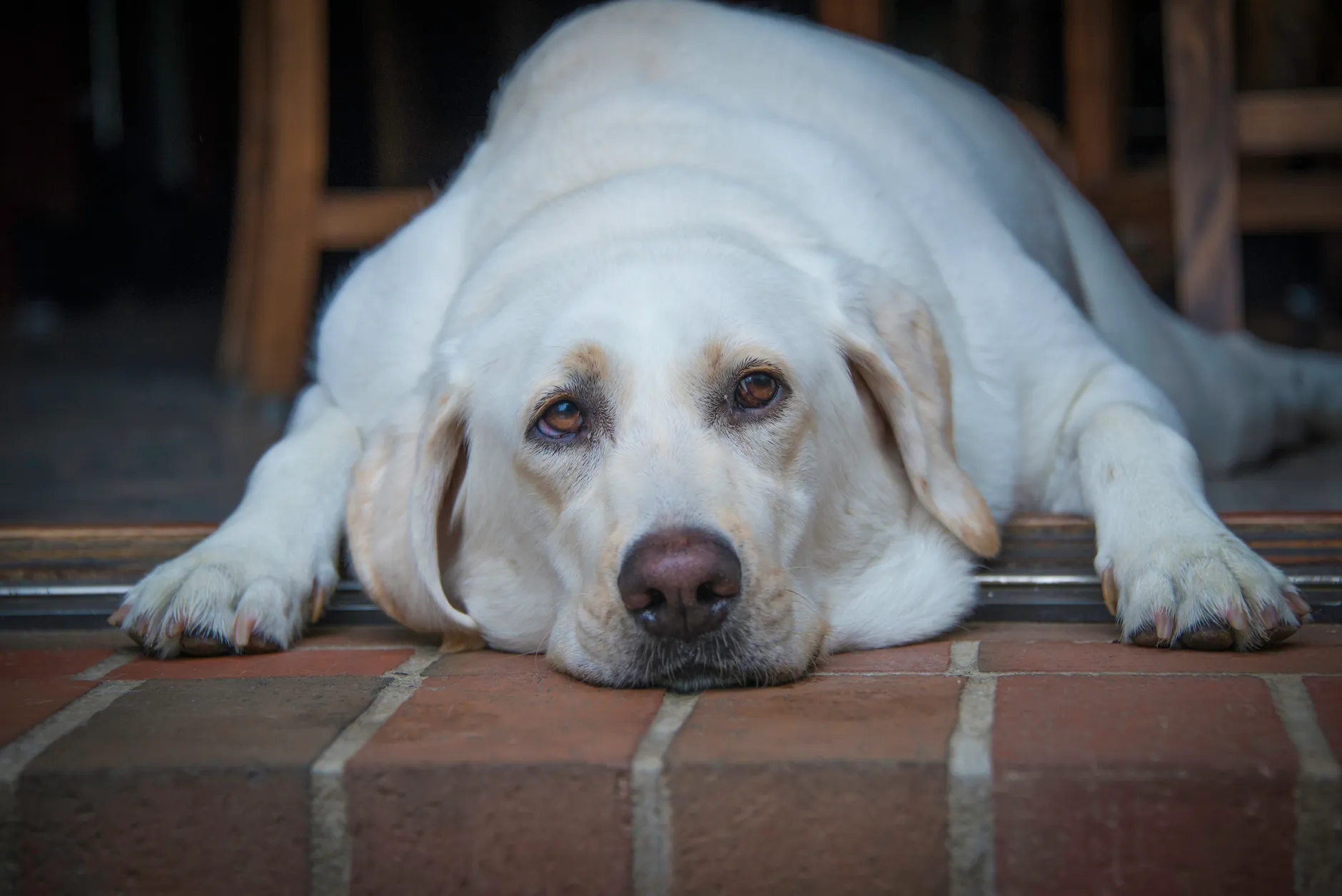
Canine obesity affects an estimated 50-60% of pet dogs in the United States and is widely recognised as the most common preventable health issue in companion animals. Carrying excess weight shortens lifespan, worsens joint disease, increases the risk of diabetes and certain cancers, and reduces quality of life in ways that accumulate gradually — making them easy to miss until the consequences are serious. The good news: unlike many health conditions, weight responds predictably to sustained changes in calorie balance, and even modest loss — as little as 6-8% of body weight — can produce measurable improvements in mobility, energy, and metabolic markers.
This guide walks through the evidence-based process step by step, from confirming your dog is actually overweight through calculating a safe calorie deficit, adjusting food and exercise, and tracking progress over time.
Is my dog actually overweight?
Weight alone is an unreliable indicator — a healthy weight for a 30 kg Labrador is very different from a healthy weight for a 30 kg Staffordshire Bull Terrier. The standard clinical tool is body condition score (BCS), a hands-on assessment that works for any dog regardless of breed or size. Most veterinary systems use a 1-9 scale, where 4-5 is ideal.
You can do a quick screening at home with five checks, all performed with your dog standing relaxed:
- Rib check. Place your hands flat on your dog's ribcage and press gently. You should feel individual ribs under a thin layer of fat without pressing hard. If you cannot feel them, or need firm pressure to find them, your dog is likely carrying excess weight.
- Waist view (from above). Looking down at your dog from above, there should be a visible narrowing behind the ribs. A profile that is straight or that bulges outward indicates excess weight.
- Abdominal tuck (from the side). Viewed from the side, the belly should angle upward from the ribcage toward the hind legs. A belly that hangs level with or below the chest line is a sign of excess fat.
- Fat deposits. Check the base of the tail, the neck, and the hips. Noticeable fat pads in these areas indicate a BCS of 7 or higher.
- Overall silhouette. An overweight dog often looks "barrel-shaped" from above and may have a visible waddle when walking.
Our dog weight and body condition checker walks through this assessment step by step and estimates a target weight range based on your dog's current condition. For a broader look at what causes weight gain and how to prevent it, see our dog weight management guide.
Why rapid weight loss is dangerous
It is tempting to cut calories aggressively to get results faster, but rapid weight loss in dogs carries real risks. The American Animal Hospital Association (AAHA) recommends a target rate of 1-2% of body weight per week — for a 30 kg dog, that is roughly 300-600 g (0.7-1.3 lb) per week.
Losing weight faster than this target risks three specific problems:
- Muscle wasting. When calorie restriction is too severe, the body breaks down lean muscle for energy alongside fat — and muscle loss reduces metabolic rate, making future weight management harder, not easier.
- Nutrient deficiency. Cutting food volume dramatically reduces the intake of essential vitamins, minerals, and fatty acids. Dogs on very low-calorie diets for extended periods can develop deficiencies even when eating a nutritionally complete food, because the total volume consumed is too small to meet minimum requirements.
- Hepatic stress. In some dogs — particularly overweight small breeds and cats (though dogs are lower risk) — rapid fat mobilisation can stress the liver. This is uncommon in dogs but is one reason veterinary supervision is recommended for dogs that need to lose more than 15-20% of their starting weight.
The 1-2% per week rate is deliberately gradual. It preserves muscle mass, allows the body to adapt metabolically, and is far more sustainable over the weeks or months a meaningful weight-loss programme typically takes.
Step 1 — Vet check before changing diet
Before reducing your dog's calories, a veterinary check is essential — not optional. Several medical conditions cause weight gain or make weight loss difficult regardless of calorie intake, and starting a diet plan without ruling them out wastes time and can mask treatable conditions:
- Hypothyroidism. One of the most common hormonal disorders in dogs, particularly in middle-aged and older medium-to-large breeds. It lowers metabolic rate, causing weight gain even on a normal calorie intake. A simple blood test confirms or rules it out, and treatment with daily thyroid hormone replacement is straightforward and inexpensive.
- Cushing's disease (hyperadrenocorticism). Excess cortisol production causes a characteristic pattern of weight gain (especially abdominal), increased hunger and thirst, and muscle weakness. More common in older small breeds. Requires specific treatment — dietary restriction alone will not resolve it.
- Medication side effects. Corticosteroids (prednisone, prednisolone) and some anti-seizure medications increase appetite and promote weight gain. If your dog is on long-term medication and gaining weight, the vet may be able to adjust the dose or suggest alternatives.
"Just feed less" may not work if any of these factors is present. At the vet visit, ask for:
- A body condition score assessment (to establish a baseline BCS, not just a weight number)
- A target weight range (based on your dog's breed, frame, and condition)
- Thyroid screening if the dog is middle-aged or older, or if weight gain has been sudden
- A daily calorie target for safe weight loss (your vet may recommend a specific weight-management food)
Step 2 — Calculating your dog's calorie deficit
Weight loss requires a sustained calorie deficit — your dog eating fewer calories than it burns each day. The standard veterinary recommendation is to reduce daily intake by 20-25% below maintenance MER (maintenance energy requirement). This produces the target 1-2% weekly weight loss for most dogs without the risks of more aggressive restriction.
The calculation starts with your dog's resting energy requirement (RER), which is the baseline energy a dog needs at complete rest:
RER = 70 x (body weight in kg)0.75
MER is then calculated by multiplying RER by an activity and life-stage factor. For weight loss, the standard approach is to feed at the RER for the dog's target weight (not its current weight), which naturally creates the deficit.
Worked example: a 35 kg overweight dog with a target of 30 kg
- Calculate RER at target weight: 70 x 300.75 = 70 x 12.82 = 897 kcal/day
- Apply a weight-loss factor of 1.0x RER (conservative starting point recommended by many veterinary nutritionists): daily target = 897 kcal/day
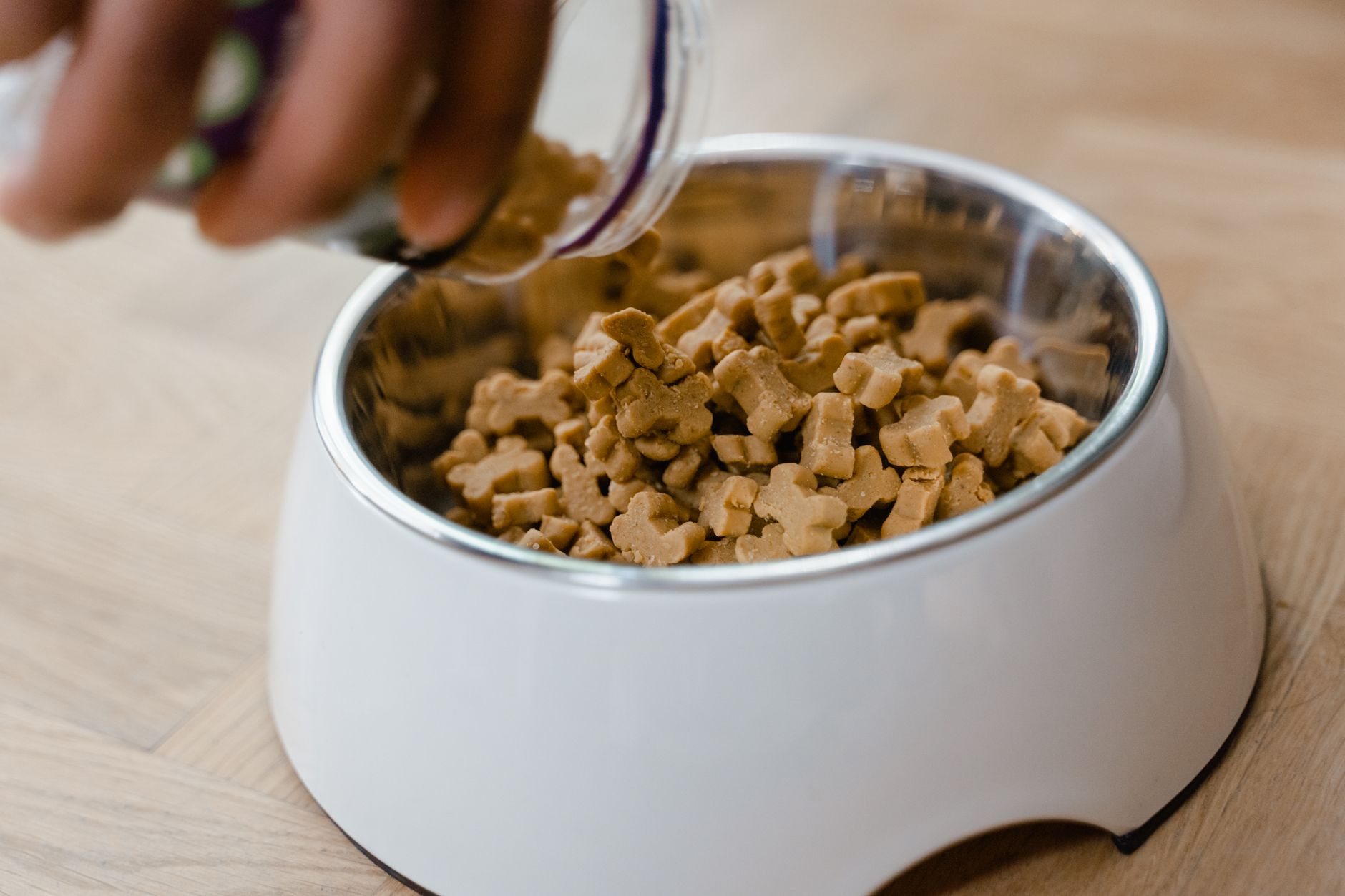
- Include treats in that budget: if treats account for 10% of daily calories (the recommended maximum), that leaves 807 kcal from meals and up to 90 kcal from treats
- Convert to food portions: if the dog's food provides 350 kcal per cup, the daily meal allowance is approximately 2.3 cups, split across 2-3 meals
Our dog food calculator automates this entire calculation — enter your dog's current weight, target weight, activity level, and food calorie density, and it returns a daily portion in cups, grams, and calories with the deficit already built in.
Recalculate every 4-6 weeks as weight drops. A calorie allowance that produces loss at 35 kg will eventually become a maintenance amount as the dog approaches 30 kg — the plan needs periodic adjustment, not a single fixed number for the entire process.
Step 3 — Food strategy
How you feed matters almost as much as how much you feed. These strategies help maintain satiety and nutrition while staying within the calorie budget:
- Low-calorie volume fillers. Adding cooked green beans, plain canned pumpkin (not pie filling), carrots, or cucumber to meals increases the physical volume of food without adding significant calories. Many dogs find larger meals more satisfying even when the calorie content is the same. Start with a small amount (a tablespoon for small dogs, 2-3 tablespoons for large dogs) and increase gradually to avoid digestive upset.
- High-protein, lower-fat formulas. Protein is more satiating per calorie than carbohydrates or fat, and it helps preserve lean muscle during a calorie deficit. Veterinary weight-management diets are typically formulated with higher protein-to-calorie ratios for exactly this reason. If switching foods, transition gradually over 7-10 days.
- Meal frequency: 2-3 times daily. Splitting the daily allowance into 2-3 meals (rather than one large meal) helps regulate blood sugar and reduces the urgency of begging behaviour. Some dogs do well with 3-4 even smaller meals. The total daily amount stays the same — only the distribution changes.
- Measuring cups vs. estimates. "A scoop" varies enormously depending on the scoop and how it is filled. Use a kitchen scale (grams) or a standardised measuring cup filled level, not heaped. Weighing food is more accurate than volume measurement because kibble density varies between brands.
- Treat budgeting: max 10% of daily calories. Treats, dental chews, and table scraps should come out of the daily calorie budget, not be added on top of it. A single medium-sized commercial treat can be 20-40 calories — for a small dog on a 500-calorie daily target, 4-5 treats could consume the entire treat budget. Break treats into smaller pieces (dogs respond to frequency, not size) or substitute low-calorie options like small pieces of carrot or apple.
For a deeper look at reading food labels, understanding calorie density, and comparing foods, see our guide to reading pet food labels.
Step 4 — Exercise plan
Exercise alone rarely produces meaningful weight loss in dogs — a 30-minute walk for a medium-sized dog burns roughly 100-150 calories, the equivalent of a small handful of kibble. But exercise is a critical complement to dietary changes: it preserves muscle mass during a calorie deficit, improves cardiovascular fitness, supports joint health, and helps with appetite regulation and behaviour.
The key principle is gradual increase. An overweight dog that has been relatively sedentary should not start with hour-long hikes:
- Start with 10-minute increments. If your dog currently walks 15 minutes, add 5-10 minutes per walk and hold at that level for a week before increasing again. Watch for signs of fatigue, heavy panting, or reluctance to continue.
- Breed-appropriate activity. A Labrador can build up to longer walks and swimming relatively quickly. A Bulldog or Pug needs shorter, cooler sessions with more rest breaks. Brachycephalic breeds are at higher risk of overheating and breathing difficulty during exercise — keep sessions moderate and avoid hot weather entirely.
- Swimming for joint-safe exercise. For dogs with arthritis or significant joint loading from excess weight, swimming or underwater treadmill therapy (available at some veterinary rehabilitation centres) provides cardiovascular exercise with minimal joint impact. Not all dogs are natural swimmers — introduce water gradually and never force it.
- Mental enrichment counts. Food puzzles, scent work, and training sessions burn calories and reduce boredom-driven begging. These are particularly valuable for dogs with mobility limitations that restrict physical exercise.
Our dog exercise and enrichment guide covers breed-appropriate activity levels, enrichment ideas, and how to build fitness safely at any starting point.
Tracking progress
Consistent tracking is what separates a plan that works from one that stalls after two weeks. The goal is not to obsess over daily fluctuations but to confirm a downward trend over weeks and adjust when it flattens:
- Monthly weigh-ins on the same scale. Weigh your dog every 2-4 weeks, at the same time of day, on the same scale. Most veterinary clinics allow you to use their walk-on scale for free — call ahead. Home bathroom scales work for smaller dogs (weigh yourself holding the dog, then weigh yourself alone, and subtract).
- BCS re-assessment every 4 weeks. Weight alone does not tell the full story — a dog that is gaining muscle while losing fat may not show dramatic scale change, but the body condition will visibly improve. Re-do the rib check, waist view, and tuck assessment each month.
- Adjust if losing too fast. If weight loss exceeds 2% per week consistently, increase the daily calorie allowance by 10-15%. Losing too fast risks muscle wasting and is often followed by a rebound.
- Adjust if losing too slowly. If there is no measurable loss after 4 weeks of accurate tracking (including all treats, chews, and extras), reduce the daily allowance by a further 10% or consult your vet about switching to a lower-calorie food. Confirm that everyone in the household is following the same plan — untracked treats from other family members are the most common reason plans stall.
- When to re-consult your vet. Go back to the vet if: the dog shows no progress after 6 weeks despite accurate calorie tracking; the dog is losing weight faster than expected without a clear explanation; you notice lethargy, coat changes, increased thirst, or muscle loss alongside the weight-loss programme; or the dog reaches its target weight and you need a maintenance calorie plan.
Keep a simple log — date, weight, BCS estimate, daily calorie allowance, and any notes (e.g. "increased walk to 25 min" or "switched from kibble X to kibble Y"). This is invaluable if you need to consult your vet about a stall, because it shows exactly what has been tried.
Disclaimer: This guide reflects general veterinary consensus on canine weight management as of 2026 and is intended for educational purposes only. It is not a substitute for veterinary advice. Individual dogs may have specific health conditions, metabolic differences, or medication interactions that affect weight-loss planning. Always consult your veterinarian before making significant changes to your dog's diet or exercise routine.
Frequently asked questions
- How long does it take a dog to lose weight?
- It depends on how much weight needs to come off and the rate of loss. At the recommended 1-2% of body weight per week, a 35 kg dog that needs to lose 5 kg would take roughly 7-14 weeks. Some dogs reach their target sooner; others — especially those with lower metabolic rates, older dogs, or dogs on medication — may take longer. The key is consistency rather than speed. Weigh your dog every 2-4 weeks and adjust the calorie allowance as weight drops, because the calories needed to sustain loss decrease as the dog gets lighter.
- Can I just feed my dog less of their regular food?
- Simply reducing the amount of existing food can work for mild cases, but it has limits. Cutting portions by more than about 20-25% risks leaving your dog short on essential vitamins, minerals, and protein — you are reducing nutrients alongside calories. For dogs that need to lose a significant amount of weight, a veterinary-formulated weight-management food is often a better approach: these are designed to be lower in calories but still nutritionally complete, and they tend to be higher in fibre and protein so the dog feels fuller on fewer calories.
- What foods help dogs lose weight?
- Low-calorie, high-fibre additions can help increase meal volume without adding significant calories. Cooked green beans, plain canned pumpkin (not pie filling), carrots, and cucumber are commonly used as fillers. Veterinary weight-management diets are formulated to be lower in fat and higher in fibre and protein relative to standard foods. Avoid "light" or "healthy weight" marketing labels without checking the actual calorie density (kcal per cup or per 100 g) — the label alone does not guarantee the food is meaningfully lower in calories than your dog's current food.
- Is exercise enough to help my dog lose weight?
- Exercise alone rarely produces meaningful weight loss in dogs. A 30-minute walk for a medium-sized dog burns roughly 100-150 calories — the equivalent of a small handful of kibble. Diet is responsible for the vast majority of weight-loss results, and exercise supports it by maintaining muscle mass, improving cardiovascular fitness, and helping with appetite regulation. The most effective approach combines a calculated calorie deficit with gradually increasing activity, rather than relying on either one in isolation.
- What if my dog is still hungry on a diet?
- Persistent hunger is common and does not mean the plan is wrong — dogs are hardwired to seek food regardless of actual energy needs. Several strategies can help: split the daily allowance into 3-4 smaller meals instead of 2 to spread satisfaction across the day, use food puzzles and slow feeders to extend mealtime, add low-calorie bulk like green beans or pumpkin to meals, and redirect begging behaviour with a walk or play session rather than food. If hunger seems severe or your dog is losing weight faster than 2% per week, consult your vet — the calorie target may be too aggressive.
- When should I worry that weight loss is not working?
- If your dog has been on an accurately tracked calorie-restricted plan for 4-6 weeks with no measurable weight loss, consult your veterinarian. Conditions such as hypothyroidism and Cushing's disease can cause weight gain or prevent loss independent of calorie intake. Similarly, if your dog is losing weight faster than 2% of body weight per week, losing muscle mass rather than fat (visible loss of muscle along the spine or hind legs), or showing signs like lethargy, coat changes, or increased thirst alongside the weight-loss plan, a veterinary check is needed to rule out underlying issues.


