

The health information on PupWiki is for educational purposes only and does not constitute veterinary medical advice, diagnosis, or treatment. Always seek the guidance of a licensed veterinarian with any questions you may have regarding your dog's health or a medical condition.
Your dog sees another dog on the other side of the street and erupts — lunging, barking, spinning at the end of the leash. The walk you imagined as a pleasant outing becomes a white-knuckle ordeal. This is leash reactivity, and it is one of the most common reasons dog owners seek professional help. It is also one of the most misunderstood. Reactivity is not aggression, disobedience, or a sign that your dog is "bad." It is an emotional response — and emotional responses can be changed.
What reactivity actually is
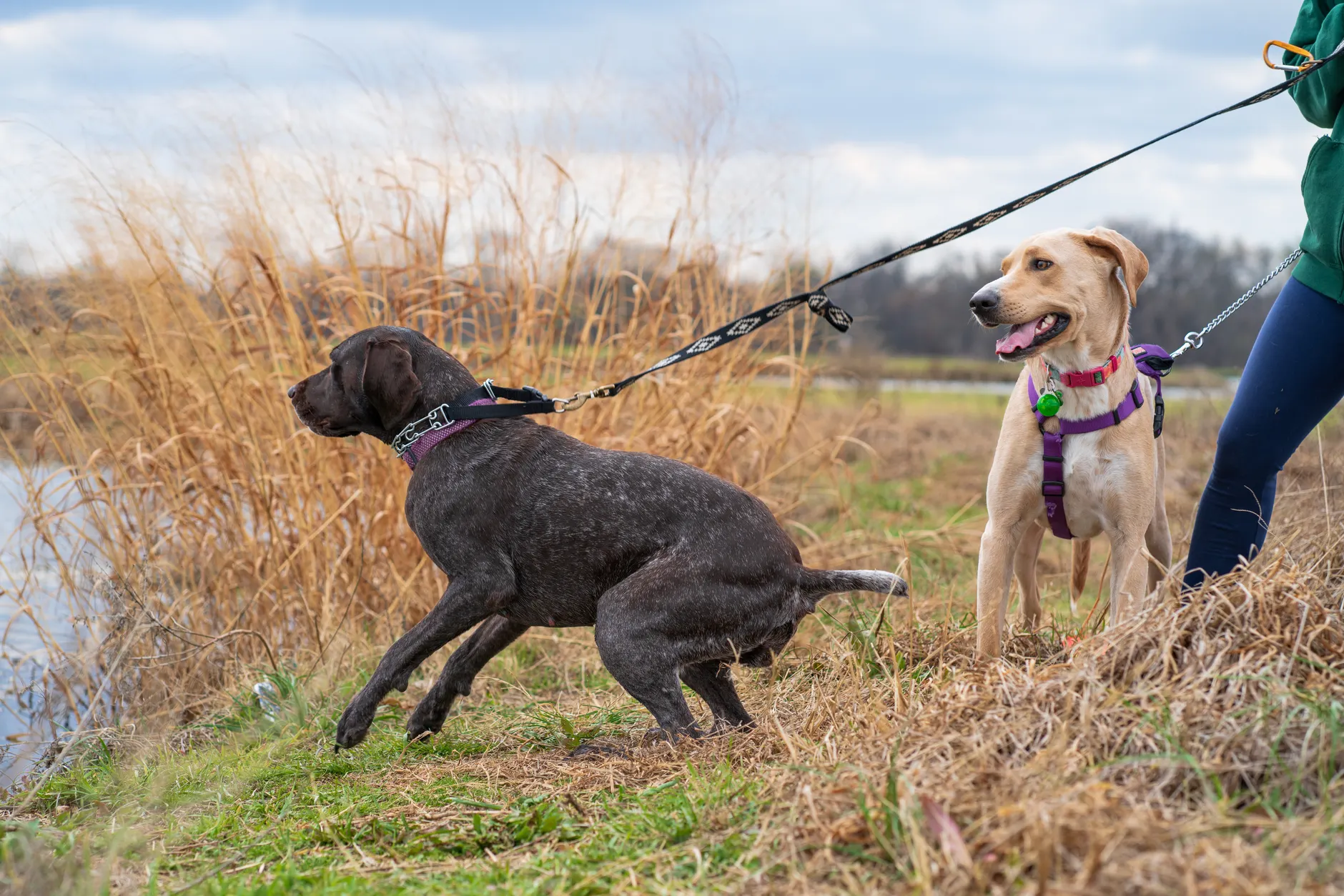
Reactivity describes an exaggerated emotional and behavioural response to a specific trigger — typically other dogs, unfamiliar people, bikes, skateboards, or vehicles. The outward behaviour (lunging, barking, growling, hackling) looks dramatic, but the behaviour itself is a symptom. The underlying cause is an emotional state that the dog cannot regulate in the moment.
The leash is a critical factor. Many reactive dogs are calmer off-leash because they can choose their own distance. On-leash, the dog cannot flee, cannot create space, and feels trapped. The leash converts a dog that would have moved away into a dog that lunges forward — because when flight is impossible, the remaining options are freeze, fidget, or fight. Most leash reactivity is the "fight" response in a dog that would prefer flight.
Fear-based vs frustration-based reactivity
Distinguishing the motivation behind the reaction matters because the training approach differs.
Fear-based reactivity
The dog is frightened of the trigger and wants it to go away. The body language before the reaction typically includes weight shifted backward, ears pinned, lowered body posture, lip-licking, or whale eye (showing the whites of the eyes). The explosion of barking and lunging is a defensive display: "Stay away from me." When the trigger moves away, the dog calms relatively quickly. Fear-based reactivity is common in under-socialized dogs, dogs with negative experiences (attacked by another dog, frightened by a cyclist), and dogs with a generally anxious temperament.
Frustration-based reactivity
The dog wants to reach the trigger — usually another dog — and the leash prevents it. The body language is forward-leaning, tail up or wagging rapidly, high-pitched barking or whining, and intense focus on the trigger. This dog is not scared; it is frustrated that the leash is preventing social access. Frustration-based reactivity is common in adolescent dogs, highly social breeds, and dogs whose early leash walks always included on-leash greetings (which taught them to expect access to every dog they see).
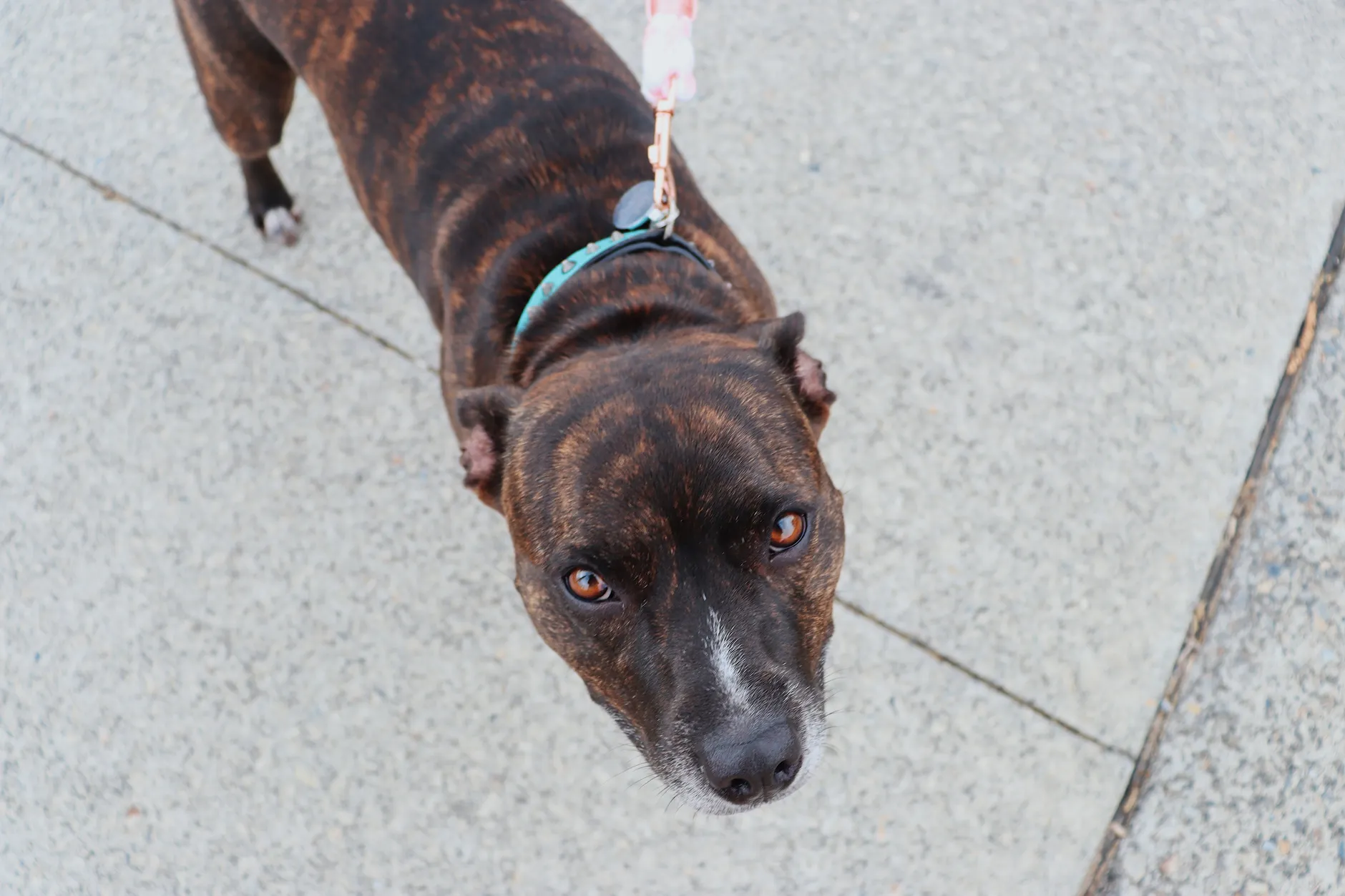
Management: the foundation of all reactivity work
Before you begin any training protocol, you need to manage the dog's environment to prevent reactions from rehearsing. Every over-threshold reaction strengthens the behaviour. Management is not a fix — it is what keeps the problem from getting worse while you work on the actual fix.
Know your dog's threshold distance
Threshold is the distance at which your dog notices a trigger but can still respond to you — take a treat, look at you, follow a cue. For some dogs, this is 50 feet. For others, it is two blocks. Finding your dog's threshold requires observation: walk toward a trigger and note the exact moment the dog's body stiffens, ears perk forward, or breathing changes. That is the edge of the threshold. Training happens below it.
Route planning
Map your walks to minimize surprise encounters. Walk at off-peak times. Know where you can create distance quickly — driveways to step into, side streets to turn down, parked cars to duck behind. Reactive dog owners become expert route planners out of necessity, and this is not avoidance — it is responsible management that protects your training progress.
Equipment for management
- Front-clip harness: Redirects forward momentum without applying pressure to the throat. Essential for reactive dogs who lunge.
- 6-foot fixed leash: Provides consistent boundaries. Never use a retractable leash with a reactive dog — the variable length creates unpredictable tension and eliminates your control.
- Treat pouch with high-value rewards: You need treats available instantly. Real chicken, cheese, or liver — not kibble. The reward must compete with the emotional intensity of the trigger.
- Basket muzzle (if appropriate): For dogs with a bite history or high-intensity reactions, a well-fitted basket muzzle conditioned positively over several weeks provides safety for everyone. A dog can pant, drink, and take treats through a basket muzzle. It is a safety tool, not a punishment.
Counter-conditioning and desensitization: changing the emotional response
Management prevents reactions. Counter-conditioning and desensitization (CC/DS) change how the dog feels about the trigger. This is the core of all evidence-based reactivity work.
Classical counter-conditioning
The principle is simple: the trigger predicts something wonderful. Dog appears at a distance → high-value treats rain from the sky. Dog disappears → treats stop. Over many repetitions, the dog's emotional response shifts from "that thing is scary/frustrating" to "that thing means chicken happens." This is not bribing the dog to behave — it is changing the underlying emotional association at a neurological level. The same mechanism that created the fear can create a positive association.
The critical requirement is that the dog must be below threshold. If the dog is already reacting, it is too aroused to form new associations. You are too close. Increase distance, try again.
Desensitization through graduated exposure
Start at a distance where the dog notices the trigger but remains calm. Over sessions (days and weeks, not minutes), gradually decrease the distance. Each step should be small enough that the dog can succeed. If the dog reacts, you moved too fast — return to the previous distance where the dog was successful and stay there longer before progressing.
Practical session structure
- Find a location where triggers are predictable (outside a dog park fence, across from a busy walking path).
- Position yourself at your dog's threshold distance or beyond.
- When a trigger appears: immediately begin feeding high-value treats, one every 1 to 2 seconds, for as long as the trigger is visible.
- When the trigger disappears: treats stop.
- Repeat for 10 to 15 minutes. End the session while the dog is calm and successful.
- Over subsequent sessions, close the distance by 5 to 10 feet at a time, only when the dog shows consistent relaxation at the current distance.
Why punishment makes reactivity worse
Leash corrections, e-collars, prong collars, and verbal scolding may suppress the outward behaviour temporarily, but they worsen the underlying emotional state. Here is the chain of events:
- The dog sees another dog (trigger).
- The dog feels fear or frustration (emotion).
- The dog lunges and barks (behaviour).
- The owner delivers a leash correction (punishment).
- The dog now has a new association: other dogs predict both fear AND pain.
- The next time the dog sees another dog, the emotional response is stronger, not weaker.
The dog may eventually learn to suppress the lunging and barking to avoid the correction, but the fear or frustration has not changed — it has intensified. These dogs often become "unpredictable" because they have learned to hide warning signals, and they may eventually bite without the warning sequence that is normal in dog communication.
When medication supports training
For dogs with moderate to severe reactivity, behavioural medication prescribed by a veterinarian or veterinary behaviorist can reduce baseline anxiety enough for the dog to learn. Medication does not sedate the dog or change its personality. Daily medications like fluoxetine or sertraline lower the anxiety floor so that counter-conditioning can work — the dog can stay below threshold at distances where it previously could not.
Medication is not a standalone treatment and is not a sign of failure. It is a tool that makes behavioural work more effective, just as glasses make it possible to read a book. If your dog cannot take treats, cannot disengage from triggers even at great distances, or is so anxious on walks that neither of you can function, ask your veterinarian about a medication evaluation.
This guide provides educational information about reactivity management. Medication decisions should always be made with a veterinarian who knows your dog. This is not medical advice.
When to seek professional help
Mild reactivity (occasional barking at distant triggers, recovers quickly, no aggression history) can often be managed with the strategies in this guide. Seek professional help if any of the following apply:
- Your dog has bitten or made contact with another dog, person, or animal.
- The intensity of reactions is escalating over time, not improving.
- Your dog cannot recover from a reaction within 30 seconds of the trigger leaving.
- Reactivity occurs toward multiple trigger types (dogs, people, bikes, sounds).
- You feel unsafe holding the leash during reactions.
- You have been working on management and counter-conditioning for 6 to 8 weeks with no measurable improvement.
For cases involving a bite history or escalating intensity, a veterinary behaviorist (DACVB) is the appropriate professional — not just a trainer. They can assess for medical contributors, prescribe medication if needed, and design a treatment plan calibrated to severity. Your regular veterinarian can provide a referral.
Frequently asked questions
- Is my reactive dog aggressive?
- Not necessarily. Reactivity and aggression are related but distinct. Reactivity is an outsized emotional response to a trigger — lunging, barking, and pulling on the leash — that is usually driven by fear or frustration. Many reactive dogs have no intention of harming the trigger; they are trying to increase distance from it (fear-based) or decrease distance to it (frustration-based). However, reactivity can escalate into aggression if the dog is pushed past its threshold repeatedly, which is why early management matters. If your dog has made contact with or bitten another dog or person, consult a veterinary behaviorist.
- What does "threshold" mean in reactivity training?
- Threshold is the distance at which your dog notices a trigger but can still make choices — look at it, look away, take a treat, respond to a cue. Below threshold, the dog can learn. Over threshold, the dog is in a reactive state (lunging, barking, unable to disengage) and learning shuts down. All effective reactivity work happens below threshold. If your dog is reacting, you are too close. The critical skill for owners is learning to recognise the moment before the reaction starts — body stiffening, ears forward, weight shifting forward — and creating distance before it escalates.
- Will my dog grow out of reactivity?
- No. Reactivity does not resolve on its own and typically worsens over time without intervention, because every reaction rehearsal strengthens the neural pathway. Each time the dog lunges and the trigger moves away (which happens naturally — the other dog walks past), the dog learns that lunging "works." Adolescent-onset reactivity (6 to 18 months) can improve with maturity combined with active management, but maturity alone is not a reliable treatment plan.
- Can I use a prong collar or e-collar to stop leash reactivity?
- This is strongly discouraged by veterinary behavior professionals including AVSAB. Aversive tools may suppress the outward behaviour (the lunging and barking) but do not change the underlying emotional state (fear or frustration). Worse, they create a new association: the trigger now predicts pain as well as fear, which typically increases the emotional response over time. Dogs trained with aversive methods for reactivity show higher cortisol levels and more avoidance behaviour in controlled studies. Reward-based counter-conditioning changes how the dog feels about the trigger, which is the only path to durable improvement.
- Should I avoid all triggers while working on reactivity?
- Avoid uncontrolled trigger exposure, but do not avoid triggers entirely. The goal is controlled sub-threshold exposure where the dog can see the trigger at a distance where it remains calm, paired with positive experiences (high-value treats, play). Complete avoidance prevents the dog from learning that triggers can predict good things. The key distinction is the difference between management (preventing over-threshold reactions in daily life) and training (deliberate, sub-threshold exposure with counter-conditioning).
- How long does it take to improve leash reactivity?
- With consistent management and structured counter-conditioning sessions 3 to 5 times per week, most dogs show measurable improvement in 4 to 8 weeks — meaning the distance at which they can remain calm decreases noticeably. Reliable behaviour change in previously high-reactivity dogs typically takes 3 to 6 months. Dogs with severe reactivity, multiple triggers, or a long reinforcement history may take longer and often benefit from behavioural medication alongside training.
- What is the difference between BAT and LAT for reactivity?
- BAT (Behaviour Adjustment Training, developed by Grisha Stewart) uses the dog's natural behaviour — sniffing, looking away, moving away from the trigger — as the reinforcer. The dog learns that calm choices result in distance or freedom. LAT (Look At That, from Leslie McDevitt's Control Unleashed) teaches the dog to look at the trigger and then look back at the handler for a treat, turning the trigger into a cue for engagement rather than reaction. Both are effective. LAT is often easier for beginners because the handler controls the reinforcement (treats). BAT requires more skill in reading the dog but can produce faster results because it uses the dog's own coping mechanisms.


