
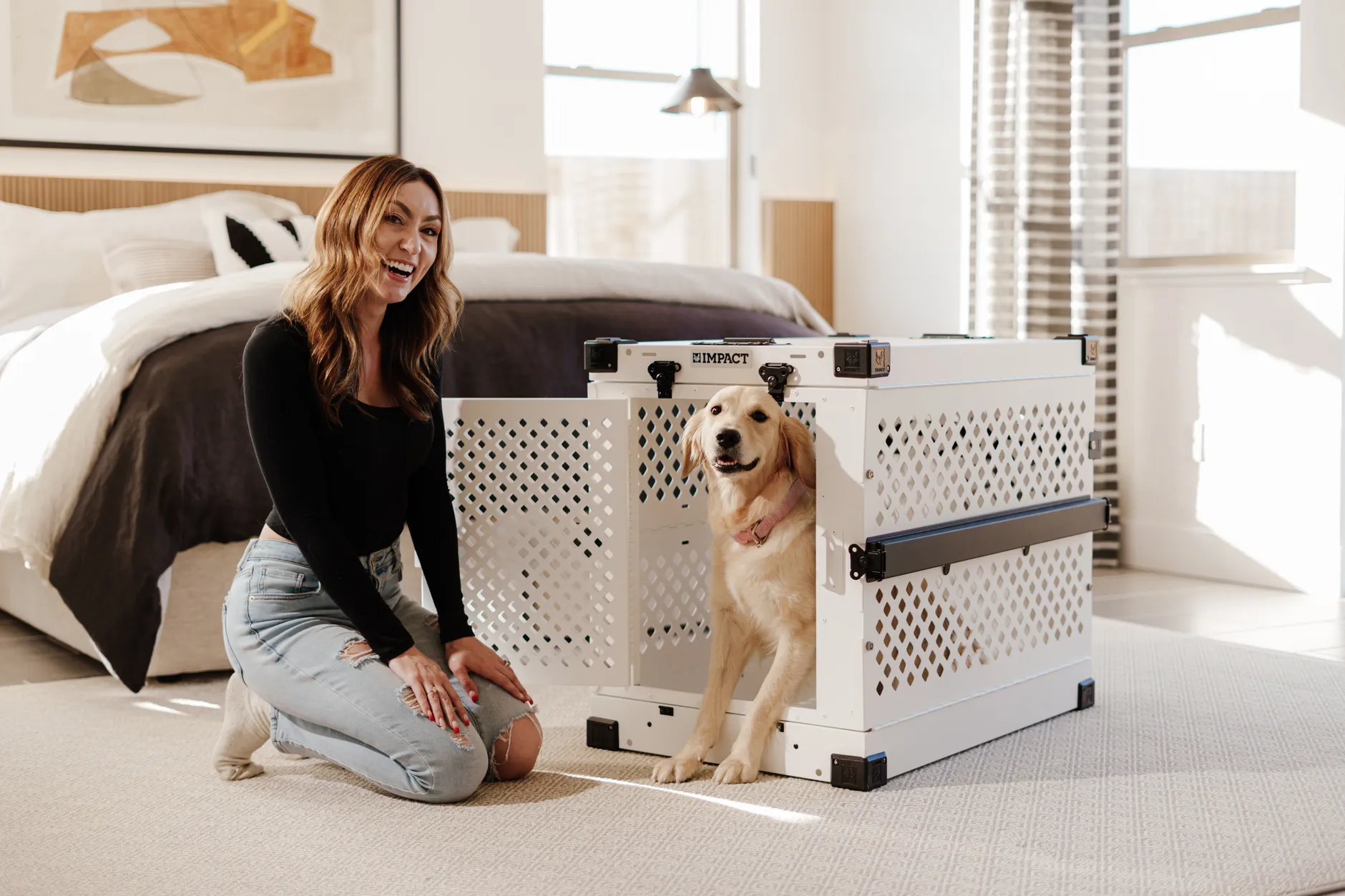
A crate, introduced correctly, becomes one of the most valuable tools in a dog owner's toolkit: a safe, predictable den that reduces anxiety, aids housetraining, and gives the dog a space of their own. Introduced badly, it becomes a source of fear. The difference is almost entirely in the method and the pace.
Why crate training works
Dogs are not naturally den animals in the strict ethological sense, but they do show a strong behavioural preference for resting in enclosed, covered spaces — under tables, behind sofas, in corners. A crate leverages this preference by providing a defined, bounded space that the dog comes to associate with safety and rest.
The most important principle is that the crate is never a punishment. The moment a crate is used to confine a dog after a scolding, it acquires negative associations that can take weeks to undo. From the dog's perspective, the crate should be one of the best places in the house — a location where good things consistently happen and where they are never disturbed.
For puppies, crate training serves an additional function: dogs instinctively avoid soiling their sleeping area, which means a correctly sized crate becomes a powerful housetraining aid. The puppy learns to hold their bladder because they do not want to soil their sleeping space — this creates the physiological urgency that drives them to signal and eventually to hold for increasing periods.
For adult dogs, particularly new rescues, a crate provides a consistent safe haven in an unfamiliar environment. Many dogs in new homes are overstimulated during the adjustment period; a crate gives them a low-stimulation space to decompress. This is not isolation — it is structure.
Choosing the right crate
Three main crate types are widely available, each with different applications:
Wire crates
The most versatile option for most homes. Provide excellent ventilation, allow the dog to see their surroundings, and fold flat for storage. Most come with a divider panel that allows you to reduce the interior size for a puppy and expand it as they grow — avoiding the need to buy multiple crates. The open design can feel less den-like for some dogs; a blanket draped over three sides addresses this. Wire crates are the preferred choice for housetraining because the dog can see you and remain visually connected to the household.
Plastic travel crates
The enclosed, den-like design suits dogs who prefer a darker, more enclosed space. They are airline-approved for cargo travel and durable for car use. The main disadvantage is reduced airflow in warm conditions and the inability to adjust size — you buy for the adult size and either buy a smaller one for puppyhood or block off the back with a divider. Good for dogs who show a strong preference for burrowing or enclosed sleeping spots.
Soft-sided crates
Lightweight and portable, suitable for travel, shows, or dogs who are already fully crate-trained and calm in confinement. Not appropriate for dogs who are still learning to accept the crate, for dogs who scratch or bite at enclosures, or for puppies who have not yet established reliable crate manners. A determined dog can destroy a soft crate quickly; use only once the crate is genuinely a place the dog wants to be.
Sizing: the single most important variable
The crate must be large enough for the dog to stand up fully without crouching, turn around in a complete circle, and lie flat on their side with legs extended. Nothing more. A crate that is too large undermines housetraining — the dog can soil one end and sleep comfortably at the other, eliminating the natural deterrent of sleeping area proximity.
For a puppy, use the divider panel to limit usable space to the appropriate size for their current body, expanding the divider every few weeks as they grow. If buying a single crate sized for the adult dog, block off the rear immediately. Oversize = housetraining setbacks that are entirely preventable.
Setting up the crate
Where you place the crate and how you equip it both influence how quickly a dog accepts it.
Location
Place the crate in a room where the family spends a significant amount of time — the living room or kitchen, rather than a spare room or utility space. Dogs are social animals and will resist a crate that isolates them from household activity. During the introduction phase, the dog should be able to see people moving around while resting in the crate. Once the dog is comfortable, you can add a second crate in the bedroom for overnight use, or move a single crate between locations as needed.
Avoid placing the crate in direct sunlight, near heat sources, or in draughty locations. Temperature regulation matters — an overheated or cold crate will never become a preferred resting spot.
Bedding
Line the crate with absorbent, washable bedding. For puppies who are still housetrained, avoid thick or expensive bedding until accidents are reliably under control. Fleece liners are practical — they absorb moisture, dry quickly, and are easy to launder. An unwashed item of clothing with the owner's scent can help during the first nights. Do not use elevated beds inside the crate for puppies who mouth and chew.
Cover options
Many dogs settle faster in a covered crate. A dedicated crate cover or a large blanket draped over the top and three sides, leaving the front door visible, creates a den-like environment with reduced visual stimulation. Observe whether your dog seems more or less settled with the cover — some dogs prefer open sides, particularly in warm weather. Never cover a crate so completely that airflow is restricted.
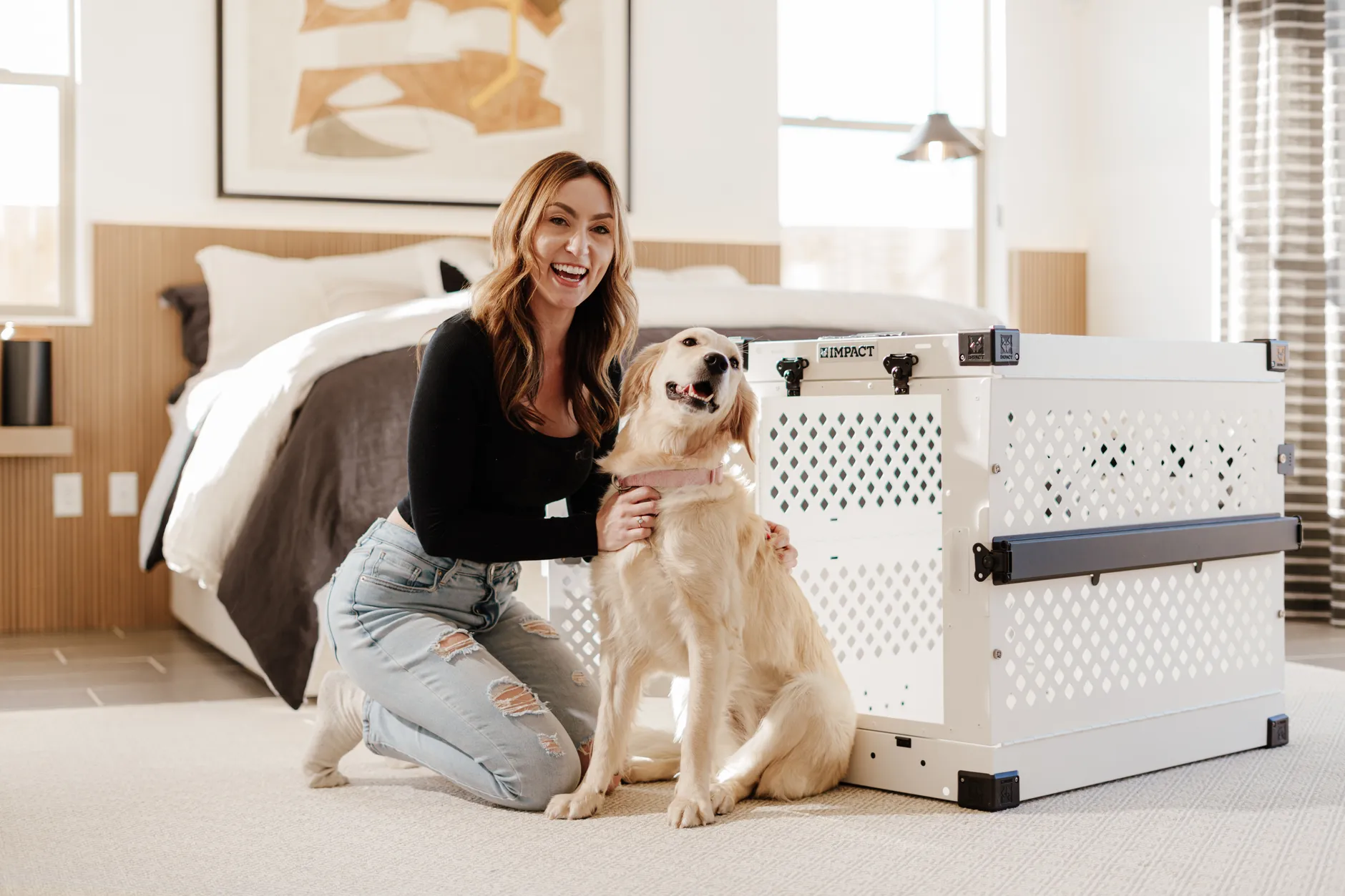
Step-by-step introduction protocol
Each step below should be completed across multiple sessions before moving to the next. There is no prescribed timeline — some dogs complete all six steps in three days; others need two weeks. Progressing only when the dog is genuinely comfortable, not merely tolerating, is what produces a dog who chooses to use the crate voluntarily.
-
Introduce the crate with the door open
Place the crate in a busy area of the home where the family spends time. Remove the door or prop it open so it cannot swing shut. Toss a few treats near the entrance and allow the dog to investigate at their own pace. Do not close the door during this phase. Scatter treats inside across multiple sessions throughout the day. The goal is simple: the crate becomes a place where good things appear.
-
Feed meals near then inside the crate
Move mealtimes progressively closer to the crate over two to three days: beside the entrance, at the entrance, just inside the entrance, then fully inside. If the dog hesitates at any stage, back up one step. The dog should be eating with their whole body inside the crate before progressing. Keep the door open throughout this phase.
-
Close the door briefly during meals
Once the dog eats comfortably with all four paws inside and the door open, gently close the door while they eat. Open it the moment they finish, before they have time to become unsettled. Repeat across several meals. Gradually allow a few seconds to pass after they finish before opening — always open before any signs of distress.
-
Extend the closed duration — stay in the room
Begin giving the dog a long-lasting chew item or stuffed frozen Kong inside the crate and closing the door. Remain visible and seated nearby. Extend the time by small increments — one minute, two minutes, five minutes — always opening before the dog becomes distressed. If the dog is calm, you are progressing at the right pace. If they paw at the door or whine, you have gone too fast; reduce the duration and build more slowly.
-
Short departures with crate closed
Once the dog is settled in the crate for 10 or more minutes with you present, practice leaving the room briefly. Leave without fanfare, return within a minute, and open the crate calmly. Gradually extend the time out of sight before expanding to leaving the house. Keep departures and arrivals low-key throughout — enthusiastic greetings after crate time increase the contrast between your presence and absence.
-
Build to 1–2 hours before first overnight
The dog should be comfortable in the closed crate for at least one to two hours during the day before attempting an overnight. On the first overnight, place the crate near your bed so you can hear and respond to genuine distress. Expect some protest on early nights — this typically reduces within three to five nights as the routine becomes established.
Overnight training
The first few nights are the most challenging. Setting realistic expectations makes the difference between owners who persist and those who abandon the crate after three nights of disrupted sleep.
Placement for overnight
Place the crate beside or very near your bed for the first several weeks. This allows you to hear early signs of distress and respond appropriately, and provides the dog with the reassurance of your proximity during the night. It is not "spoiling" the dog to have the crate near you — it is a practical step that reduces overnight anxiety and speeds the conditioning process. Once the dog is reliably sleeping through the night without distress, you can begin gradually moving the crate if a different location is preferred.
Managing the first nights
Ensure the puppy or dog eliminates immediately before going into the crate. A stuffed frozen Kong given at the last toilet trip creates a positive crate association and occupies the dog for the first 20 to 30 minutes. Keep the bedroom lights off and activity minimal. If vocalisation begins, wait to determine whether it escalates or settles. A puppy under four months of age may genuinely need to eliminate once overnight — take them out calmly and with minimal light or interaction, then return them directly to the crate.
When to expect improvement
Most puppies show marked improvement in overnight crate acceptance between nights three and seven, provided the daytime introduction has been completed properly. A puppy who is unsettled after two weeks of consistent overnight crating should be assessed: the crate size may need adjustment, the daytime protocol may need to be revisited, or there may be a genuine anxiety component requiring different management.
Adult dogs who have never been crated before often settle faster than puppies overnight, because they have greater bladder control and reduced novelty reactivity. Most adult dogs with a positive introduction are reliably settled overnight within the first week.
Common problems and troubleshooting
Whining in the crate
Distinguish demand whining from distress whining. Demand whining is typically intermittent, stops if the dog hears you respond, and is accompanied by an otherwise settled body position. Distress whining is continuous, escalating, and accompanied by frantic movement, salivation, or attempts to escape. Respond to distress; wait out demand whining by waiting for at least a 10-second pause before any interaction. Responding immediately to demand whining trains the dog that whining produces results.
Accidents inside the crate
Accidents in a correctly sized crate almost always indicate the dog was left for longer than their bladder can manage. Review the age-appropriate time limits, ensure the dog eliminates immediately before crating, and reduce the duration. Never punish an accident in the crate — the dog cannot connect a delayed punishment to a behaviour that occurred earlier, and punishment increases anxiety around the crate. Clean thoroughly with an enzymatic cleaner to remove olfactory traces that may attract repeat elimination.
Refusing to enter the crate
Never push, carry, or lure with pressure a dog who is refusing to enter. This creates the exact negative association you are trying to avoid. Return to the earliest step of the protocol — simply tossing treats near the entrance without any expectation of entry. Increase the value of the treats. Ensure the door is fully open and cannot move. Look at the crate location — is it in a high-traffic, high-energy area where the dog cannot settle? Give the process more time; some dogs need five to seven days of treat scattering before they will step inside voluntarily.
Barking in the crate
Rule out distress before addressing barking as a demand behaviour. If the dog is barking continuously from the first moment the door closes, the introduction protocol has been progressed too quickly — go back to the step before door closure. If the dog settles for several minutes then begins demand barking, the same waiting protocol applies as for whining: wait for a clear pause before any response. Covering the crate to reduce visual stimulation often reduces barking in dogs who are reacting to movement in the room.
Crate time limits by age
These limits apply to daytime, waking-hours crating. Overnight crating is a separate category — most dogs, once conditioned, sleep comfortably through the night regardless of age, because sleep dramatically reduces bladder pressure and the dog is not in an aroused, active state.
| Age | Maximum daytime crate duration | Notes |
|---|---|---|
| 8–10 weeks | 30–60 minutes | Bladder control is minimal; this age needs near-constant supervision and toilet access |
| 10–12 weeks | 1 hour | Roughly 1 hour per month of age is the standard guideline |
| 3–4 months | 2 hours maximum | Still developing; needs a midday break if owner is away for longer |
| 4–6 months | 3 hours maximum | Building control; a dog walker or lunchtime return is needed for working owners |
| 6–12 months | 4 hours maximum | Adolescent dogs have capacity but high energy needs; adequate exercise before crating is essential |
| Adult (1+ year) | 4–6 hours maximum | Beyond 4 hours, a break for exercise and toileting is strongly recommended regardless of physical capacity |
These are guidelines, not hard physiological limits. Individual dogs vary significantly. A dog who is distressed, not eating, or showing escalating behaviour at durations within these ranges needs a different management approach, not simply more time to adjust.
When not to use a crate
A crate is a management tool, not a solution to every problem. There are situations where crating is contraindicated or counterproductive:
- As punishment — the crate must never be used as a consequence for unwanted behaviour. This association destroys the positive conditioning required for it to function as a safe space.
- For dogs with separation anxiety — a dog with true separation anxiety will often escalate dramatically when crated, because the confinement amplifies panic. These dogs require a separate, specialised desensitisation protocol and should not be crated while in active distress.
- When physical or medical issues cause accidents — urinary tract infections, gastrointestinal illness, or conditions that reduce bladder control mean the dog cannot meet the physical demands of crating. Accidents in this context are medical, not behavioural.
- For extended periods beyond the age limits above — using the crate as an all-day management solution for a puppy who needs training is not appropriate. The solution to not having time to train a puppy is either adjusting your situation or reconsidering timing of dog ownership, not extended daily crating.
- When the dog shows extreme distress — if the dog is self-harming, breaking teeth on bars, or in a continuous state of panic when crated, the crate introduction has broken down and professional assessment is needed before continuing.
Frequently asked questions
- How long does it take to crate train a dog?
- Most puppies begin accepting the crate comfortably within one to two weeks of consistent, positive introduction. Adult dogs with no prior crate experience may take the same time, or slightly longer if they have any history of negative confinement. The key variable is how gradually you progress — dogs rushed through the protocol take longer overall because setbacks require returning to earlier steps.
- Should I put the crate in my bedroom at night?
- For puppies, keeping the crate in or near the bedroom for the first several weeks is strongly recommended. It allows you to hear distress signals, respond to genuine elimination needs, and provides the pup with the auditory and olfactory presence of the owner, which reduces overnight anxiety. Once the puppy is reliably comfortable overnight, you can gradually move the crate to a preferred location.
- What should I do if my dog whines in the crate at night?
- First determine whether the whining is distress or a demand. Puppies under four months may genuinely need to eliminate — take them out calmly and quietly, with no interaction beyond the toilet trip. If the puppy has recently eliminated and is whining as a demand, wait for a pause of at least 10 seconds before any response. Responding immediately to demand whining teaches the dog that whining is effective. If whining is continuous, high-pitched, or accompanied by frantic movement, it may indicate the introduction was progressed too quickly.
- Can I crate train an adult rescue dog?
- Yes, and many adult dogs take to crates quickly once the association is positive. The same step-by-step introduction applies. However, some rescue dogs have histories of crate misuse — prolonged confinement, using the crate as punishment, or crating a dog with unaddressed separation anxiety. Watch for signs of genuine panic (excessive salivation, self-injury attempts, frantic scratching) rather than initial protest and adjust the pace accordingly.
- Is it cruel to crate a dog overnight?
- A properly introduced crate is not cruel. Dogs are not obligate social sleepers and, once positively conditioned, many seek their crate voluntarily as a resting space. What is problematic is prolonged daytime crating beyond the dog's age-appropriate limits, using the crate as punishment, or crating a dog who has not been given an adequate introduction. Overnight crating for an appropriately aged, positively conditioned dog is widely accepted by veterinary and behavioural organisations.


