
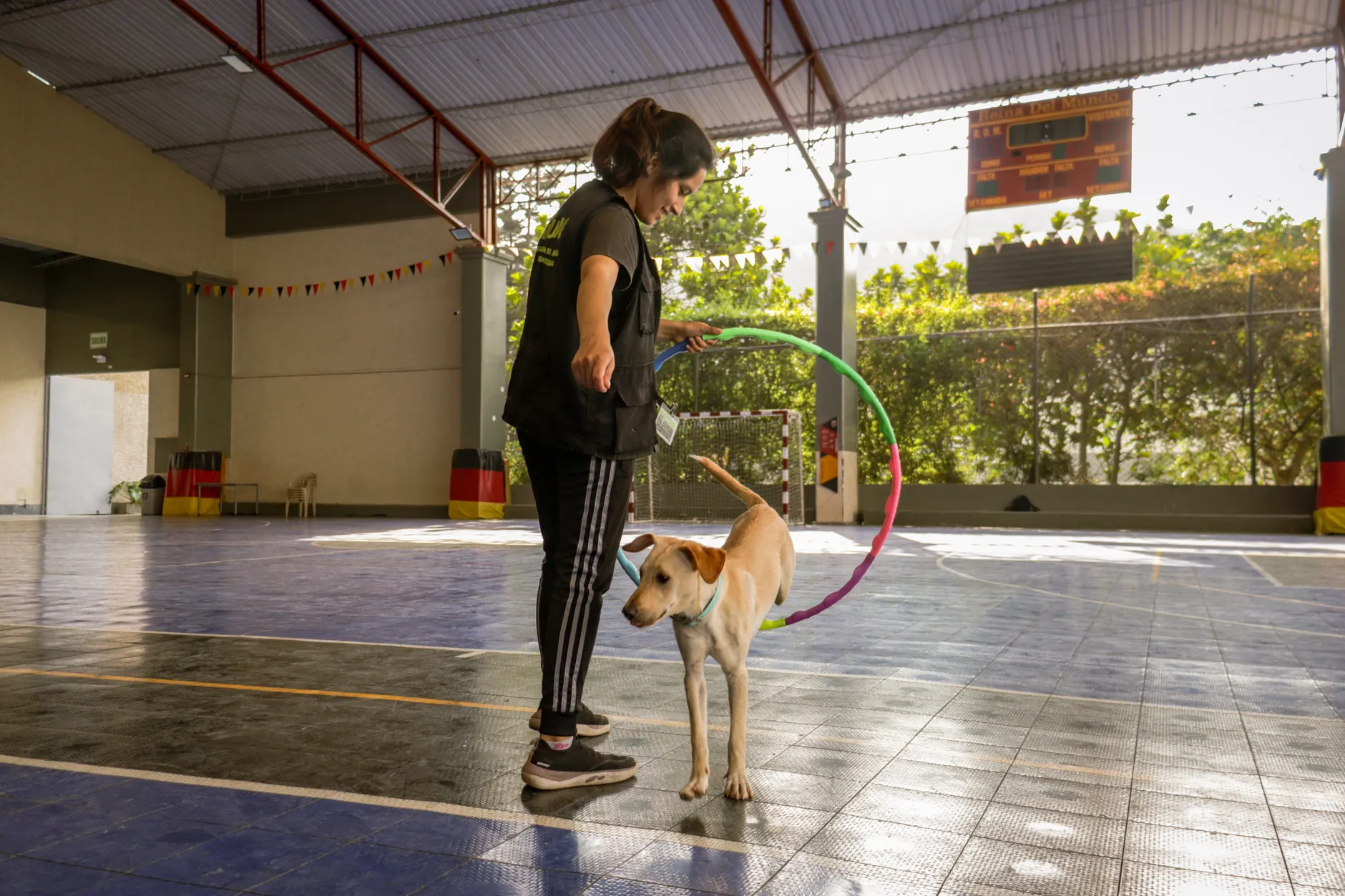
Positive reinforcement is not a soft alternative to "real" training — it is the method backed by the largest body of evidence in veterinary behavioural science. This guide gives you the principles, the practical mechanics, and the breed-by-breed context to actually use it.
Why positive reinforcement
Positive reinforcement (R+) means adding something the dog wants immediately after a desired behaviour, making that behaviour more likely to occur again. This is not permissiveness — it is precision. Studies published through veterinary behavioural organisations consistently show that:
What the evidence shows
- R+ methods produce faster acquisition of new behaviours in most dogs
- Punishment-based methods (leash corrections, spray bottles, alpha rolls) are associated with increased fear, aggression, and anxiety — especially in fearful or reactive dogs
- Dogs trained with aversive methods show more owner-directed aggression
- The AVMA, AVSAB (American Veterinary Society of Animal Behavior), and most board-certified veterinary behaviourists recommend R+ as the primary training method
What R+ is not
- It is not "letting the dog do anything" — boundaries are set through managing the environment and rewarding incompatible behaviours
- It is not bribing — luring is a teaching phase; rewards fade once the behaviour is established
- It is not only for easy dogs — high-drive, independent, and reactive dogs benefit from R+ precisely because it reduces conflict
The four core mechanics
Understanding these four principles is what separates effective training from random treat-giving.
Timing (≤ 0.5 seconds)
The reward must arrive within half a second of the desired behaviour for the dog to make the association. At 2–3 seconds, you're already rewarding whatever the dog is doing now. This is why marker training (a clicker or a sharp "yes!") is so effective — the marker bridges the gap between behaviour and treat.
Rate of reinforcement
In the early stages of teaching a new behaviour, reward every correct repetition (continuous reinforcement). Once the behaviour is reliable, shift to variable ratio reinforcement — rewarding unpredictably — which produces more durable, resistant-to-extinction behaviour. Think of the way slot machines maintain engagement.
Criteria clarity
Each training session should have a single, specific criterion for reward. If you're teaching "sit," reward only the moment the bottom touches the floor — not the approach, not the maintained sit. Splitting complex behaviours into tiny steps (shaping) builds the clearest understanding.
The Three Ds: Distance, Duration, Distraction
Only ever increase one D at a time. Teaching a 30-second down stay in the living room before adding distance, then adding mild distractions, then combining all three. Rushing all three at once is the most common reason training plateaus.
Choosing effective rewards
The dog determines what is rewarding — not you. A treat your dog ignores in a busy park is not a reinforcer, regardless of how appealing it looks. Match reward value to distraction level.
Use for: new behaviours, high distraction, recall, reactive dog training
- Real meat (chicken, beef, sausage) — small pea-sized pieces
- Cheese (strong varieties work in distracting environments)
- Commercial high-value treats (single-ingredient, strong smelling)
- Toy reward (for play-motivated dogs — ball throw, tug game)
Use for: known behaviours in moderate distraction
- Soft commercial training treats
- Small pieces of the dog's normal food (if food-motivated)
- Verbal praise + brief petting (for socially-motivated dogs)
Use for: well-established behaviours at home, maintenance
- Kibble (own food)
- Verbal praise alone (once behaviour is fully established)
- Life rewards: access to things the dog wants (going outside, greeting people)
The 6 essential cues
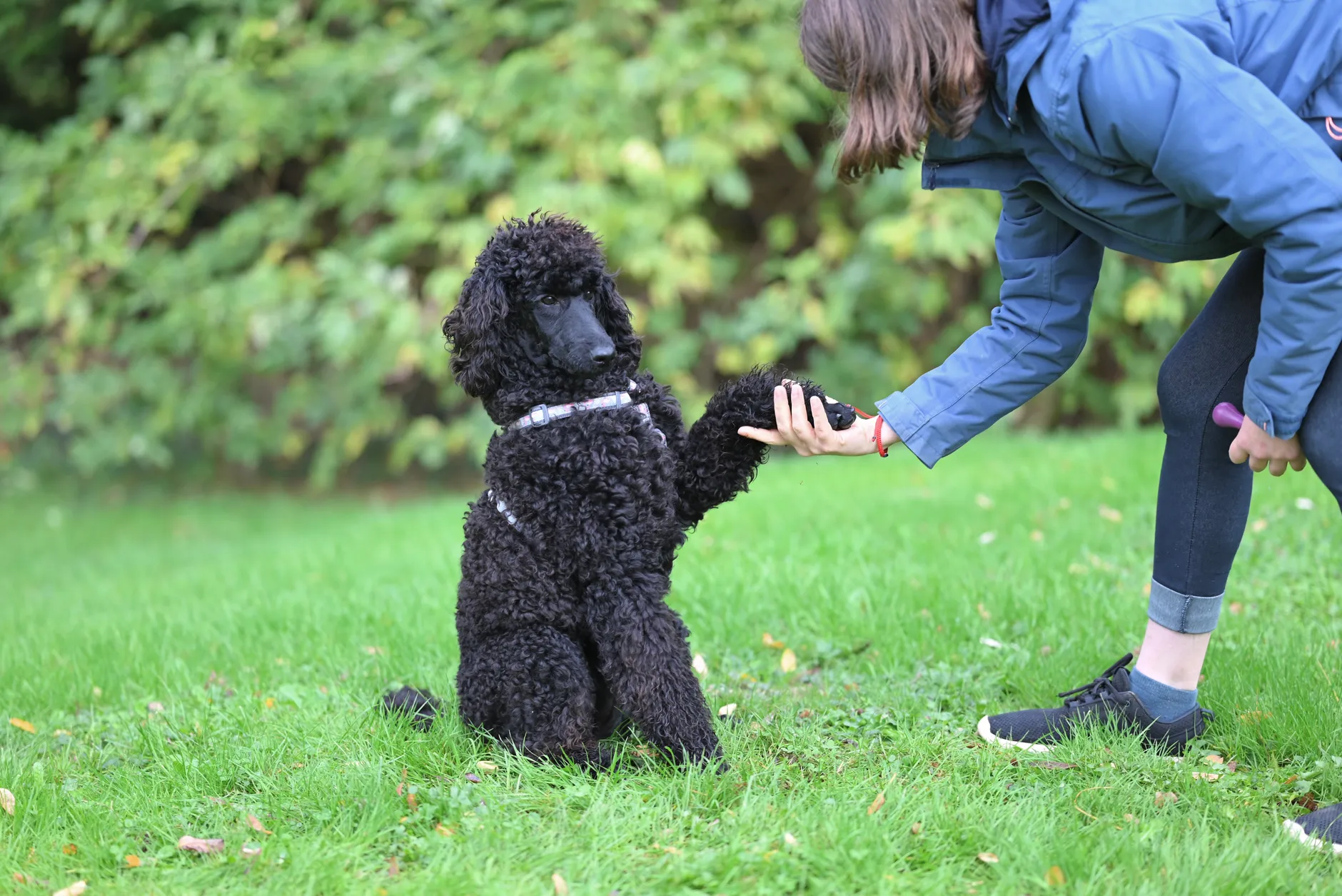
Every dog, regardless of breed, should have reliable fluency in these six cues before moving to advanced skills. Reliable means "responds correctly 9 times out of 10 in a distracting environment."
1. Name recognition
Goal: Dog turns to look at you within 1 second of hearing their name.
How to teach: Say name once, immediately mark and reward any eye contact. Never use the name to call the dog away from something fun — pair it only with positive things.
Common mistake: Repeating the name when the dog ignores it teaches them that multiple repetitions are required.
2. Sit
Goal: Bottom touches floor on first cue.
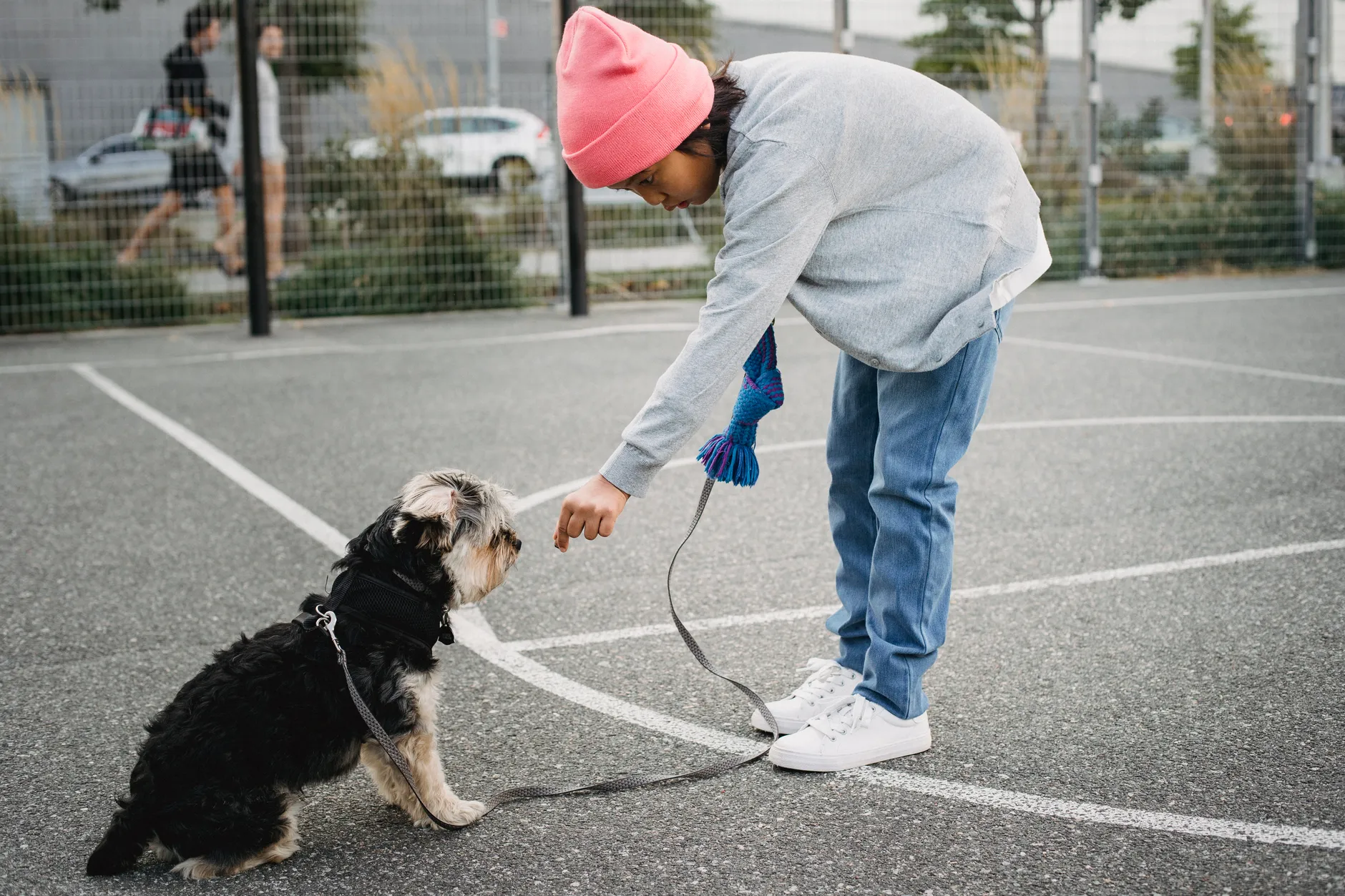
How to teach: Lure with treat held above nose and moved slightly back. Mark the moment the bottom touches the ground. Add the verbal cue only after the behaviour is consistent.
Common mistake: Pushing the dog's bottom down — this teaches them to tolerate pressure, not to respond to a verbal cue.
3. Down
Goal: Dog lies flat on first cue, in any environment.
How to teach: From sit, lure the treat to the ground between front paws. Mark the moment elbows touch the ground. Alternatively, shape the down by marking any approximation toward lying.
Common mistake: Teaching down only on soft surfaces — proof it on multiple surfaces early.
4. Stay (or Wait)
Goal: Dog holds position until released, at distance, with distractions.
How to teach: Start with 1-second stays, reward without the dog moving, then gradually extend duration. Add distance only after duration is solid. Use a release word ("ok" or "free") consistently.
Common mistake: Calling the dog out of the stay — this teaches breaking is correct. Walk back to release the dog instead.
5. Come (Recall)
Goal: Dog runs to you immediately from any distance, in any environment. The most critical safety cue.
How to teach: Use highest value reward. Never punish a dog for coming to you — even if they took a long time. Practice in long-line (5–10m) before any off-lead recall.
Common mistake: Calling the dog to "come" then doing something they dislike (bath, nail trim, going inside). Teach a separate "let's go" for those situations.
6. Leave it
Goal: Dog looks away from any item on cue.
How to teach: Present a low-value item in closed fist. Wait — when the dog stops nosing the fist and looks away, mark and reward with a high-value treat from the other hand. Gradually build to seeing items on the ground.
Common mistake: Rewarding with the very item you asked them to leave — this teaches them that leaving it leads to getting it.
5 common training mistakes
Sessions that are too long
Most dogs' effective training attention spans are 3–5 minutes per session. Longer sessions produce declining engagement and trial-and-error errors that undo previous progress. Train 3–4 short sessions per day rather than one 20-minute block.
Adding cues too early
Saying "sit, sit, SIT" while the dog hasn't yet associated the word with the action teaches the dog that the cue requires multiple repetitions. Add the verbal cue only once the physical behaviour is happening reliably on a lure or hand signal.
Lumping instead of splitting
Asking for too much in a single step. If the dog is failing 30% of repetitions, your criteria are too high. Split the behaviour into smaller, achievable steps and build success rate before raising the bar.
Inconsistent cues across household members
One person says "down" to mean lie down, another uses it to mean get off the furniture. Dogs learn the specific word — mixed signals extend the learning process significantly. Agree on a single cue word for each behaviour before training begins.
Training in only one location
Dogs do not generalise well across environments. "Sit" in the kitchen and "sit" in the park are, initially, two different behaviours to the dog. Proof every behaviour across different rooms, gardens, streets, and eventually public spaces.
Training difficulty by breed
Training difficulty reflects the breed's typical trainability, motivation type, and independent thinking. A "high difficulty" rating means more patience and experience required — not that the breed is untrainable. Every breed can learn the 6 essential cues with consistent positive reinforcement.
| Breed | Training difficulty | Trainer note |
|---|---|---|
| Border Collie | Low | Exceptionally fast learner; needs mental stimulation as much as exercise. |
| Golden Retriever | Low | Eager to please and food-motivated; one of the easiest breeds for beginners. |
| Labrador Retriever | Low | Highly food-motivated; excels in structured training from puppyhood. |
| German Shepherd | Low–Medium | Highly capable; thrives on clear leadership and task-oriented training. |
| Standard Poodle | Low | Often ranked among the most intelligent breeds; picks up cues quickly. |
| Beagle | Medium–High | Scent-driven; recall is challenging. High-value rewards and short sessions essential. |
| Dachshund | Medium–High | Independent and stubborn. Patient, consistent training from 8 weeks is critical. |
| Siberian Husky | High | Independent working dog. Recall reliability requires extensive proofing. |
| French Bulldog | Medium | Responds well to short, fun sessions. Heat sensitivity limits outdoor training duration. |
| Boston Terrier | Medium | Smart and biddable; responds to positive reinforcement and games. |
| Chihuahua | Medium–High | Smart but strong-willed. Short sessions and high-value food rewards are essential. |
| Shih Tzu | Medium–High | Can be stubborn and easily distracted. Keep sessions very short and reward-rich. |
| Labradoodle | Low–Medium | Usually eager to please with retriever instincts; highly responsive to positive methods. |
| Pomeranian | Medium | Alert and intelligent; responds well to consistent short training sessions with high-value rewards. |
| Pug | Medium | Food-motivated and trainable, but exercise capacity is limited — keep sessions brief and low-intensity. |
Ratings are generalised averages for the breed. Individual variation is significant — a "high difficulty" breed raised with consistent early training often performs better than a "low difficulty" breed with inconsistent handling.
Beyond the basics
Once the 6 essential cues are reliable across environments, the training door opens wide. The following are evidence-backed next steps:
Loose-lead walking
The most commonly neglected skill. Teaching a dog to walk without pulling requires systematic reinforcement of position, not just corrections. Reward every step taken with the lead slack.
Impulse control
Leave it, wait at doors, not jumping to greet — these are all impulse control skills. Builds the dog's ability to override instinct on request.
Nose work / scent games
One of the most mentally tiring activities for dogs — particularly valuable for high-drive breeds. Can be done indoors and requires minimal space.
When to get professional help
If your dog shows fear, aggression, resource guarding, or separation anxiety, consult a certified behaviour specialist (IAABC or CCPDT credential). These issues require professional assessment, not YouTube.
Frequently asked questions
- What is positive reinforcement dog training?
- Positive reinforcement (R+) means adding something the dog wants — typically a treat, toy, or praise — immediately after a desired behaviour, making that behaviour more likely to occur again. It is the method endorsed by the AVMA, AVSAB, and most board-certified veterinary behaviourists because it produces faster learning and avoids the fear and aggression risks associated with punishment-based methods.
- How long should dog training sessions be?
- Most dogs have an effective training attention span of 3–5 minutes per session. Longer sessions produce declining engagement and errors that can undo previous progress. Three to four short sessions spread throughout the day is more effective than one 20-minute block. Puppies need even shorter sessions — 1–2 minutes at a time.
- What are the most important commands to teach a dog first?
- Every dog should have reliable fluency in six core cues: name recognition, sit, down, stay, come (recall), and leave it. Reliable means responding correctly 9 times out of 10 in a distracting environment. Of these, recall (come) is the most critical safety cue and should receive consistent high-value reinforcement.
- What treats work best for dog training?
- Match reward value to distraction level and novelty of the behaviour. High-value rewards — small pieces of real meat, cheese, or commercial single-ingredient treats — are needed for new behaviours, high-distraction environments, and recall training. Keep treats pea-sized and count them toward the day's calorie allowance. The dog, not you, determines what is rewarding.
- Does positive reinforcement work for all dog breeds?
- Yes. The principles of timing, rate of reinforcement, and criteria clarity apply to all breeds. What varies is the type of reward (food vs toy vs praise) and the intensity of motivation. High-drive, independent, and reactive dogs often benefit most from R+ precisely because it reduces conflict. Breeds rated "high training difficulty" need more patience and shorter sessions, not different methods.


