
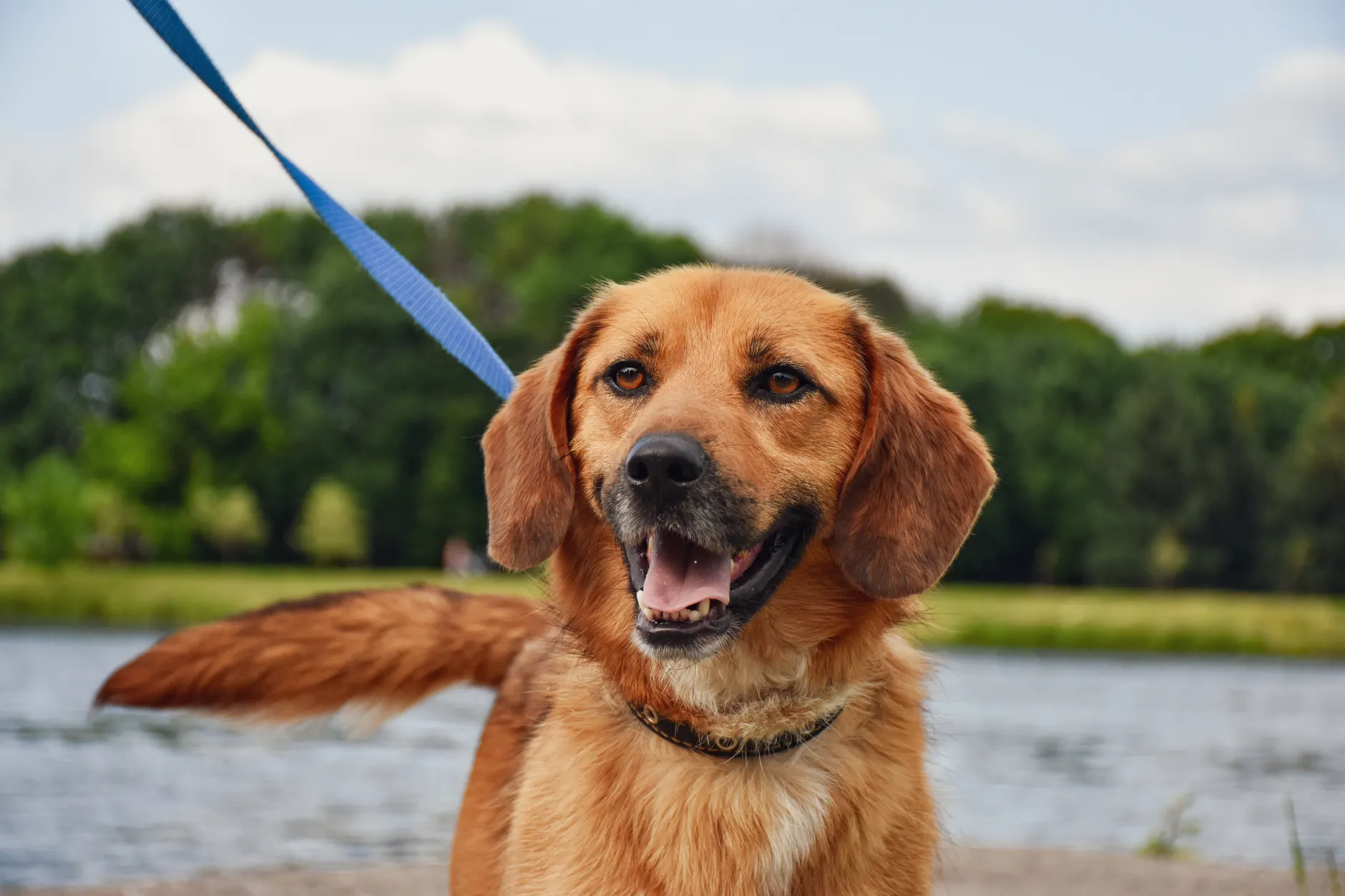
Loose-leash walking is the skill most dog owners want and the one most dogs never properly learn. The reason is straightforward: pulling works. Every time a dog surges forward and the owner follows, the dog gets what it wanted. Teaching an alternative requires consistency, timing, and realistic expectations about how long the process takes. This guide covers the mechanics, the equipment, and the progression from first steps to reliable outdoor walking.
Equipment: what to use and what to skip
The right equipment makes training easier. The wrong equipment makes it harder — or teaches the wrong thing entirely.
Use: front-clip harness
A front-clip harness (clip at the chest, not the back) redirects pulling momentum toward you instead of forward. This gives you a mechanical advantage without applying pressure to the dog's throat. Good options include the Blue-9 Balance Harness, Ruffwear Front Range, and Freedom No-Pull Harness. Fit is critical — a harness that shifts sideways or rides up behind the elbows creates discomfort and chafing.
Use: 6-foot fixed leash
A standard 6-foot leash (leather or biothane preferred — more comfortable to hold than nylon and less likely to cause rope burn) provides enough slack for the dog to explore within range while keeping a consistent boundary. The fixed length teaches the dog where the limit is; a retractable leash teaches the opposite.
Use: treat pouch
A hip-mounted treat pouch gives you instant access to rewards. Speed of delivery matters in leash training — a 2-second delay between the behaviour and the treat significantly reduces learning speed. Fumbling in a jacket pocket adds 3 to 5 seconds per treat and breaks the reinforcement cycle.
Skip: retractable leashes
Retractable leashes teach dogs that pulling extends the available range — the exact opposite of loose-leash walking. They also pose safety risks: rope burns, finger injuries, sudden snapping, and no reliable control near traffic or other dogs.
Skip: slip leads and prong collars
These tools rely on discomfort (tightening or pinching) to suppress pulling. They don't teach the dog what to do instead, and they create negative associations with the walk environment. A dog who stops pulling because the collar hurts has learned to avoid pain, not to walk politely. Reward-based methods produce more reliable results without the behavioural fallout.
Foundation skills before the walk
Teaching loose-leash walking outdoors before the dog understands the basic concept is like teaching algebra before arithmetic. Start indoors where distractions are minimal.
Name recognition
The dog should turn to look at you when they hear their name — reliably, within 1 to 2 seconds, indoors. This becomes your redirect tool on walks. Practice: say the name once, mark the turn with "yes" or a clicker, deliver a treat. Repeat 20 to 30 times across a day. Do not repeat the name if the dog doesn't respond — that trains the dog to ignore the first call.
Voluntary check-ins
Stand still with the puppy on leash indoors. Say nothing. When the puppy happens to look at you, mark and treat. Within a few sessions, the puppy will start offering eye contact more frequently. This builds the habit of checking in with you rather than being permanently focused on the environment — the foundation of all leash manners.
Following a lure
Hold a treat at your left hip (or whichever side you prefer for walking). Take 3 to 5 steps. If the puppy follows in position, mark and treat. Gradually increase the number of steps. This teaches the puppy where the "pay zone" is — the position relative to your body where good things happen.
The pressure-release mechanic
This is the core technique. It teaches the dog that tension on the leash stops forward movement, and a loose leash allows it.
- Walk forward at a normal pace. The leash should have a visible J-shaped droop between you and the dog.
- The moment the leash goes tight, stop. Plant your feet. Do not pull back on the leash, jerk the dog, or say "no." Just stop. The dog learns: tight leash = walk stops.
- Wait for the dog to create slack. This might mean the dog turns to look at you, takes a step back, or shifts sideways. Any movement that loosens the leash counts. Mark ("yes") and take 2 to 3 steps forward as the reward.
- If the dog immediately pulls again, stop again. The first session may involve stopping every 2 to 3 steps. This is normal. You are rebuilding the dog's understanding of how leash walking works.
- Gradually increase the distance between stops. Over days and weeks, the dog learns that maintaining a loose leash is what gets them where they want to go. Add intermittent treats for choosing to walk in position (loose leash near your side) without being asked.
Progression: low to high distraction
The biggest training mistake is expecting outdoor performance before indoor reliability. Dogs don't generalise well — a skill learned in the kitchen is not automatically available on a busy street.
Stage 1: Indoors (week 1 to 2)
Practice foundation skills and pressure-release in hallways, around furniture, and between rooms. The indoor environment is low-distraction enough for the dog to focus on the leash mechanic. Sessions: 5 to 10 minutes, 2 to 3 times daily.
Stage 2: Garden or quiet car park (week 2 to 4)
Move to an outdoor space with moderate novelty but limited foot traffic. The smells and sounds are more interesting than indoors, so the dog will pull more. This is expected. Return to the pressure-release technique with higher-value treats. Sessions: 10 to 15 minutes.
Stage 3: Quiet residential streets (week 4 to 8)
Introduce the occasional passing person, distant dog, and ambient traffic noise. When distractions appear, increase your treat frequency and shorten the distance between rewards. If the dog cannot focus at all, the distraction level is too high — move further away and try again.
Stage 4: Busier environments (month 2 to 6)
Parks, pet-store car parks, and busier streets. This is where most training stalls because owners expect the same performance as in quiet settings. Be patient — proofing a skill in high distraction takes longer than teaching it initially. Continue to mark and reward check-ins, loose-leash position, and voluntary disengagement from distractions.
Common mistakes that reinforce pulling
- Inconsistent stopping: If you stop for pulling on training walks but allow it on "real" walks, the dog learns to pull harder to find out which type of walk this is. Every walk is a training walk until the behaviour is fluent.
- Jerking the leash: Leash corrections (sudden yanks) cause startling and pain without teaching the dog what to do instead. They also create negative associations with the walk — and with whatever the dog was looking at when the jerk happened (often another dog, which can seed reactivity).
- Shortening the leash to prevent pulling: A leash held at 2 feet gives the dog no room to make choices. The dog is in position because they have no alternative, not because they understand what's expected. Use the full 6 feet and let the dog choose the right position for a reward.
- Rewarding too slowly: A treat delivered 5 seconds after the behaviour has minimal training value. Use a treat pouch, mark the instant the leash goes loose or the dog checks in, and deliver within 1 to 2 seconds.
- Training only in one context: A dog trained in a quiet park will pull on a busy street. Deliberately vary the environment: different routes, times of day, distraction levels. Generalisation requires practice across many contexts.
Age-appropriate expectations
| Age | Realistic expectation | Session length |
|---|---|---|
| 8–12 weeks | Comfortable wearing harness; follows lure for 5–10 steps; accepts leash without biting it | 3–5 minutes |
| 3–4 months | Walks 20–30 steps on loose leash with frequent treats; responds to name outdoors | 5–10 minutes |
| 4–6 months | Loose leash for 50+ steps in low-distraction settings; check-ins becoming habitual | 10–15 minutes |
| 6–9 months (adolescence) | Expect regression — increased pulling, distraction, and testing. This is normal. Continue the technique. | 10–20 minutes |
| 9–18 months | Reliable in moderate distraction; still needs management in high-distraction environments | 15–30 minutes |
| 18+ months | Consistent loose-leash walking in most environments with intermittent reinforcement | Full walks |
Adolescent regression (6 to 12 months) is the stage where most owners give up on reward-based methods and switch to aversive equipment. This is counterproductive — the pulling will return once the aversive tool is removed, and the dog has now missed months of building the actual skill. Stay the course. The behaviour consolidates with maturity if the training foundation is solid.
Frequently asked questions
- At what age should I start leash training?
- Start indoor leash familiarisation the day your puppy comes home (typically 8 weeks). Let the puppy drag a lightweight leash around the house under supervision for short sessions. Outdoor leash walking can begin after the first round of vaccinations (usually 10 to 12 weeks), sticking to low-traffic areas. Formal loose-leash walking training (with structured exercises and criteria) works best from 12 to 16 weeks, when the puppy can maintain short bursts of attention.
- Should I use a harness or collar for leash training?
- A front-clip harness is the safest and most effective starting point for most puppies and dogs. It redirects pulling momentum without putting pressure on the throat. Flat collars work for dogs who already walk politely but offer no mechanical advantage for teaching the skill. Head halters (Gentle Leader, Halti) are useful for strong pullers but require a separate conditioning period before use. Slip leads and prong collars are not recommended — they rely on discomfort to suppress pulling rather than teaching an alternative behaviour.
- How long does it take to train a dog to walk on a loose leash?
- With consistent daily practice (two 10-minute sessions), most puppies show significant improvement in 2 to 4 weeks in low-distraction environments. Reliable loose-leash walking in high-distraction environments (other dogs, squirrels, busy streets) takes 3 to 6 months for most dogs. Adolescent dogs (6 to 18 months) often regress temporarily — this is normal and not a sign that training has failed. Adult rescue dogs with established pulling habits may take 2 to 6 months depending on reinforcement history.
- Why does my dog pull on the leash?
- Dogs pull because it works — when they pull forward and the owner follows (even unconsciously), the dog reaches the thing they wanted (a smell, another dog, a squirrel). Every step forward while the leash is tight reinforces pulling as a successful strategy. Dogs are also naturally faster walkers than humans, and without training, they default to their natural pace. The solution is making pulling ineffective (stopping forward movement) and rewarding the position you want (loose leash, near your side).
- What treats should I use for leash training?
- Soft, small, high-value treats that can be eaten in under 2 seconds. Pea-sized pieces of cooked chicken, cheese, or commercial training treats work well. Hard biscuits and dental chews take too long to eat and break the training rhythm. For outdoor sessions with distractions, use treats one tier higher in value than what works indoors — if kibble works inside, use chicken outside. Keep treats in a treat pouch at your hip for fast delivery.
- Can I use a retractable leash for walking?
- No — retractable leashes are counterproductive for leash training and potentially dangerous. They teach the dog that pulling extends the leash (the opposite of what you want), provide no consistent feedback about where the "right" position is, and can cause rope burns, finger injuries, and entanglement. Use a fixed 6-foot leash (leather or biothane is more comfortable than nylon). Once your dog walks reliably on a loose leash, a long line (15 to 30 feet) in appropriate settings provides more freedom safely.


