
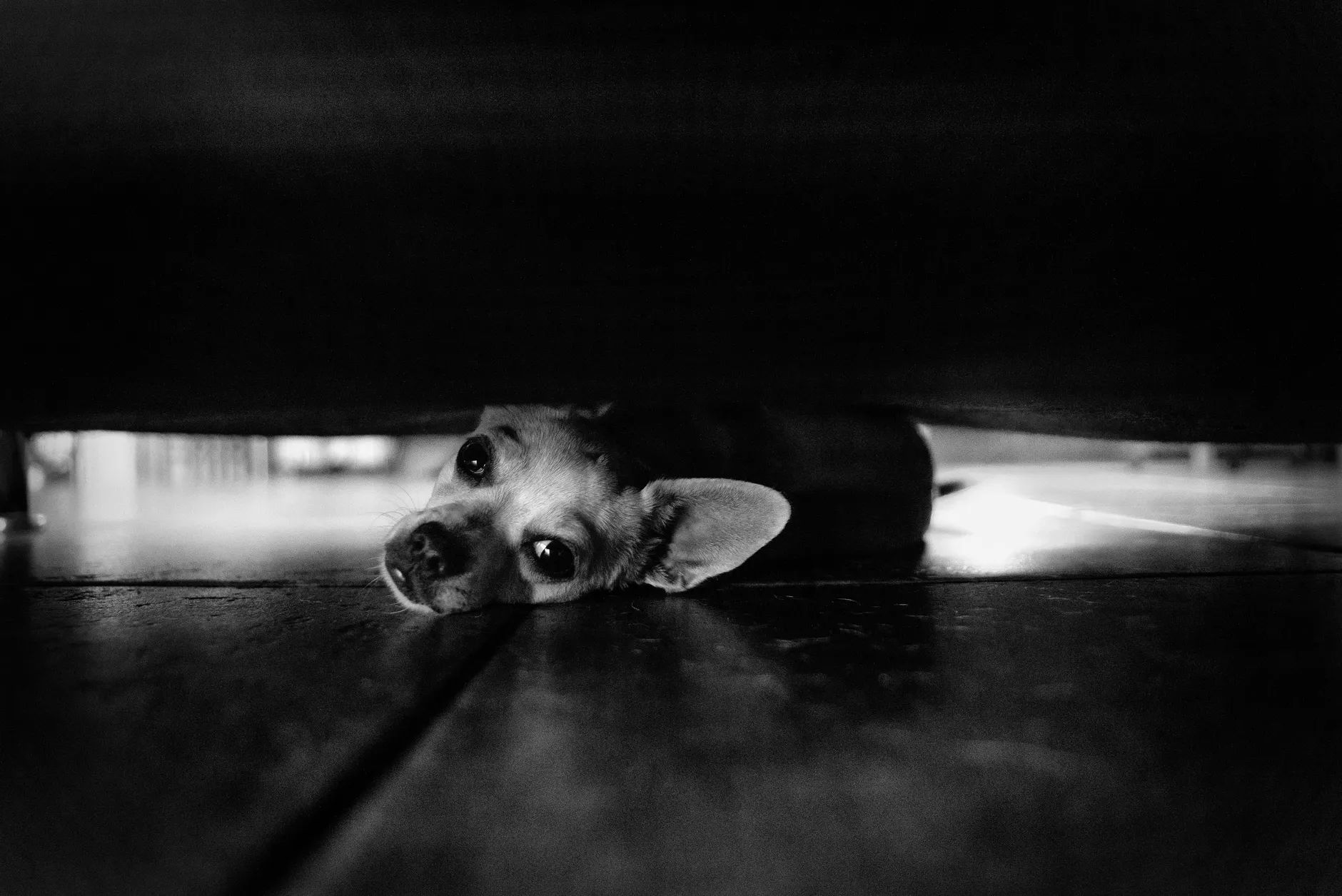
A dog that trembles during storms, refuses to walk past a particular spot, or seems permanently "on edge" is not being difficult — they are experiencing real distress. Fear and anxiety are among the most common reasons dogs are surrendered or struggle with daily life, yet they are also among the most treatable, once the underlying response is understood rather than dismissed or punished.
Fear, anxiety, and phobia: what's the difference
These terms are often used interchangeably, but the distinction matters for how you respond:
- Fear — a normal, adaptive response to something the dog perceives as threatening right now. It is proportional to the situation and resolves once the trigger is removed. A dog startled by a dropped pan and recovering within a minute is showing normal fear.
- Anxiety — the anticipation of a future threat, which can persist even when nothing threatening is currently present. A dog that starts pacing, panting, and drooling an hour before fireworks typically begin is showing anxiety, not fear of a sound that hasn't happened yet.
- Phobia — an extreme, persistent fear response that is disproportionate to the actual level of threat, often triggered by a specific stimulus such as thunder, fireworks, or gunshots. Phobic responses tend to worsen over time without intervention rather than improving on their own.
All three share the same underlying stress physiology — the body's fight-or-flight system activating — and a single dog can experience more than one. A dog with noise phobia, for example, often develops broader anticipatory anxiety around the conditions that precede storms (darkening skies, changes in air pressure, distant rumbling).
Common triggers and how they present
- Noise phobia — thunderstorms, fireworks, gunshots, construction. Often presents as pacing, panting, drooling, hiding, trembling, and in severe cases destructive escape attempts (digging at doors, breaking through screens).
- Novel environments and travel — vet clinics, car rides, new places. A dog that is relaxed at home but shuts down, trembles, or refuses to move in unfamiliar settings is showing situational fear that often stems from limited early exposure to varied environments.
- Specific object or situational fears — vacuum cleaners, umbrellas, men in hats, stairs, slippery floors, specific types of people or animals. These are frequently linked to a lack of positive exposure during the critical socialisation window — see our puppy socialisation basics guide for how this window shapes adult confidence.
- Generalised anxiety — chronic low-level vigilance across many contexts: a dog that startles easily, struggles to settle even in familiar environments, and seems unable to relax even when nothing specific is happening.
- Separation-related distress — fear specifically tied to being left alone is common enough to warrant its own approach; see our managing dog separation anxiety guide for a dedicated protocol.
Recognising fear and anxiety in your dog
Fear and anxiety often show up in subtle body language before they become obvious. Common signs include:
- Lip licking, yawning, or turning away when nothing tired or hungry is happening
- "Whale eye" — whites of the eyes visible as the dog looks away while keeping a trigger in view
- Low or tucked tail, lowered body posture, ears pinned back
- Trembling, excessive panting when not hot or exercised, sudden shedding
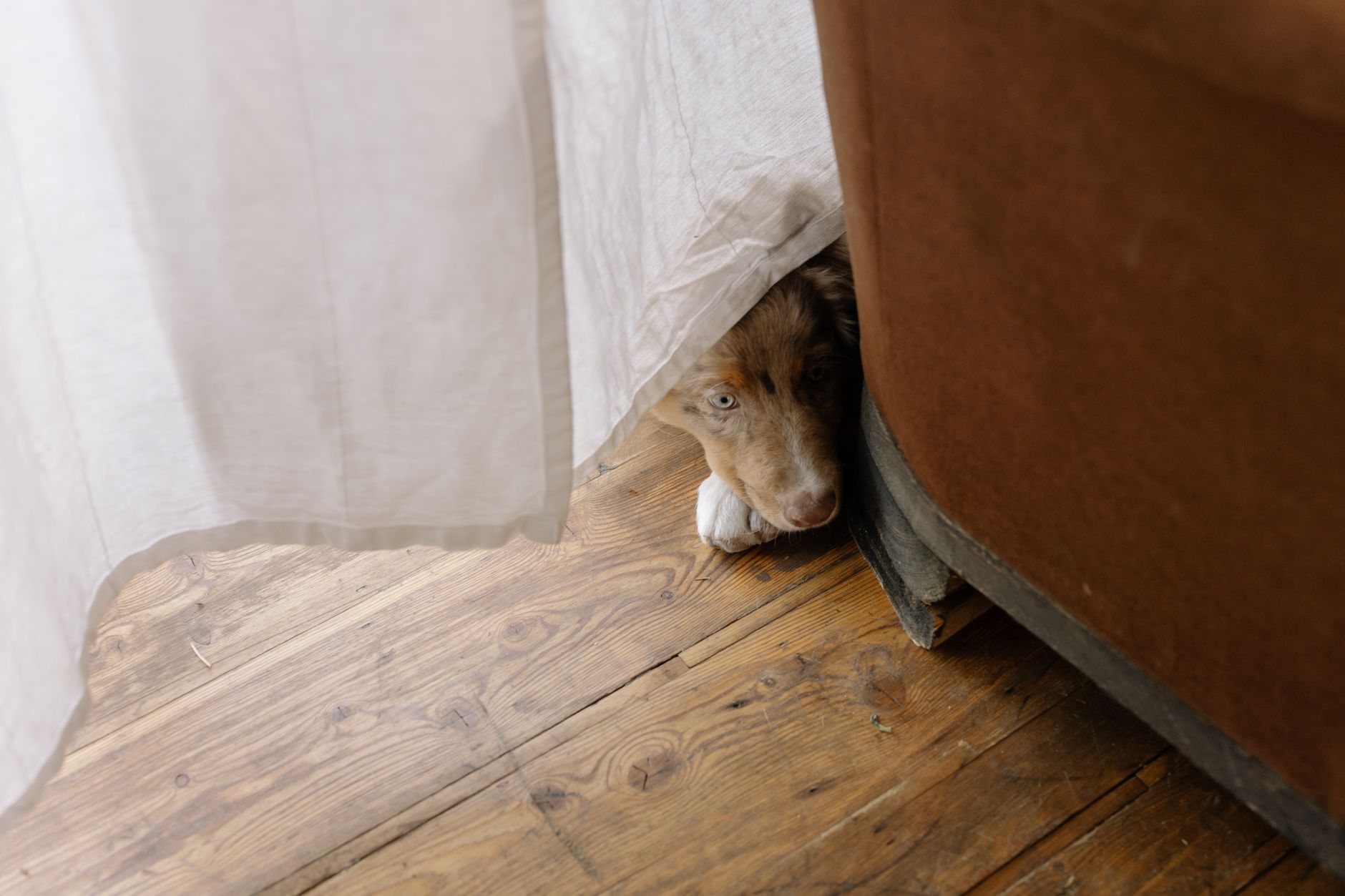
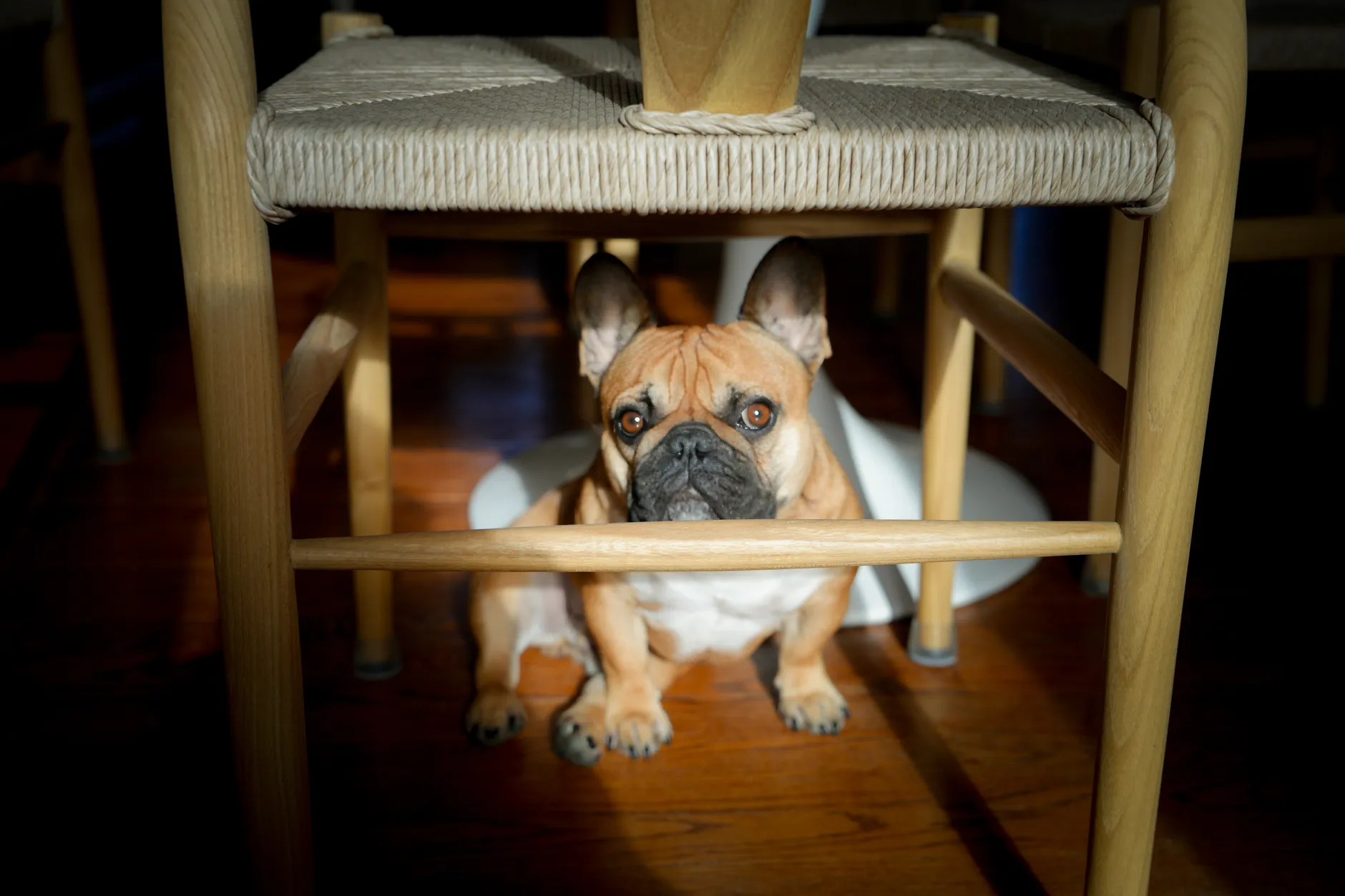
- Freezing or refusing to move ("planting"), or attempting to hide behind the owner or furniture
- Avoidance — taking a wide path around a trigger, refusing treats they would normally accept
Our dog body language guide covers the full range of stress signals and how they sit on the same spectrum as the warning signs that precede a growl or bite — useful background for understanding why early intervention with a fearful dog matters.
Desensitisation and counter-conditioning: the evidence-based approach
Desensitisation and counter-conditioning (DSCC) is the core technique recommended by veterinary behaviourists for fear and anxiety. The principle is straightforward, but execution requires patience:
- Start below the fear threshold. Expose your dog to a version of the trigger so mild it does not produce a fear response — for noise phobia, this might mean a recording played so quietly your dog barely notices it.
- Pair the trigger with something your dog loves. High-value food is most common. The goal is to build a new association: trigger predicts good things, rather than trigger predicts danger.
- Increase intensity only when your dog stays relaxed. Volume, proximity, or duration should increase in small steps, and only once the current level produces no fear response at all over multiple sessions.
- Never push past the threshold. If your dog shows any fear response, you have moved too fast — go back to the last comfortable level. Exposing a dog to a level of trigger that produces panic ("flooding") does not build tolerance; it reinforces the fear and can make future sessions harder.
This process typically takes weeks to months, not days, and progress is rarely linear. For dogs with significant baseline anxiety, the stress response itself can prevent learning from happening at all — which is why combining DSCC with anti-anxiety medication, under veterinary guidance, often produces faster and more durable results than behavioural work alone.
Management strategies that help while you work on the underlying fear
- A safe space. An interior room, crate, or covered den area your dog can retreat to during stressful events, away from windows and external noise where possible.
- Predictable routines. Anxiety is partly about uncertainty — consistent daily patterns for feeding, walks, and downtime reduce the baseline level of vigilance.
- Pheromone diffusers. Dog-appeasing pheromone (DAP) products have modest supporting evidence for reducing situational stress and are low-risk to try.
- Pressure wraps. Products such as Thundershirts help some dogs and do nothing for others — a low-risk option worth trialling individually.
- Avoid punishment for fear responses. Punishing a dog for hiding, trembling, or vocalising out of fear adds a second negative association on top of the original one and consistently makes things worse.
When to involve a professional
Most mild, situational fears respond well to consistent desensitisation at home. Involve a veterinarian or veterinary behaviourist (DACVB) when:
- The fear response is severe — panic, attempts to escape that risk injury, or complete shutdown
- Anxiety appears to be generalising across more and more situations over time
- There has been no improvement after several weeks of consistent, correctly applied desensitisation
- The fear is accompanied by growling, snapping, or other defensive aggression
- A previously confident dog suddenly becomes fearful — this always warrants a veterinary check, since pain and certain medical conditions can present as new-onset anxiety
A veterinary behaviourist can rule out medical contributors, design a structured DSCC plan tailored to your dog's specific triggers, and determine whether anti-anxiety medication — used alongside, not instead of, behavioural work — would help. This guide is educational and cannot replace an individual behavioural assessment.
Frequently asked questions
- What is the difference between fear, anxiety, and a phobia in dogs?
- Fear is a normal, short-term response to something the dog perceives as threatening right now — it resolves once the trigger is gone. Anxiety is the anticipation of a future threat, and can persist even when nothing threatening is currently happening (a dog pacing and panting an hour before fireworks typically start). A phobia is an extreme, persistent fear response that is out of proportion to the actual danger — most commonly seen with noise (thunderstorms, fireworks). All three share the same underlying stress physiology, and a single dog can experience more than one at once.
- My dog shakes, hides, or tries to escape during thunderstorms — what can I do?
- Noise phobias are common and tend to worsen over time without intervention, so it is worth addressing rather than just "riding out" each storm. In the short term: provide a safe, den-like space (an interior room, away from windows), use background white noise or calm music to mask the sound, stay calm yourself, and never punish the fear response. Longer term, desensitisation using recordings of storm sounds at very low volume, paired with food, can reduce the response over weeks — but this needs to start well before storm season and progress slowly. For severe noise phobia, a veterinary behaviourist can discuss situational anti-anxiety medication for storm days.
- Do calming products like pheromone diffusers, anxiety wraps, or calming chews actually work?
- The evidence is mixed and modest, but these products are low-risk and can be a reasonable part of a broader plan — they are not a substitute for addressing the underlying fear. Dog-appeasing pheromone (DAP) diffusers have some supporting evidence for reducing situational stress. Pressure wraps (such as Thundershirts) help some dogs and do nothing for others; a short trial is low-risk. Be cautious with calming chews — check with your vet before combining with other medications, and do not rely on any product alone for a dog showing severe or worsening fear responses.
- Should I comfort my dog when they are scared, or will that reward the fear?
- You cannot "reinforce" an emotion like fear by comforting your dog — fear is not a behaviour chosen for attention, it is an involuntary stress response. Calm, quiet reassurance (sitting nearby, a steady voice, gentle physical contact if your dog seeks it) does not make fear worse and can help. What does not help is forcing a frightened dog toward the thing it is afraid of, or being anxious or frustrated yourself, since dogs pick up on handler tension. The goal is to keep your dog below the threshold where panic takes over, not to "prove" the trigger is safe by exposure.
- Can a fearful or anxious dog become aggressive?
- Yes — fear is one of the most common underlying causes of aggression. A frightened dog that cannot escape a trigger may growl, snap, or bite as a last resort to increase distance from what scares it. This is why addressing the underlying fear matters even if the dog has not yet shown aggression: reducing the fear response reduces the likelihood it ever needs to escalate to defence. If your dog's fear is accompanied by growling, snapping, or stiff, defensive body language, see our guide on dog aggression for how the two overlap and how to get the right help.


