
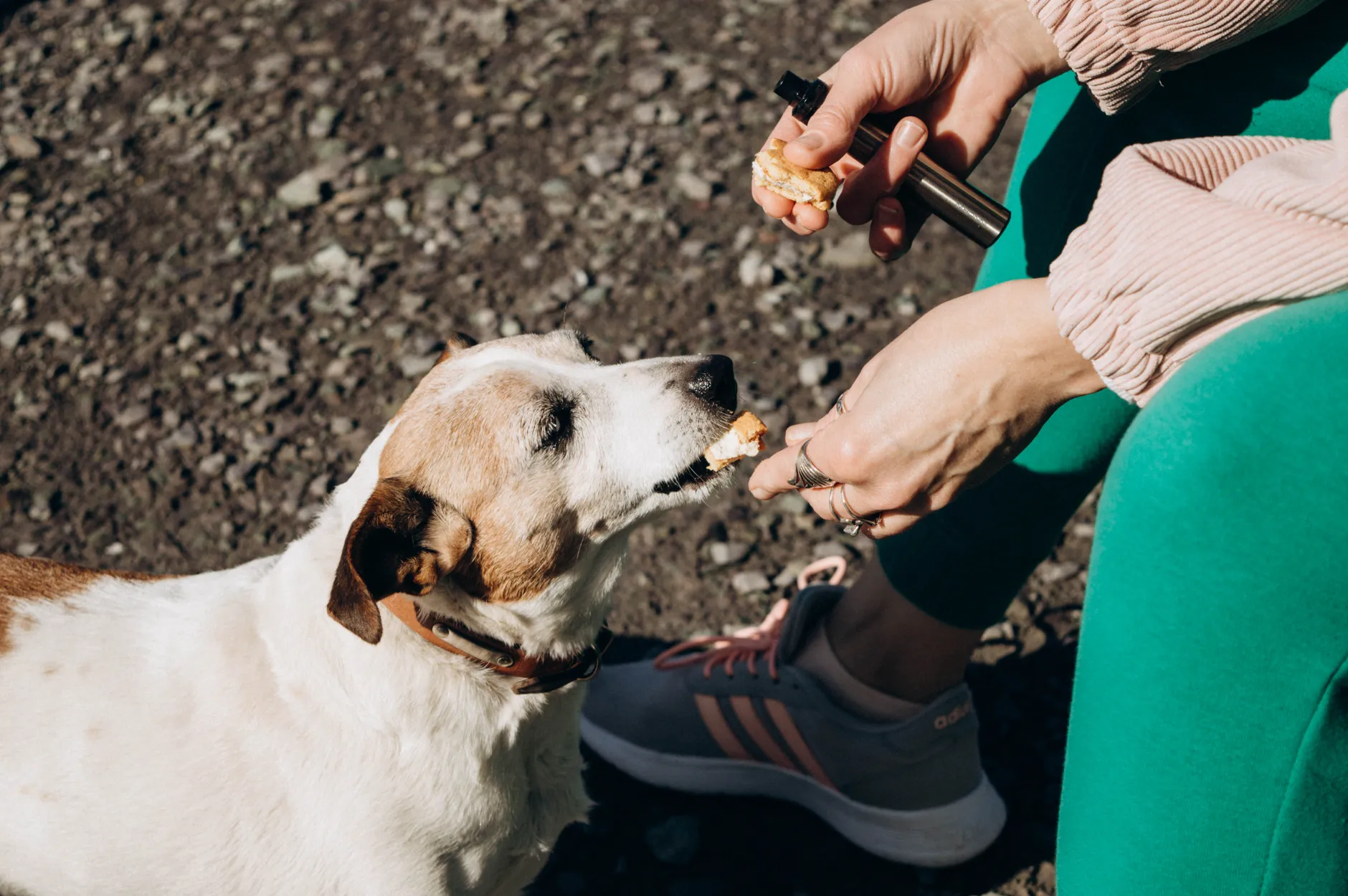
The right training equipment makes reward-based methods easier to execute. The wrong equipment makes them harder or actively undermines your progress. This guide covers what belongs in your training bag, what to leave on the shelf, and how to match gear to your dog's stage and temperament.
Essential gear for reward-based training
These five items form the core toolkit that every positive-reinforcement trainer uses. They are not optional extras; they are the mechanical foundation that makes timing, marking, and reinforcement work reliably. If you are starting from zero, buy these before anything else.
Clicker (or conditioned verbal marker)
EssentialWhat it does: Produces a short, distinct sound that tells the dog "that exact behaviour earned a reward." The click bridges the 0.5-second gap between the desired behaviour and treat delivery.
When to use it: During all active training sessions for new behaviours. Once a cue is fully established, you can fade the marker and rely on intermittent reinforcement.
Selection tips: Box clickers are louder (better outdoors but can startle sound-sensitive dogs). Button clickers are quieter and easier to hold. I-click models work well for people with limited hand strength. Whichever you choose, condition it first: click, then treat, repeated 20 times before your first training session.
Treat pouch
EssentialWhat it does: Keeps high-value rewards accessible at your hip so you can deliver treats within 1-2 seconds of the marker. Fumbling in pockets breaks timing and reduces learning speed.
When to use it: Every training session, every walk where you are reinforcing behaviours. Even experienced trainers use a pouch because speed matters.
Selection tips: Look for a wide opening (at least 10 cm), magnetic or spring-hinge closure for one-handed access, and belt-clip attachment rather than a lanyard. Silicone-lined pouches are easiest to clean. Capacity of at least one cup prevents mid-session refills.
Front-clip harness
EssentialWhat it does: Attaches the lead at the dog's chest. When the dog pulls, the chest attachment redirects momentum sideways, turning the dog toward you rather than allowing forward drive. This is the mechanical replacement for corrections -- it manages pulling without pain.
When to use it: During all on-lead walks and loose-lead training sessions. Especially important during the adolescent stage (4-12 months) when pulling peaks.
Selection tips: Choose a Y-shaped front strap that sits above the sternum without crossing or compressing the shoulder joint. Straps should be at least 2 cm wide and padded. Two adjustment points (chest strap and belly strap) ensure fit across body shapes. Avoid harnesses that tighten when the dog pulls -- these are no-pull aversive tools in disguise.
Long line (5-10 m)
EssentialWhat it does: Gives the dog freedom to explore at distance while maintaining safety and control. The critical tool for recall training -- it lets you practise "come" in realistic conditions without risking the dog running off.
When to use it: During recall proofing, scent games, and any training in open or unfenced areas. Start with 5 m for puppies, move to 10 m for adolescent and adult recall work.
Selection tips: Biothane (waterproof webbing) is the best material: it does not tangle, absorb water, or cause rope burns. Nylon works but tangles in wet grass. Avoid rope-style lines -- they are difficult to grip and burn hands. Attach to a harness, never a collar, to prevent neck injury if the dog hits the end at speed.
Flat collar with ID
EssentialWhat it does: Carries identification tags and serves as the everyday collar. Not a training tool in itself -- the harness handles that job -- but a legal requirement in most jurisdictions and a safety essential.
When to use it: All the time, including indoors (unless crated or unsupervised with snag risk). Use a separate harness for lead attachment during training.
Selection tips: Flat buckle or quick-release clip. Two-finger rule: you should be able to slide two fingers between the collar and the dog's neck. Lightweight nylon for puppies; wider, sturdier options for large breeds. Replace when hardware shows wear.
Useful additions
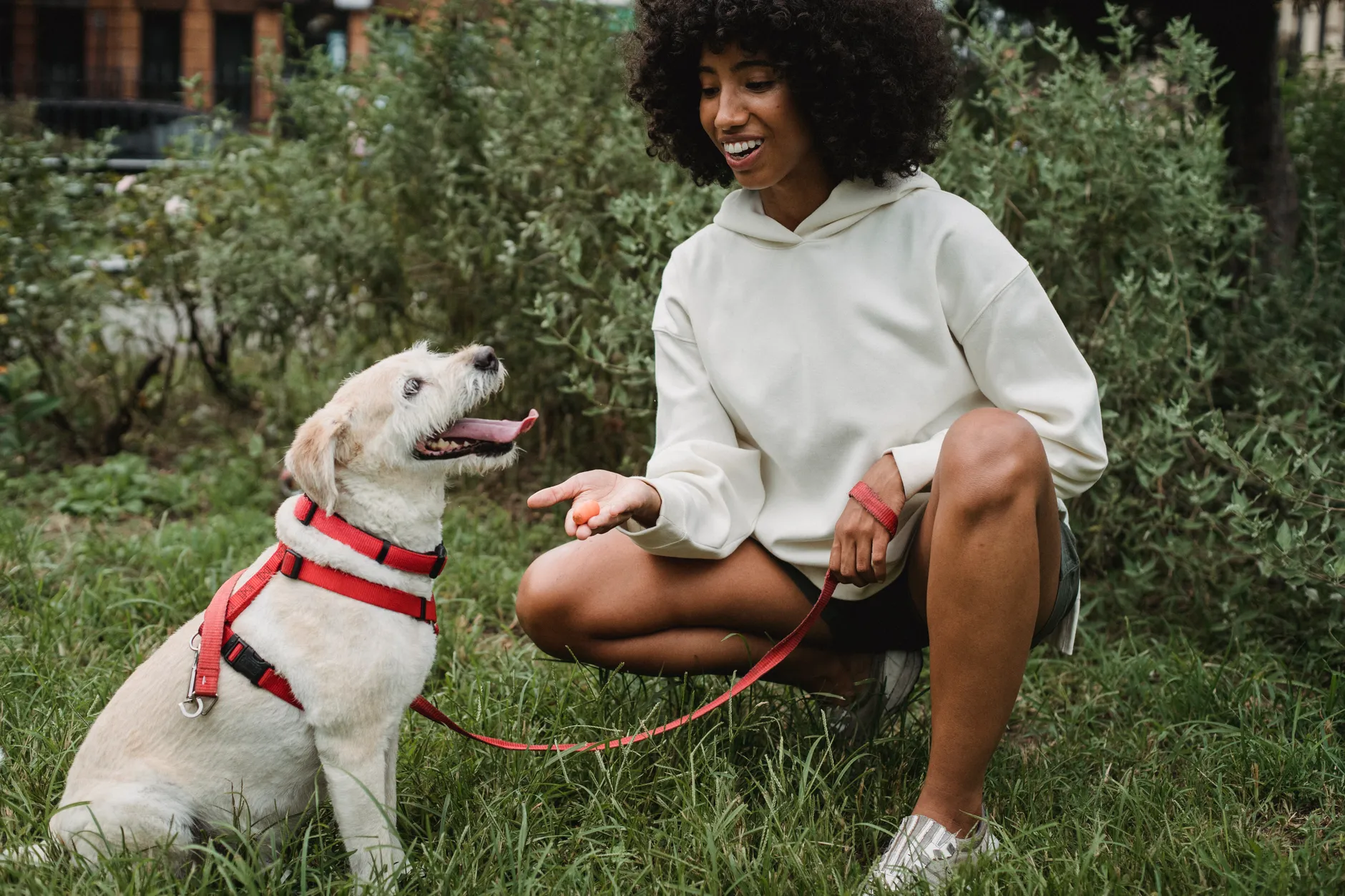
These tools are not strictly required, but they solve specific training problems well. Add them as your dog's training progresses and you encounter situations where the essentials alone are not enough.
Target stick
UsefulWhat it does: Extends your reach to guide the dog's nose to specific positions without luring with food. Teaches the dog to follow a target, which can then be used to shape heel position, spins, figure-eights, and complex behaviours.
Selection tips: Telescoping sticks are easiest to carry. A soft rubber tip is easier for the dog to target. You can also teach hand-targeting (nose to palm) as a free alternative.
Snuffle mat
UsefulWhat it does: Scatters kibble or treats across fabric strips that the dog must nose through to find food. Engages the dog's primary sense (smell) and builds calm, focused behaviour. Ten minutes of snuffle mat work is mentally equivalent to a moderate walk.
Selection tips: Machine-washable mats with a non-slip rubber base. Avoid mats with loose parts that could be chewed off and swallowed. Supervise use until you know your dog will not try to destroy it.
Puzzle toys
UsefulWhat it does: Provides mental enrichment by requiring the dog to solve a problem to access food. Reduces boredom-related behaviour problems and builds frustration tolerance -- a skill that transfers directly to training.
Selection tips: Start with level-1 difficulty and progress. Rotate toys weekly to maintain novelty. Kongs, lick mats, and wobble feeders are good entry points. For dogs prone to destructive behaviour, choose rubber or hard-plastic options rated for heavy chewers.
Crate
UsefulWhat it does: Provides a safe, enclosed resting space. When introduced correctly using positive association, a crate supports house-training, prevents unsupervised destructive behaviour, and gives anxious dogs a place to decompress. See our crate training guide for the full protocol.
Selection tips: The crate should be large enough for the dog to stand, turn, and lie flat. Use a crate size calculator to get exact dimensions. Wire crates with a divider panel are best for growing puppies because you can expand the space as they grow. Never use a crate as punishment.
Gear to avoid
These tools work through pain, fear, or discomfort. They may suppress unwanted behaviour in the short term, but they do so by teaching the dog to avoid punishment rather than to choose desired behaviour. The AVSAB, AVMA, and most certified behaviour professionals advise against their use.
Prong collar (pinch collar)
Metal links with inward-facing prongs that press into the dog's neck when tightened. Designed to cause discomfort to stop pulling. Risks include tracheal bruising, puncture wounds, increased fear-based reactivity, and negative associations with whatever the dog was looking at during the correction. A front-clip harness achieves the same mechanical redirection without any of these risks.
Choke chain (slip chain)
A metal chain that tightens around the dog's neck with no limit when the lead is pulled. Unlike a limited-slip (martingale) collar, a choke chain has no tightening stop. Documented injuries include collapsed trachea, laryngeal damage, restricted blood flow, and eye damage from increased intraocular pressure. There is no training scenario where a choke chain is necessary or preferable to humane alternatives.
Shock collar (e-collar, remote trainer)
Delivers an electric stimulus to the dog's neck via remote control. Even on low settings ("vibration" or "stim"), the device works through aversive conditioning -- the dog changes behaviour to avoid the unpleasant sensation. Peer-reviewed studies show that dogs trained with electronic collars show more stress signals, more fear-related behaviour, and no better obedience outcomes compared to dogs trained with positive reinforcement. Several countries have banned their use.
Retractable leash (for training)
While not aversive, retractable leashes actively undermine training. They teach dogs that pulling extends the available distance -- the exact opposite of loose-lead walking. The thin cord causes rope burns, the lock mechanism fails under sudden force, and the variable length makes consistent reinforcement impossible. Use a fixed-length lead for walks and a long line for distance work.
Matching gear to temperament
Not every dog needs the same setup. Temperament, size, and breed tendencies determine which tools deserve priority. Use the behaviour checker if you are unsure whether a specific behaviour needs professional assessment before you address it with training gear.
High-energy pullers
Front-clip harness is non-negotiable. Add a double-ended lead (clips to both harness front and back) for maximum steering control. Prioritise high-value treats outdoors -- kibble will not compete with environmental stimulation. A 5 m long line for recall practice is critical before considering any off-lead work.
Sound-sensitive or anxious dogs
Use a verbal marker ("yes!") instead of a clicker -- the click can be aversive for noise-sensitive dogs. Snuffle mats and lick mats build calm focus and lower arousal before training sessions. Avoid training in high-stimulus environments until the dog is reliably calm at home. See our training basics guide for marker conditioning.
Independent or low-motivation breeds
Experiment with reward type: some hounds and terriers respond better to toy rewards or real meat than to commercial treats. A target stick can engage breeds that lose interest in lure-based training. Keep sessions under 3 minutes and quit while the dog is still engaged. Build a structured weekly training schedule to maintain consistency.
Puppies (under 16 weeks)
Lightweight, adjustable gear only. A flat collar, a lightweight 1.5 m lead, and pea-sized soft treats are sufficient. Introduce the harness gradually with positive association before using it on walks. The crate is the single most impactful tool at this stage for house-training and settling. Puzzle toys build problem-solving skills from the start.
Gear checklist by training stage
Use this checklist to build your training kit progressively. You do not need everything on day one -- buy for your dog's current stage and add tools as training advances. For a detailed timeline of what to train at each stage, see our week-by-week puppy training schedule.
Puppy basics (8-16 weeks)
| Item | Priority | Note |
|---|---|---|
| Flat collar + ID tag | Essential | Lightweight, adjustable; ensure two-finger fit |
| Fixed lead (1.5 m) | Essential | Lightweight nylon or biothane; avoid chain leads |
| Treat pouch | Essential | Wide-mouth, magnetic or spring closure |
| Clicker or verbal marker | Essential | Condition the marker before first training session |
| Crate (appropriately sized) | Essential | Wire crate with divider for growing puppies |
| Snuffle mat | Useful | Builds calm focus; good for meal enrichment |
Adolescent training (4-12 months)
| Item | Priority | Note |
|---|---|---|
| Front-clip harness | Essential | Y-shaped, non-restrictive; for loose-lead practice |
| Long line (5 m) | Essential | For recall proofing in open areas |
| Target stick | Useful | For heel position, spin, and complex shaping |
| Puzzle toys (2-3 types) | Useful | Rotate weekly to maintain novelty |
| Treat variety kit | Essential | High, medium, and low value options |
Adult maintenance (12+ months)
| Item | Priority | Note |
|---|---|---|
| Long line (10 m) | Useful | Extended recall practice and off-lead transition |
| Advanced puzzle toys | Useful | Multi-step feeders for ongoing enrichment |
| Hands-free lead | Optional | For casual walks once loose-lead is established |
| Backup high-value treats | Essential | Variable reinforcement still needs occasional jackpots |
Frequently asked questions
- Do I need a clicker to train my dog?
- No. A clicker is a precision marker tool that produces a consistent, short sound to bridge the gap between the desired behaviour and the reward. However, a verbal marker like a sharp "yes!" works the same way once conditioned. Clickers are useful because they are more consistent than the human voice (same sound every time, no emotional variation), but they are optional. If you find holding a clicker awkward or have limited hand mobility, a verbal marker is equally effective.
- Are prong collars safe for dogs?
- Veterinary behaviour organisations including the AVSAB (American Veterinary Society of Animal Behavior) recommend against prong collars. They work by applying pain to the neck when the dog pulls, which can cause tracheal damage, increase stress hormones, and create negative associations with the triggers present during corrections (other dogs, people, environments). A front-clip harness achieves the same mechanical effect of redirecting pulling without the pain or risk of physical injury, and produces better long-term results because the dog is not learning through avoidance.
- What harness is best for dogs that pull?
- A front-clip harness (where the lead attaches at the chest) is the most effective tool for managing pulling. When the dog pulls, the chest attachment point causes the dog to turn toward you rather than powering forward. Look for a harness with a Y-shaped front that does not cross or compress the shoulders, padded straps at least 2 cm wide, and two points of adjustment (chest and belly). Avoid harnesses that tighten or restrict shoulder movement, as these can alter gait and cause discomfort over time.
- When should I switch from a long line to off-lead training?
- Only transition to off-lead work when your dog responds to recall reliably 9 out of 10 times on a long line in a distracting environment. Start in a secure, fenced area first. Most dogs need 3-6 months of consistent long-line recall practice before they are ready. If your dog has high prey drive or is an independent breed (huskies, hounds, terriers), off-lead reliability may take longer or may not be safe in unfenced areas near roads.
- What size treat pouch should I get?
- Choose a treat pouch that holds at least one cup of treats, has a wide opening (at least 10 cm) so you can reach in quickly without fumbling, and a secure closure to prevent spills. Magnetic closures or spring-hinge openings are fastest for single-hand access. Belt-clip or waist-belt attachment is more stable than a lanyard. Some pouches include a secondary pocket for your phone and waste bags, which reduces what you carry.
- Are retractable leashes good for dog training?
- No. Retractable leashes teach dogs the opposite of what training requires: they learn that pulling extends the available distance. The thin cord can cause rope burns, the locking mechanism fails under sudden force, and the variable length makes it impossible to maintain consistent leash pressure or reward proximity. For training, use a fixed-length lead (1.5-2 m for walks, 5-10 m long line for recall). Retractable leashes are also a safety hazard near roads and other dogs.


