
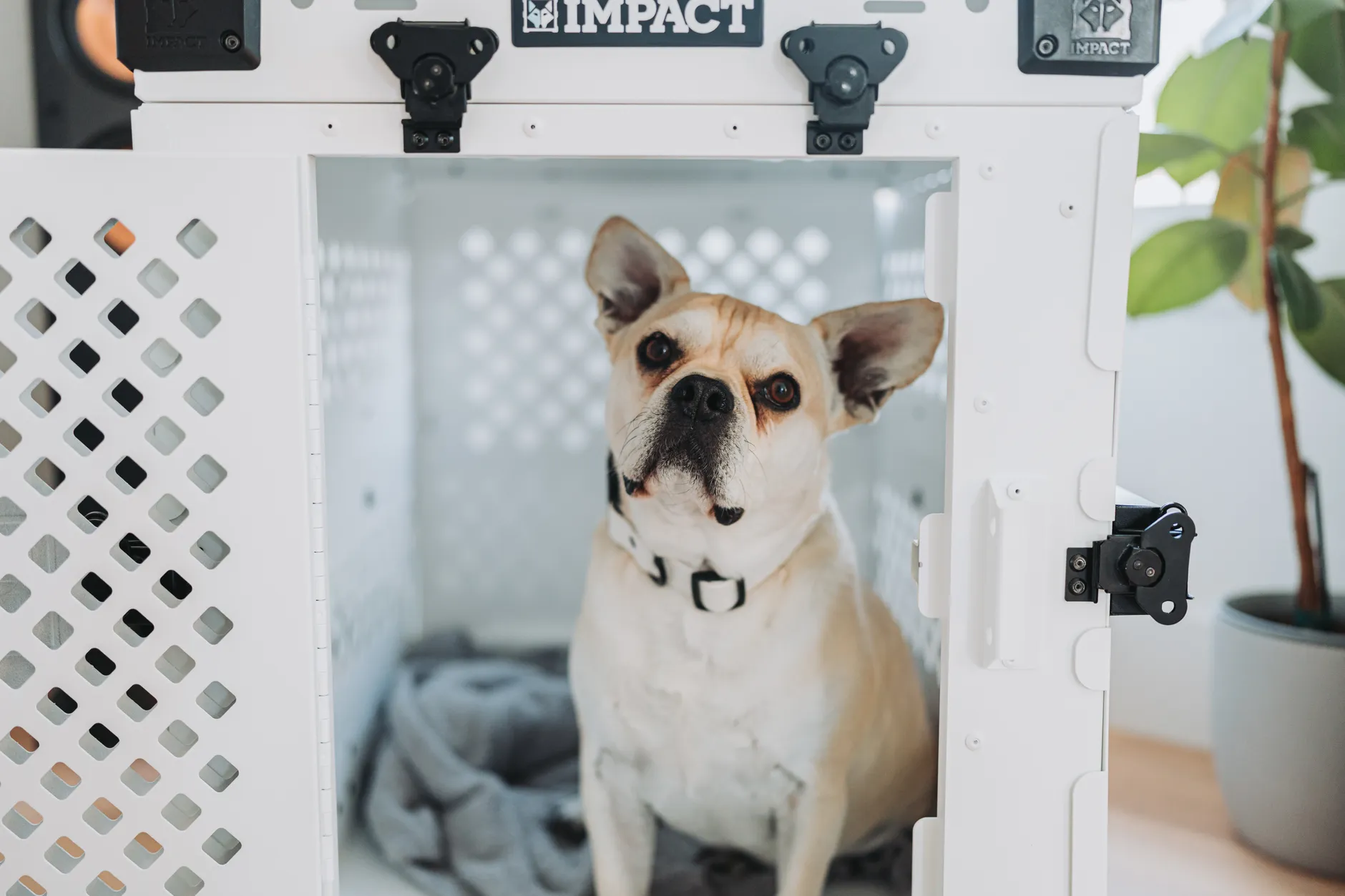
Crate training is one of the most effective tools in house training a puppy — but the supplies that go with it matter as much as the training itself. The wrong crate size undermines house training. The wrong bedding becomes a choking hazard. The wrong toys teach the puppy to associate the crate with frustration instead of rest. This guide covers exactly what to buy, what to avoid, and how to spend your money where it actually matters.
The crate itself: wire, plastic, or soft-sided?
The crate is the single most important purchase, and the type you choose affects ventilation, portability, house-training effectiveness, and how secure the puppy feels. There are three main types, each suited to different situations.
Wire crates (recommended for most puppies)
Wire crates are the standard recommendation for crate training. They provide excellent airflow, the puppy can see out on all sides (reducing isolation stress for most dogs), they fold flat for storage or travel, and nearly all models include an adjustable divider panel. The divider is critical: it lets you reduce the interior space to match the puppy's current size during house training, then expand it as the puppy grows. Without a divider, the puppy has too much space and will use one end as a bathroom.
Wire crates also accept a drape or cover easily, so if your puppy does better with a more enclosed space, you can add one without buying a different crate. Most wire crates have a front door and a side door, which gives flexibility in room placement.
Plastic airline crates
Plastic crates (also called airline kennels) are more enclosed, with solid walls and a wire door. They create a den-like environment that some puppies find calming — particularly breeds prone to anxiety or overstimulation. If you plan to fly with the dog, an IATA-compliant plastic crate is required by most airlines, so buying one now avoids purchasing twice.
The drawback: most plastic crates do not include a divider, and the enclosed walls reduce airflow in warm environments. Ventilation matters — overheating in a crate is a genuine safety risk, especially for brachycephalic breeds (French Bulldogs, Pugs, Bulldogs).
Soft-sided crates (not for puppies)
Soft-sided crates are lightweight and convenient for travel with adult dogs that are already crate trained. They are not suitable for puppies. A puppy can chew through the mesh and fabric walls in minutes, the frame has no structural integrity against a determined chewer, and they cannot be cleaned effectively after house-training accidents. Do not buy a soft-sided crate for a puppy.
Sizing the crate correctly
The most common crate mistake is buying the wrong size. The adult dog should be able to stand at full height without the top of the head touching the roof, turn around in a full circle, and lie fully stretched with the nose and tail not touching the walls. For a puppy, use the divider to reduce the internal space to just enough room for a bed and a small turning area.
Use the Dog Crate and Bed Size Calculator to get precise measurements for your breed, including the IATA airline formula if you plan to fly. Guessing the size almost always leads to buying too large (which undermines house training) or too small (which causes physical discomfort and negative crate associations).
Bedding and comfort
What goes inside the crate matters as much as the crate itself. The goal is a sleeping surface that is comfortable, safe for unsupervised puppies, and easy to clean after the inevitable accidents.
What works for puppies under 5 months
A thin, machine-washable crate mat or a folded fleece blanket. These survive frequent washing, dry quickly, and are inexpensive enough to replace if the puppy destroys them. Ask the breeder to place a piece of bedding with the litter for a week before you collect the puppy — the scent of the mother and littermates is genuinely calming on the first night, which is the hardest transition. For a more detailed first-week plan, see the first week with a puppy guide.
What to avoid early on
Plush beds with removable stuffing, memory foam beds with non-removable covers, and any bedding with zippers, buttons, or decorative trim. Puppies in the teething phase (3 to 7 months) will chew bedding aggressively. Swallowed stuffing is a veterinary emergency (intestinal obstruction), and a $70 bed destroyed in week 2 is money wasted. Save the quality orthopedic bed for after the chewing phase — typically 6 to 10 months for most breeds, later for high-energy breeds.
When to upgrade
Once the puppy reliably stops chewing bedding (test with an inexpensive blanket outside the crate first), transition to a proper crate bed or mat. For breeds prone to joint issues (Labrador Retrievers, German Shepherds, Golden Retrievers, and giant breeds), an orthopedic or supportive bed becomes worth the investment from around 8 to 12 months.
Enrichment: keeping the crate a positive place
A crate should never be empty and boring. Enrichment items give the puppy something to do, create positive associations with the space, and reduce whining and protest barking during the training period. The key is choosing items that are safe for unsupervised use.
Food-dispensing toys (the essentials)
A Kong Classic (or similar natural rubber food toy) is the single most useful crate enrichment item. Stuff it with wet puppy food, mashed banana, or plain pumpkin puree and freeze it overnight. A frozen Kong occupies most puppies for 15 to 30 minutes, which covers the critical transition from "owner just closed the door" to "puppy is engaged and calm." Buy two or three so you always have one in the freezer.
Other safe food-dispensing toys include the West Paw Toppl (wider opening, easier for small puppies), lick mats that suction to the crate floor or wall, and slow-feeder bowls for mealtime inside the crate during the early training days.
Safe chews
Appropriate chews redirect the teething impulse away from the crate, bedding, and the puppy's own paws. Bully sticks (6-inch minimum for most breeds), frozen carrots (for teething puppies), and appropriately sized natural rubber chew toys are the safest options for in-crate use. Avoid rawhide (swelling and choking risk), antlers and bones (tooth fracture risk in growing teeth), and any chew small enough to be swallowed whole.
What to leave out of the crate
Rope toys (fibers can be ingested and cause intestinal blockage), squeaky toys (the squeaker is a choking hazard when unsupervised), tennis balls (the felt wears teeth over time and a deflated ball can obstruct the airway), and puzzle feeders with small removable parts. These are fine for supervised play outside the crate, but none belong inside it when you are not watching.
For a step-by-step crate introduction protocol that uses these enrichment items effectively, see the crate training guide.
Cleaning supplies
House-training accidents inside the crate are a certainty in the first weeks. The cleaning strategy matters because a puppy's nose detects residual urine compounds that human noses cannot — and if the crate smells like a bathroom, the puppy will treat it as one.
Enzymatic cleaner (non-negotiable)
Standard household cleaners do not break down the uric acid crystals in dog urine. Only enzymatic cleaners (Nature's Miracle, Rocco & Roxie, or Bissell Pet Stain Eraser) fully decompose the compounds that attract a puppy back to the same spot. Buy a large bottle before the puppy arrives — not after the first accident.
Spare crate liners
Have at least two washable crate mats or blankets so you can swap one out immediately after an accident while the other is in the wash. Leaving a soiled mat in the crate while you wait for the laundry cycle teaches the puppy that the crate is a place where soiling is normal. A bare crate floor for 30 minutes is better than a soiled bed.
Crate tray cleaning
Most wire crates have a removable plastic tray at the base. Rinse this weekly with warm water and a mild pet-safe cleaner, then spray with enzymatic cleaner. Allow it to dry fully before replacing — moisture trapped under the bedding creates odor and bacteria buildup.
Safety: placement, temperature, and hazards
Where you put the crate and how you set it up affects both safety and training effectiveness.
Crate placement
Place the crate in a room where the family spends time during the day — typically the living room or kitchen. Puppies are social animals; isolating the crate in a basement, garage, or laundry room increases distress and slows crate training. At night, move the crate to the bedroom (or use a second crate) so the puppy can hear and smell you, which significantly reduces overnight crying.
Avoid placing the crate in direct sunlight, next to a radiator or heating vent, or in a drafty corridor. Temperature extremes inside a crate are more pronounced than in the open room because airflow is restricted.
Collar and harness removal
Always remove collars, harnesses, and any clothing before the puppy enters the crate. Collar tags and buckles can catch on wire bars, creating a strangulation risk. This is not theoretical — veterinary emergency rooms treat collar-entanglement injuries from crates regularly. The collar goes back on when the puppy comes out.
Temperature monitoring
Puppies cannot regulate body temperature as effectively as adult dogs. In summer, a crate in a warm room with a cover over it can overheat quickly. Brachycephalic breeds (French Bulldogs, Pugs, English Bulldogs, Boston Terriers) are at higher risk. If you cannot comfortably hold your hand against the crate floor for 10 seconds, it is too warm. In winter, ensure the crate is off cold tile or concrete floors — a piece of carpet or a rubber mat under the crate provides insulation.
Common mistakes that cost money or cause problems
These are the purchases and decisions that new puppy owners make most frequently and regret most quickly.
- Buying a crate without a divider: An adult-sized crate without a divider gives the puppy too much space and undermines house training from day one. Most wire crates include a divider — if yours does not, buy one separately (usually $10 to $20). This is not optional for house training.
- Buying a fancy bed too early: A $90 orthopedic bed is destroyed by a teething puppy in under a week. Start with a $15 washable mat, and upgrade once the chewing phase ends. The puppy does not care about memory foam — it cares about warmth and familiar scent.
- Buying multiple crate sizes: Some owners buy a small crate for the puppy and plan to buy a larger one later. This doubles the cost. An adult-sized crate with a divider grows with the puppy. The only exception is if you need a plastic airline crate in a puppy size for travel during the first few months.
- Leaving the collar on inside the crate: A flat collar with tags can snag on wire bars. This is a strangulation hazard, not just an inconvenience. Remove the collar every time the puppy enters the crate.
- Putting puppy pads inside the crate: Puppy pads inside a crate teach the puppy that eliminating in their sleeping space is acceptable. This directly contradicts the biological instinct (den = clean) that makes crate training work. Pads belong in a puppy pen or a designated bathroom area — never in the crate.
- Over-investing in enrichment toys too early: Complicated puzzle feeders designed for adult dogs frustrate puppies under 12 weeks. A frozen Kong is the right entry point. Graduate to more complex enrichment as the puppy's problem-solving ability develops — typically around 4 to 5 months.
Crate training supply checklist with cost estimates
The table below covers everything you need for a complete crate training setup at three price tiers. These are US market estimates as of 2026. For a full first-year cost breakdown, use the Puppy First-Year Planner.
| Supply category | Budget | Mid-range | Premium |
|---|---|---|---|
| Wire crate with divider (adult size) | $30–$50 | $60–$100 | $120–$200+ |
| Washable crate mat / blanket | $10–$20 | $25–$45 | $50–$90 |
| Kong Classic + spare (x2) | $15–$20 | $20–$30 | $30–$45 |
| Safe chews (bully sticks, rubber toys) | $10–$20 | $20–$40 | $40–$70 |
| Enzymatic cleaner (large bottle) | $10–$15 | $15–$25 | $25–$40 |
| Spare crate liner (x1) | $10–$15 | $20–$35 | $35–$60 |
| Crate cover (optional — blanket works) | $0–$15 | $15–$35 | $30–$55 |
| Estimated total | $85–$155 | $175–$310 | $330–$560 |
These figures cover crate training supplies only. For the complete puppy starter kit including food, bowls, collar, lead, and vet supplies, see the puppy supplies checklist. For a month-by-month budget including vet care and insurance, use the Dog Cost Calculator.
What to buy first vs. what can wait
Not everything needs to be ready before the puppy arrives. Here is the priority order:
- Before day 1 (non-negotiable): Wire crate with divider, one washable crate mat or folded fleece, one frozen Kong (stuffed and frozen the night before), enzymatic cleaner. Total: under $75 at budget level.
- Week 1 (add as needed): Spare crate liner, a second Kong, one or two safe chews (bully sticks or natural rubber). The first week reveals whether your puppy chews bedding, prefers food toys or chews, and how they respond to the crate environment.
- Month 1 (based on observation): Crate cover (only if the puppy settles better with reduced visual stimulation), lick mat, and additional enrichment based on what the puppy actually engages with. The full puppy first-year checklist provides a month-by-month timeline for all supply categories.
Frequently asked questions
- What size crate should I buy for my puppy?
- Buy a crate sized for the adult dog, not the puppy. The dog should be able to stand at full height, turn around, and lie fully stretched. Use a divider panel to reduce the interior space while the puppy is house training — too much space allows a puppy to soil one end and sleep in the other. The Dog Crate and Bed Size Calculator provides precise measurements for each breed, including the IATA formula if you plan to fly.
- Should I put a bed in my puppy's crate?
- For most puppies under 5 months, a washable crate mat or folded fleece blanket is better than a plush bed. Puppies in the chewing stage will frequently destroy stuffed beds, creating both a choking hazard and an unnecessary expense. A thin, machine-washable mat handles accidents better and dries faster. Upgrade to a proper orthopedic bed once the puppy has outgrown the heavy chewing phase — typically around 6 to 10 months for most breeds.
- How much do puppy crate training supplies cost?
- A complete crate training setup runs $85 to $175 at budget level, $155 to $310 at mid-range, and $280 to $520 or more at premium. The crate itself is the largest expense ($30 to $200+ depending on size and brand). Bedding, enrichment toys, and cleaning supplies add $55 to $120. Buying the adult-sized crate with a divider from day one is the most cost-efficient strategy — you buy once instead of sizing up two or three times.
- Is a wire crate or plastic crate better for crate training?
- For most crate training scenarios, a wire crate with a divider panel is the best first choice. Wire crates offer better ventilation, visibility (which reduces isolation stress for most puppies), and almost all include a divider for sizing down during house training. Plastic airline crates are the better choice if you plan to fly with the dog, if the puppy seems calmer in a more enclosed space, or for breeds prone to anxiety where the den-like enclosure helps. Soft-sided crates are not suitable for puppies — they cannot withstand chewing and offer no house-training benefit.
- What should I never put inside a puppy's crate?
- Never leave a collar (flat or harness) on a puppy inside a crate — tags and buckles can catch on wire bars and create a strangulation risk. Do not place bowls of water inside overnight for puppies under 4 months (use a clip-on crate bottle if needed). Avoid stuffed toys with small eyes, buttons, or removable squeakers — these are choking hazards when unsupervised. Do not put puppy pads inside the crate, as it teaches the puppy that eliminating in the crate is acceptable, which defeats the purpose of crate training.
- Do I need a crate cover for my puppy?
- A crate cover is not essential, but it can help puppies who are easily stimulated by visual activity in the room — particularly at bedtime. A simple blanket draped over the top and three sides works as well as a purpose-built cover. Leave the front partially uncovered so air circulates. If the puppy pulls the cover into the crate and chews it, remove it — the blanket becomes a hazard rather than a calming tool. Some puppies settle better with the cover, others show no difference.


