
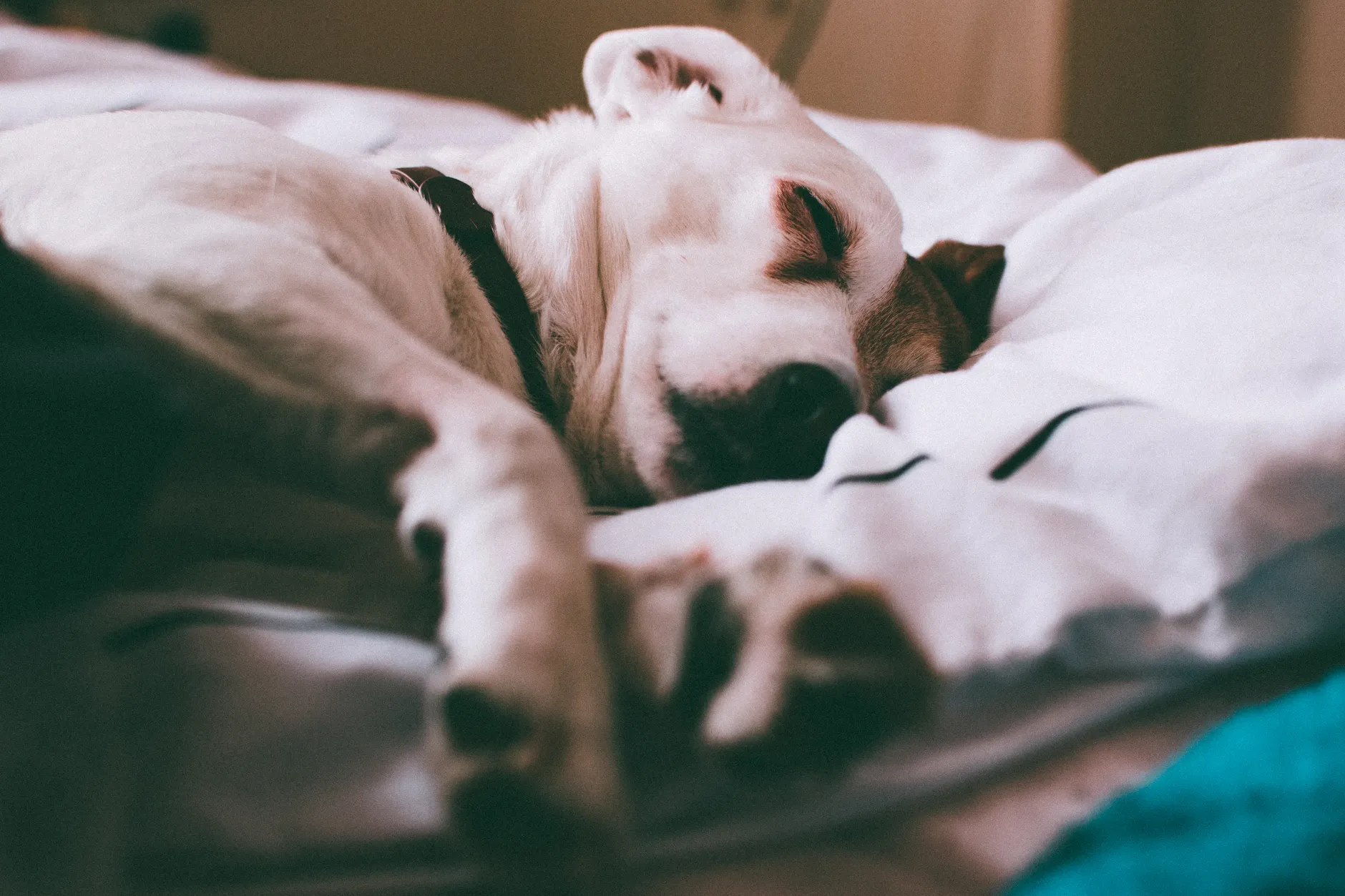
Puppies sleep far more than new owners expect — 18 to 20 hours a day for the youngest, gradually decreasing to 12 to 14 hours by their first birthday. Understanding how much sleep your puppy needs at each age, and building a routine that supports it, prevents the most common puppy behaviour problems: biting, hyperactivity, and difficulty settling.
Sleep requirements by age
The table below shows typical total sleep (day + night) for each developmental stage. Individual puppies vary, but these ranges reflect veterinary and developmental research consensus.
| Age | Total daily sleep | Overnight stretch | Daytime naps |
|---|---|---|---|
| 8–10 weeks | 18–20 hours | 3–4 hours between breaks | 6–10 naps, 30 min–2 hours each |
| 10–12 weeks | 18–20 hours | 4–5 hours between breaks | 5–8 naps |
| 3–4 months | 16–18 hours | 5–6 hours between breaks | 4–6 naps |
| 4–6 months | 14–16 hours | 6–8 hours (often through the night) | 3–4 naps |
| 6–9 months | 14–16 hours | 8+ hours | 2–3 naps |
| 9–12 months | 12–14 hours | 8+ hours | 1–2 naps |
Size matters: Giant breed puppies (Great Dane, Saint Bernard, Newfoundland) tend to sleep at the higher end of these ranges and take longer to reach adult sleep patterns. Small breeds reach adult patterns earlier but may still need mid-day naps well into adulthood.
Sample daily schedules
8 to 12 weeks: the napathon phase
At this age, the puppy is awake for only 30 to 60 minutes at a time before needing another nap. The schedule revolves around short wake windows with enforced rest between them.
- 6:30 AM — Wake up, immediate bathroom trip, 10 minutes of play
- 7:00 AM — Breakfast in crate or slow feeder
- 7:15 AM — Bathroom, short socialisation activity (handling, sounds)
- 7:45 AM — Nap in crate (1–2 hours)
- 9:45 AM — Wake, bathroom, 20 minutes of play or training
- 10:15 AM — Nap (1–2 hours)
- 12:00 PM — Wake, bathroom, lunch
- 12:30 PM — Short activity, then nap (1.5–2 hours)
- 2:30 PM — Wake, bathroom, gentle play
- 3:00 PM — Nap (1–2 hours)
- 5:00 PM — Wake, bathroom, dinner
- 5:30 PM — Family time, short walk or garden exploration
- 6:30 PM — Final nap (45 min–1 hour)
- 7:30 PM — Calm wind-down, frozen Kong in crate
- 8:00 PM — Last bathroom trip, bedtime
- 11:30 PM–12:00 AM — Overnight bathroom break
- 3:00–4:00 AM — Overnight bathroom break (if needed)
4 to 6 months: consolidating naps
Wake windows extend to 1.5 to 2.5 hours. Overnight bathroom breaks are no longer needed for most puppies. The schedule starts resembling a structured day.
- 6:30 AM — Wake, bathroom, breakfast, 15-minute walk or play
- 8:00 AM — Morning nap (1.5–2 hours)
- 10:00 AM — Wake, bathroom, training session (10–15 minutes), play
- 11:30 AM — Midday nap (1–1.5 hours)
- 1:00 PM — Wake, bathroom, lunch, enrichment activity
- 2:30 PM — Afternoon nap (1–1.5 hours)
- 4:00 PM — Wake, walk or outdoor play session (20–30 minutes)
- 5:30 PM — Dinner, family time
- 7:00 PM — Calm wind-down, chew or frozen Kong
- 8:30 PM — Last bathroom trip, bedtime
Managing daytime naps
The most counterintuitive puppy fact: overtired puppies don't fall asleep — they get more active, more bitey, and harder to manage. If your puppy is showing escalating excitement, mouthy play, and an inability to settle, they almost certainly need a nap, not more stimulation.
Recognising tired signals
- Yawning when not just waking up
- Biting hands, ankles, or clothing with increasing intensity
- Inability to follow simple cues they normally know
- Lying down and then immediately getting back up repeatedly
- Glazed or unfocused eyes
- Zoomies (frantic running) — often a sign of overtiredness, not excess energy
Enforced naps
Puppies under 5 months rarely self-settle if there's activity around them. Enforced naps — placing the puppy in their crate with a frozen Kong when they've been awake too long — are not punitive. They're the puppy equivalent of putting a toddler down for a nap. The crate should already be a positive space (see the crate training guide).
A good rule of thumb: if the puppy has been awake for longer than the maximum wake window for their age, they need a nap regardless of whether they're showing tired signals. Some puppies push through tiredness until they're severely overtired.
Building a bedtime routine
Puppies learn bedtime through consistency. A predictable wind-down sequence signals that the active part of the day is over.
- Calm the environment (30 minutes before bed): Dim lights, lower voice volume, stop active play. This is not the time for tug-of-war or fetch.
- Final bathroom trip: Take the puppy outside (on leash to the same spot each time) and wait quietly. Praise and treat for elimination.
- Crate entry with enrichment: A frozen Kong or small chew makes the crate transition positive. The puppy should walk into the crate voluntarily for the treat, not be placed in.
- Lights out, minimal interaction: Once the crate door is closed, avoid extended eye contact, talking, or reaching in. Brief reassurance ("settle") is fine; a 10-minute conversation is not.
Maintain the same bedtime (within 30 minutes) every night, including weekends. Puppies with inconsistent sleep schedules take longer to settle into overnight routines and show more overnight vocalisation.
Crate placement for sleep
First 4 to 8 weeks after adoption: Place the crate in your bedroom, close enough that the puppy can hear and smell you. This single adjustment reduces overnight crying by more than any other intervention. It does not create permanent dependence — once the puppy is sleeping through the night reliably, you can move the crate gradually if desired.
For daytime naps: A quieter area of the house works better than the main living room. The puppy needs to sleep, and a high-traffic location with children, other pets, and household activity makes settling harder. A partially covered crate in a spare room or quiet corner is ideal.
Avoid placing the crate near heating vents, direct sunlight, or drafty doors. Temperature regulation is harder for puppies than adult dogs, and overheating inside a crate happens faster than in open air. For detailed setup, see the crate training supplies guide.
When night waking signals a problem
Night waking is expected for puppies under 4 months. After that age, persistent night waking may indicate a medical or management issue.
- Urinary tract infection: Frequent small urinations, straining, or accidents in the crate after previously being reliable. Vet visit recommended within 24 to 48 hours.
- Gastrointestinal upset: Whining paired with soft stool, gas, or vomiting. Often triggered by dietary changes, treats, or ingesting something inappropriate. Monitor for 24 hours; vet visit if symptoms persist or worsen.
- Pain or discomfort: Sudden onset of night waking in a puppy who previously slept through. Check for limping, tender areas, or changes in posture. Growing pains (panosteitis) in large breed puppies can cause nighttime discomfort.
- Separation distress vs. attention-seeking: A puppy who panics (drooling, attempting to escape, destructive scratching at the crate) needs professional support. A puppy who barks for 5 minutes and then settles is testing boundaries. The response differs significantly — the separation anxiety guide covers the distinction.
Frequently asked questions
- How many hours should an 8-week-old puppy sleep?
- An 8-week-old puppy sleeps 18 to 20 hours per day, split between overnight sleep (6 to 8 hours with bathroom breaks) and multiple daytime naps of 30 minutes to 2 hours. This is normal and necessary — puppies at this age are undergoing rapid neurological development, and sleep is when memory consolidation and growth hormone release occur. Waking a sleeping puppy for play or socialisation is counterproductive.
- When will my puppy sleep through the night?
- Most puppies can sleep 6 to 8 hours without a bathroom break by 16 weeks (4 months). Bladder capacity is the limiting factor: a general guideline is that a puppy can hold their bladder for their age in months plus one hour (so a 3-month-old can manage about 4 hours). Giant breeds may take longer to develop full bladder control. If a puppy over 5 months is still waking multiple times at night, consult your vet to rule out urinary tract issues.
- Should I let my puppy nap whenever they want?
- Yes — forced wakefulness in puppies causes overtiredness, which manifests as hyperactivity, excessive biting, and poor impulse control (the opposite of what most owners expect). Puppies who are not getting enough sleep often look like they have behaviour problems when they actually have a sleep deficit. The only exception is adjusting nap timing to protect overnight sleep: avoid a long late-evening nap that pushes bedtime past the household routine.
- Why does my puppy get hyper in the evening?
- The "puppy witching hour" (typically 6 to 8 PM) is usually a sign of overtiredness, not excess energy. Puppies who have been awake too long without naps become overstimulated and lose the ability to self-settle. The solution is not more exercise — it is an earlier last nap and a calm wind-down routine before bed. A frozen Kong in the crate at 7 PM is often more effective than a 30-minute play session.
- Where should my puppy sleep at night?
- In a crate in your bedroom for the first 4 to 8 weeks after adoption. Proximity to you reduces overnight distress, makes it easier to hear bathroom signals, and does not create long-term dependence — you can gradually move the crate once the puppy is sleeping through the night reliably. Puppies isolated in another room (laundry, kitchen, garage) show higher stress markers, more vocalisation, and slower house-training progress.
- Is my puppy sleeping too much?
- Unlikely, unless the puppy also shows lethargy when awake (disinterest in food, reluctance to play, low energy during waking periods). Puppies under 6 months sleeping 18 to 20 hours is completely normal. If a puppy who previously had good energy becomes excessively sleepy, or if sleep is accompanied by vomiting, diarrhoea, or behavioural changes, contact your vet — these can indicate illness, parasites, or nutritional deficiency.


