
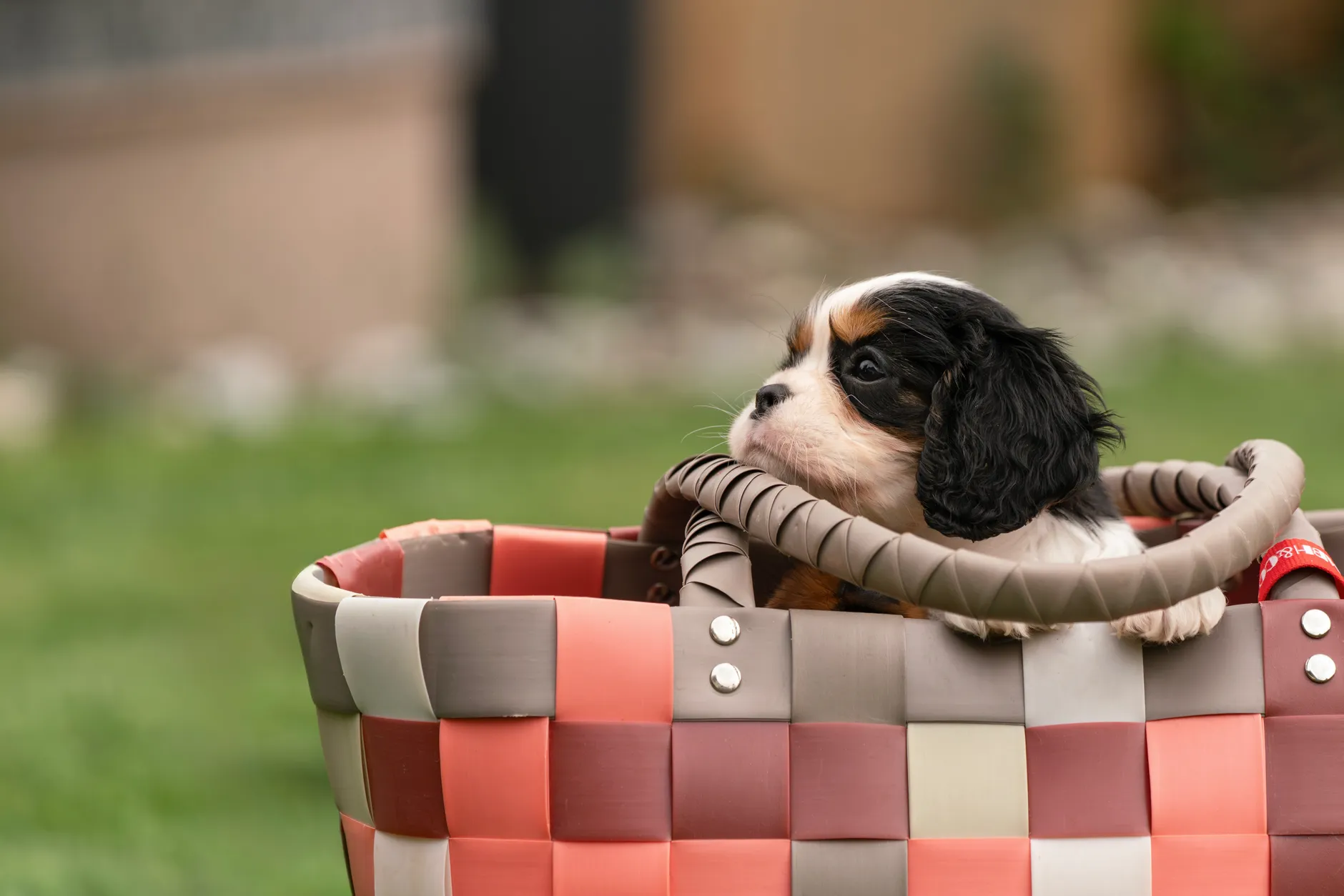
The puppy supplies industry is engineered to sell you more than you need. A new puppy owner can easily spend $800 before the puppy arrives home and discover half of it goes unused. This guide separates what is genuinely necessary before day 1, what to add as you learn your puppy's specific needs, and what to ignore until the puppy tells you otherwise.
The non-negotiables: must-have before day 1
These items need to be in place before the puppy sets a paw inside your home. Do not substitute or delay — each serves a specific function in the first 24 hours.
Crate
The most important purchase. A crate sized for the adult dog (with an adjustable divider panel to reduce space while house training) is the most cost-efficient approach — you buy once. Wire crates with a divider are the standard choice for most breeds. Plastic airline crates work well for breeds where the owner plans to fly.
Not sure what size you need? The Dog Crate and Bed Size Calculator gives precise crate dimensions based on your breed's adult measurements — including the IATA formula for airline travel.
Bed or crate liner
A washable crate mat or folded fleece blanket. Ask the breeder to place a piece of bedding in with the litter for a week before collection — the scent of the mother and littermates on day 1 is genuinely calming. Avoid plush beds with removable stuffing for puppies that chew.
Collar, lead, and ID tag
A flat buckle collar in the smallest adult size, adjusted for the puppy now. An ID tag with your phone number must be on before the puppy leaves your sight — in many US jurisdictions this is a legal requirement, not just a recommendation. A 4–6 ft standard lead for walking. Do not use retractable leads with puppies.
Food and water bowls
Stainless steel or ceramic — both are dishwasher safe and do not harbor bacteria the way plastic can. Size matters: a toy breed puppy eating from a large bowl cannot reach the food easily. Elevated bowls are not generally recommended for deep-chested breeds (some evidence of increased bloat risk).
Puppy food
The same brand and variety the breeder was feeding, for at least the first 7–10 days. Changing food immediately adds digestive stress on top of the emotional stress of a new home. Ask the breeder in advance and have a supply ready. The food must be labeled for "growth" or "all life stages" per AAFCO. Large breeds require a food specifically formulated for large-breed puppies.
Enzymatic cleaner
Accidents will happen — especially in week 1. Standard household cleaners do not break down the uric acid in dog urine, so the scent remains detectable to the dog (even if you cannot smell it), which draws them back to the same spot. An enzymatic cleaner (brands like Nature's Miracle, Rocco & Roxie, or Bissell Pet Stain) breaks down the compounds completely. Buy before day 1 — not after the first accident.
Puppy pads (optional, but practical for week 1)
Puppy pads create a temporary indoor bathroom option for the early days before full vaccination allows outdoor access, or for apartment owners without immediate outdoor access. They are not a long-term house training strategy — puppies trained primarily on pads have a harder transition to outdoor only — but as a week-1 bridge, they are useful.
First-month additions
Once you know your puppy is settling well, add these in week 1–4 based on what you observe:
- Harness: A front-clip or Y-harness distributes pressure away from the trachea — important for brachycephalic breeds (French Bulldog, Pug, Bulldog) and any puppy that pulls. Do not fit until you know the puppy's measurements; puppy harnesses are sized differently than adult ones.
- Treat pouch: A small belt-mounted treat pouch keeps training treats accessible without fumbling in your pockets. Inexpensive (under $15) and a real practical improvement for training sessions.
- Puppy toothbrush and toothpaste: Start dental hygiene as early as possible — ideally in the first month. Use a toothpaste formulated for dogs (human toothpaste contains xylitol, which is toxic to dogs). Finger brushes are the easiest entry point for puppies.
- Safe chew toys: Natural rubber toys (Kong, West Paw Toppl) and appropriate edible chews (bully sticks, raw meaty bones appropriate for size) redirect chewing from furniture and hands. Avoid small toys that can be swallowed, and hard nylon or antler chews that can crack teeth.
- Puppy pen / X-pen: An expandable exercise pen creates a safe contained area larger than the crate, suitable for periods when you cannot actively supervise. Sizes from 24 inches (toy breeds) to 36–42 inches (larger breeds).
What to skip until you know your puppy
These are commonly purchased items that are frequently wasted money in the early weeks:
- Expensive dog clothing: Some breeds genuinely benefit from a jacket in winter (short-coated toy breeds, dogs with low body fat). But buying an extensive wardrobe before you know the puppy's adult size, temperament, and coat type is rarely money well spent. A single waterproof jacket for wet weather is the only practical early purchase.
- Training tools that use aversives: Shock collars (e-collars), citronella spray collars, and prong collars are not appropriate for puppies and are not recommended by professional bodies including the American Veterinary Society of Animal Behavior. Positive reinforcement achieves the same training goals with fewer behavioral risks.
- Complicated puzzle feeders for under-12-weeks: Enrichment feeders and snuffle mats have a real place in a dog's life — but a puppy under 12 weeks has not yet learned the patience or problem-solving required. A Kong stuffed with wet food and frozen is the appropriate entry-level enrichment.
- Large toy bins before you know the puppy's preferences: Many puppies prefer one toy type over all others. Buying 20 different toys before you know whether yours prefers tugging, chewing, or chasing is wasteful. Start with a variety of 3–4 types and expand based on what the puppy actually engages with.
How much does a puppy starter kit cost?
The table below covers the core first-month equipment at three price tiers. These are US market estimates as of 2026.
| Item | Budget | Mid-range | Premium |
|---|---|---|---|
| Crate (wire, adult-sized with divider) | $30–$50 | $60–$100 | $120–$200+ |
| Crate bed / mat | $15–$25 | $30–$55 | $60–$120 |
| Collar, lead, ID tag | $15–$25 | $30–$50 | $55–$100 |
| Food and water bowls | $10–$15 | $20–$35 | $40–$70 |
| Puppy food (1 month supply, medium breed) | $30–$45 | $50–$80 | $90–$130 |
| Enzymatic cleaner | $10–$15 | $15–$25 | $25–$40 |
| Toys (starter set of 3–4) | $15–$25 | $30–$50 | $55–$100 |
| Treats (training treats, 1 month) | $10–$15 | $20–$30 | $35–$55 |
| Estimated total (first month) | $135–$215 | $255–$425 | $480–$815 |
For a complete first-year cost projection including vet care, food, grooming, and insurance, use the Dog Cost Calculator.
Sizing your crate and bed correctly
Crate sizing is one of the most common early mistakes. The crate should allow the adult dog to:
- Stand at full height without the head touching the roof
- Turn around in a full circle
- Lie fully stretched with the nose and tail not touching the walls
For a puppy, the interior space should be temporarily reduced to just enough for a bed and a small turning area using a divider panel. Too much space allows a puppy to soil one end and sleep in the other — defeating the house-training purpose of crate confinement.
Use the Dog Crate and Bed Size Calculator to get precise measurements based on your specific breed, including the IATA airline formula if you plan to fly with the dog.

Setting up your home: puppy proofing in 5 zones
A puppy's mouth is their primary exploration tool. Walk through your home and address these five zones before the puppy arrives:
- Kitchen: Move cleaning products, dishwasher tablets, and anything containing xylitol (sugar-free gum, some peanut butters) to locked cabinets or elevated shelves. Baby locks on low cabinets are inexpensive and effective. Garbage cans should have locking lids.
- Living room: Bundle or hide cables. Television cables, phone chargers, and laptop power cables are chewing hazards and electrocution risks. Cable management boxes (available for around $15) contain the majority of the risk. Remove plants that are toxic to dogs (Pothos, Philodendron, Sago Palm are among the most common — check the ASPCA toxic plant list).
- Garden / yard: Walk the perimeter and identify gaps in fencing a puppy could squeeze through — gaps that seem too small often are not. Check for toxic plants (Azalea, Foxglove, Yew, Lily of the Valley). Ensure the gate latch cannot be nosed open.
- Electrical cords: Any cord at or below skirting board level is at risk. Cord protectors (plastic split loom tubing, available cheaply from hardware stores) are an effective deterrent for most puppies.
- Bathroom and laundry: Toilet lids closed. Laundry detergent pods are highly toxic and attractive to puppies (bright colors, soft texture). Drain cleaning products, bleach, and fabric softener sheets all require locked storage.
Frequently asked questions
- What do I need before bringing a puppy home?
- The non-negotiables before day 1: a correctly sized crate (with a divider if buying an adult-sized crate for a small puppy), a crate bed or blanket, a collar with an ID tag, a 4–6 ft lead or leash, stainless steel or ceramic food and water bowls, the same puppy food the breeder was feeding (ask in advance), and enzymatic cleaner for accidents. A puppy pen is highly recommended for creating a safe zone. Everything else can be purchased in week 1 or 2 once you know the puppy's size, temperament, and preferences.
- How much does puppy gear cost in the first month?
- Expect to spend $150–$300 on a budget starter kit, $300–$500 at mid-range, and $500–$700+ at premium. The biggest cost variations are in the crate ($30–$200+ depending on size and brand), bed ($20–$120), and harness ($15–$80). Food costs vary significantly by brand and puppy size — a 30 lb bag of decent puppy kibble runs $40–$80 depending on the brand. Many budget items perform as well as premium versions for a rapidly growing puppy who will need sizing up within months.
- What size crate does a puppy need?
- The crate should be large enough for the adult dog to stand, turn around, and lie down comfortably — but no larger for a puppy still in house training. A crate that is too big allows the puppy to use one end as a sleeping area and the other as a bathroom, which defeats the house-training purpose. Most breeders recommend buying the adult-size crate now and using an adjustable divider panel to reduce the internal space as the puppy grows. Use the Dog Crate and Bed Size Calculator for precise measurements based on your breed.
- Do I need a puppy pen as well as a crate?
- They serve different purposes. A crate is a smaller, den-like space for sleeping and short-term confinement (not more than 1 hour per month of age during the day). A puppy pen (exercise pen / X-pen) is a larger, open area where the puppy can move, play, and access a water bowl without being in the confined crate. Many owners use the pen during the day when they cannot actively supervise, with the crate for overnight sleeping. If you work from home or are present most of the day, a pen is less critical. If the puppy is regularly unsupervised for more than an hour, a pen is strongly recommended.
- Is premium puppy food worth it?
- Not necessarily in the way the marketing suggests. The most important factor is that the food carries an AAFCO nutritional adequacy statement for "growth" or "all life stages" — this means it has been formulated or tested to meet puppy nutritional requirements. Beyond that, large breeds require a food with controlled calcium-to-phosphorus ratios to prevent skeletal issues. Look for a named meat protein as the first ingredient and an established brand with a feeding trial history. Premium price does not always correlate to superior nutrition. The Dog Food Calculator can help you assess labels and portions.


